
 E-Paper



Beyond the Medal: Deepa Malik on Rebuilding Life, Finding Purpose and Choosing Possibility
In a revealing episode, Deepa Malik reflects on her life after paralysis, discussing her path to independence and identity as a Paralympic athlete.

 Prefer HTon Google


Some stories of achievement begin with ambition. Deepa Malik's began, more than once, with having to start over.
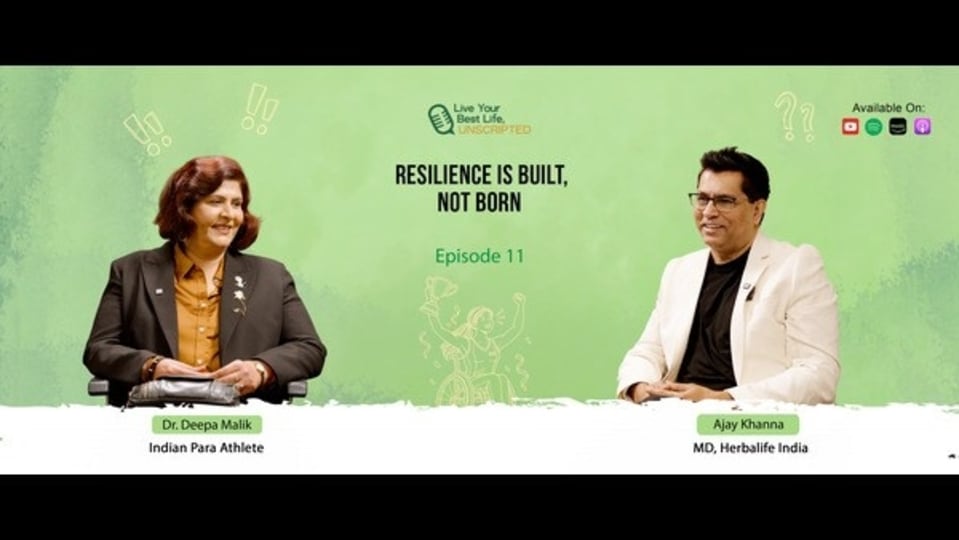
In a deeply personal episode of Herbalife India'sLive Your Best Life, Unscripted, India's first female Paralympic medallist joins host Ajay Khanna, Managing Director, Herbalife India, for a conversation that goes well beyond sport.
It is a conversation about what happens when the life you had imagined is suddenly no longer available to you, and how you begin building another one.
Malik speaks candidly about paralysis, motherhood, changing relationships, social attitudes towards disability and the long process of rediscovering her identity. What emerges is not a neatly packaged story of triumph over adversity. It is something more human: a story of repeatedly learning how to live differently.
Her experience with paralysis began in childhood, when a spinal tumour led to years of treatment, rehabilitation and recovery. She eventually walked again. Years later, after becoming a mother, another spinal tumour changed the course of her life permanently, leaving her paralysed from the chest down.
At the time, her older daughter was undergoing rehabilitation of her own following an accident, her younger daughter was still very small, and her husband, an Army officer, was away on duty.
Malik doesn't romanticise what followed.
She talks about learning the most basic aspects of living in a changed body. How to dress. How to bathe. How to manage daily routines. How to be dependent on others for things that had once required no thought at all.
But perhaps harder than the physical adjustment was the identity that people began assigning to her.
A woman who had once been admired for her appearance was suddenly spoken about as a burden and a financial liability. Sympathy was plentiful. A roadmap for how to build a meaningful life with disability was not.
That gap became important.
Malik realised that if she could not find the role model she needed, she would have to become one.
Her first acts of reinvention did not begin with a Paralympic medal. They began with smaller acts of independence and, occasionally, ideas that other people considered unreasonable.
She started a small food business that grew into a garden restaurant. She wanted to ride motorcycles again. She had vehicles modified and challenged systems around licences and accessibility. She drove in the Himalayas. Hydrotherapy led her towards swimming. Swimming led to competitive sport. And competitive sport eventually gave her a new identity.
One phrase from the conversation captures her relationship with disability particularly well. Malik rejects the description "wheelchair bound." She prefers to call herself "wheelchair liberated."
For her, the wheelchair represents mobility, independence and movement. Why, she asks, should something that enables movement be described as something that binds?
That shift in language mirrors the larger shift in her life.
Sport gave Malik much more than medals. It gave her a platform to challenge perceptions of what a woman with disability could do. It gave her credibility when she spoke about mobility, independence and inclusion. And it transformed the way the world introduced her.
She was no longer simply a paralysed woman. She was an athlete representing India.
Her sporting journey itself was anything but linear. Swimming did not take her where she wanted to go, so she moved into athletics. When one discipline did not work, she learnt another. When javelin was not the route to the Paralympics, she shifted to shot put.
That instinct to adapt runs throughout the episode.
Malik describes adaptability as a form of upskilling. If Plan A stops working, she believes the answer is not always to keep forcing it. Sometimes it is to learn something new and find another way forward.
One of the biggest setbacks of her sporting career came when she could not make it to the London Paralympics because of delays around paperwork and the final qualifying competition. At the time, it felt devastating.
In retrospect, she says, the disappointment exposed what was missing from her preparation. She had concentrated on training but had not understood enough about administration and sports science. Instead of ending her journey, the setback forced her to prepare more completely for what came next.
It is a useful distinction in an age obsessed with winning.
Success, Malik suggests, does not always arrive in the form you had originally imagined. She wanted Paralympic gold. She won silver. That did not make the achievement incomplete.
Nor does she reserve the word "victory" for podiums.
She recalls her father's belief that anyone who performs their responsibility honestly and to the best of their ability is a winner. She even jokes about celebrating when a cake rises perfectly in the oven.
Small victories matter because a life is made up of far more ordinary days than medal ceremonies.
The conversation also touches on something that motivational stories often overlook help.
Malik is unequivocal about it.
"No one is anybody without help," is the essence of her argument. A medal may hang around one athlete's neck, but behind it are coaches, nutritionists, psychologists, sports scientists, family members, caregivers, administrators and countless others.
For Malik, accepting support is not weakness. It is part of being human.
Perhaps the most revealing part of the conversation comes when she speaks about the motivation that kept her moving during the hardest years.
Motherhood.
She wanted her daughters to grow up in a happy home. She wanted them to become positive people. That meant she could not allow sadness, guilt and frustration to become the only emotional language of the household.
Eventually, she also had to stop looking at herself through the judgments of others.
Her advice is simple: listen to the inner voice rather than the external noise. Choose carefully whose opinions deserve space in your life. Surround yourself with people who strengthen rather than diminish you.
And keep learning.
Malik sums up that philosophy beautifully in Hindi:"Maine jitna seekha, maine jeevan ko utna jiya."
The more she learnt, the more she lived.
That may ultimately be the most important idea in this episode. Deepa Malik's story is extraordinary because of the medals, records and recognition. But it resonates because beneath all of that is something far more familiar: life changed, she changed with it, and then she kept going.
Not once.
Again and again.
Watch Now
Also streaming on:
Spotify:https://open.spotify.com/episode/4N8pjlwBv72nOLXmJMQJHW?si=JEA9-jV-THSAdK4QnBZqPg
Apple Podcasts:https://podcasts.apple.com/us/podcast/resilience-is-built-not-born-ft-deepa-malik-live-your/id1808386057?i=1000791572561
Herbalife (NYSE: HLF) is a premier health and wellness company, community and platform that has been changing people's lives with great nutrition products and a business opportunity for its independent distributors since 1980. The Company offers science-backed food products to consumers in more than 90 markets through entrepreneurial distributors who provide one-on-one coaching and a supportive community that inspires their customers to embrace a healthier, more active lifestyle to live their best life.
Live Your Best Life, Unscripted is an extension of this mission, a podcast where authentic stories, lived experiences, and wellness insights help listeners make better choices for their body, mind, and life.
Note To Readers: This article is part of HT’s paid consumer connect initiative and is independently created by the brand. HT is not responsible for the content’s accuracy or completeness. Readers should verify all information independently. This content is for informational purposes only. It neither constitutes, nor is a substitute for professional medical advice, diagnosis, or treatment. Always consult a qualified healthcare provider for guidance on your health concerns.
Want to get your story featured as above?click here!


