
 E-Paper



Punjab launches Mission Samrath 4.0 with attendance-linked reform to boost school learning
Daily SMS alerts for parents, focus on accountability and foundational learning.

 Prefer HTon Google


Punjab on Thursday launched Mission Samrath 4.0, a flagship education initiative aimed at strengthening foundational learning and improving classroom accountability, with the introduction of a state-wide attendance tracking system.
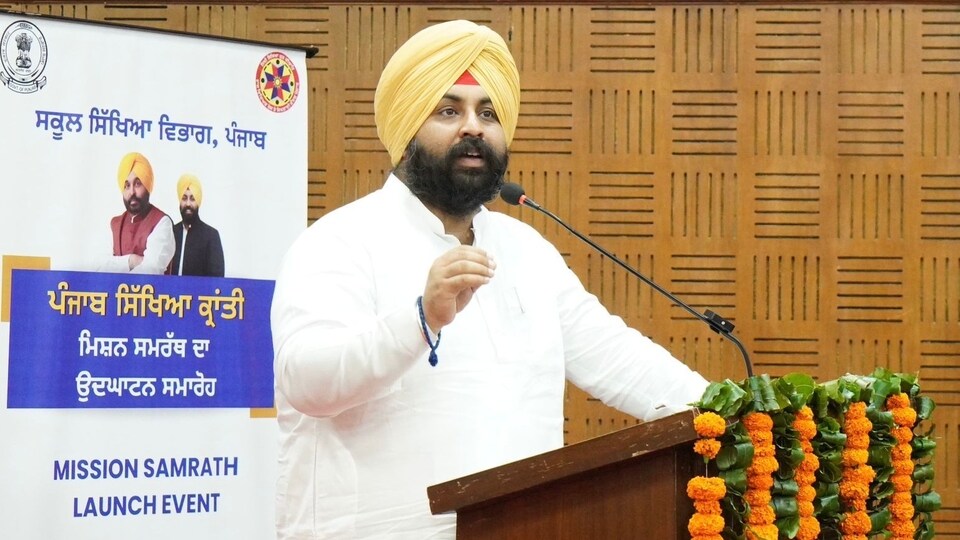
Punjab education minister Harjot Singh Bains, along with AAP leader Manish Sisodia, unveiled the programme and released a compendium of 38 classroom practices developed by government school teachers.
Under the new system, parents will receive daily SMS alerts about their child’s attendance. Officials said that if a student remains absent for seven consecutive days, the case will be escalated to district authorities, while absence beyond 15 days will be flagged at the state level.
Bains described Mission Samrath 4.0 as the next phase of Punjab’s “education revolution,” adding that the state is moving from national recognition to measurable outcomes. He highlighted that the government led by chief minister Bhagwant Singh Mann has increased the education budget to ₹19,279 crore, ensuring improved infrastructure and learning outcomes in government schools.
The minister said the programme focuses on students in Classes 3 to 8, aiming to strengthen reading, writing and mathematical skills through level-based teaching rather than grade-based instruction.
He also cited improvements in school infrastructure and service delivery, including timely distribution of textbooks and deployment of staff such as campus managers, security guards and sanitation workers in schools.
Sisodia said Punjab’s top rank in the PARAKH 2024 assessment reflects the impact of sustained reforms, adding that the new phase will ensure that “every child is in school every day and learning well.”
Officials said Mission Samrath currently covers around 12 lakh students and involves more than 70,000 teachers across the state.
The programme also emphasises continuous assessment, teacher mentoring and the scaling up of best classroom practices to improve learning outcomes, particularly for students requiring additional academic support.


