
 E-Paper



Car owners in Gurugram without high-security plates face action; 44,607 fined
Authorities are actively cracking the whip on violators, with a total of 44,607 challans (each worth Rs 500) having been issued against private and commercial vehicles since January 2018.


Gurugram residents who have not yet fitted their vehicles with high-security registration plates (HSRPs) are liable to be fined heavily by the traffic police, with the Supreme Court’s deadline for the installation of these specialised plates having expired on September 30 this year.
Authorities are actively cracking the whip on violators, with a total of 44,607 challans (each worth Rs 500) having been issued against private and commercial vehicles since January 2018.
Himanshu Garg, deputy commissioner of police (traffic), said that since October 1, traffic constables have doubled down on their campaign against those violating the rules. Since October 1, at least 6,000 such challans have been issued, with the enforcement set to continue in full swing.
HSRPs are internationally standardised license plates, which differ from non-standard plates in that they are equipped with multiple security features, such as a laser-readable hologram, embossed print for better visibility, and tamper-proof rivet locks. “These will help in preventing theft of vehicles and counterfeit registration plates, which may later be used as a ploy in illegal activities, such as terrorism,” said Garg. The order mandating HSRPs was, in fact, passed in response to a public interest litigation(PIL) by MS Bitta, chairman of the All India Anti-Terrorist Front.
In 2012, the apex court made the HSRPs mandatory for all vehicles registered in and after that year. Since then, the guidelines have routinely been extended to vehicles registered before 2012, with deadlines being imposed on vehicle owners to make them start complying with the rules.
In March this year, the apex court instructed transport departments nationwide to begin penalising violators after the September 30 deadline. “Since then, enforcement has gone up and there has been a mad rush to procure HSRPs across the country. As such, it has been putting some pressure on the private vendors who manufacture and fit these plates,” said Navdeep Asija, a transport and road safety expert based in Chandigarh.
Anup Sanghwan, a traffic constable, also said, “We have been instructed to slap fines on any vehicle still having standard number plates. Many times, vehicle owners are unaware of the law. There are also times when they have applied for a HSRP, but the plate hasn’t arrived yet.”
In such instances, he added, vehicle owners are asked to produce a receipt as proof of the fact that they have applied for a HSRP. “If the receipt is new, we tend to let them off, but if it has been more than two or three months since the application, we assume that they have not yet collected the plates. We then impose a fine,” Sanghwan added.
RK Singh, secretary to the Road Transport Authority in Gurugram, explained the process to procure an HSRP in the city. “It is very simple. One can either go to a licensed vendor or, if you are buying a new vehicle, get one from the manufacturer. There is a nominal fee to be paid and you get a receipt. It takes about a week or so to get the plate, which will be installed only by the vendor on site to avoid any malpractice or theft,” he said. Once can also apply for a HSRP online, via the Haryana transport department website.
However, Hindustan Times found that the process does not run quite as smoothly on the ground. Despite being mandatory, lakhs of vehicles in the city continue to ply without them, and residents believe the district administration is to be blamed. While enforcement is strict, vehicle owners say there is no reliable system to procure HSRPs in Gurugram in the first place.
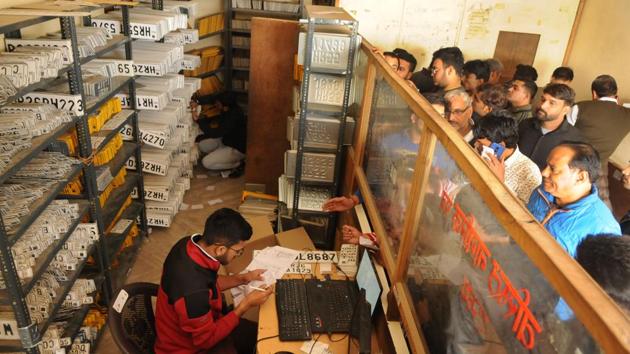
The process of issuing, manufacturing and fitting the plates has been outsourced by the Road Transport Authority(RTA) to a single private company, Link Utsav, since 2012. From Monday to Saturday, between 9am and 5pm, Link Utsav’s office in Beriwala Bagh witnesses long queues of frustrated individuals. In the back, two attendants sort through about 35,000 licence plates, doling them out one by one over the din of confused applicants. With a few hundred HSRP applicants coming in every day to pick up their plates and just two service windows (one for registration and the other for pickup), the process is sluggish.
While many applicants do receive their plates in about 10 to 15 days, others are not so lucky. Hindustan Times spoke to over a dozen residents at Link Utsav’s office who applied for a HSRP in the last six months, but are yet to receive their plates, making them liable to penalties despite following the law. “I applied for the plate in August, and have visited the vendor on multiple occasions. Every time they say they plate will come in ten or fifteen days,” said S Sehrawat, 76, for whom a trip to the office in Beriwala Bagh is a tedious task given his age.
Another vehicle owner, Sunil Sukhija, said he applied for the plate online in September, paying a fee of Rs 379. “When my plate came two months later, it was the wrong size,” he said. Sukhija had to repeat the application process, in person this time, as one can only apply via the online portal once. “The second time, I was charged Rs 670,” he added.
Three of Link Utsav’s employees, who spoke to Hindustan Times (and wished to remain anonymous for fear of retribution) did not provide any reason for the difference in online and offline pricing. By contrast, in neighbouring Punjab, online and offline fees are the same: Rs100 for a motorbike and Rs 300 for a car.
There are also at least 30 outlets across the state where one can procure the plates. In Delhi, too, there are 13 outlets in the city where such plates can be procured, at a cost of Rs70 for a two-wheeler and 100 for a four-wheeler.
Vinod Chauhan, Link Utsav’s zonal officer in Gurugram, did not respond to multiple calls and text messages for comment between December 12 and December 18.
A district court on December 1 has ordered a trial against Link Utsav under sections 420, 406 & 120 of the Indian Penal Code(IPC) for prolonged delays in service and overcharging customers. The matter reached the court after a petition was filed from by city-based RTI activist Harinder Dhingra against the directors of Link Utsav. The trial’s next hearing is scheduled for February 2019.
According to an official in the RTA who did not wish to be named, “The situation can be fixed if more vendors are brought on board, and more centres opened across the city. There is just one office, and almost 20 lakh registered vehicles in the district. The demand is outstripping the supply.”
When asked about the various delays and issues plaguing the operation on the ground, Singh simply reiterated the application process and said that if one follows it carefully, no issues should arise.
Complaints regarding poor service and delays in delivery were the responsibility of Link Utsav, and not the RTA, he clarified.

Stay updated with all the Breaking News and Latest News from Mumbai. Click here for comprehensive coverage of top Cities including Bengaluru, Delhi, Hyderabad, and more across India along with Stay informed on the latest happenings in World News.


