
 E-Paper



Gurgaon: 3D-printed vertebrae helps woman walk again
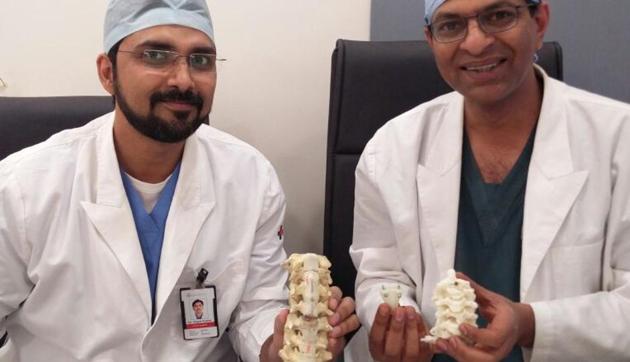
A team of surgeons replaced the damaged vertebrae with a 3D-printed titanium vertebra to bridge the gap between the first and fourth cervical vertebrae.


A 32-year-old woman got to walk again after the successful implantation of the country’s first 3D-printed artificial vertebrae at a Gurgaon hospital on Tuesday, doctors have said.
The woman was suffering from spinal tuberculosis (TB), doctors at Medanta -The Medicity, where she was treated, said.
A team of surgeons led by Dr V Anand Naik, senior consultant, spine surgery, institute of bone and joint, replaced the damaged vertebrae with a 3D-printed titanium vertebra to bridge the gap between the first and fourth cervical vertebrae.
The surgery took 10 hours as the first, second and third cervical vertebrae were severely damaged to the extent that there was no skeletal support available between the skull and lower cervical spine, said a press release from the hospital.
Dr Naik, said, “It was a very complex surgery and the patient’s condition was deteriorating by the day. It would not have been possible to do it without 3D-printing technology.”
Dr Gopal Kumar, consultant, head and neck onco-surgeon, said,” The challenge for our team was to reach high into the neck without altering the position of the patient. The anterior approach and small working field, in cases such as these, are a necessity. As the patient is a singer, preservation of laryngeal nerve was of prime importance. Swallowing, chewing and movement of tongue — all were at risk.”
According to the hospital, Dr Naik and his team used a computer software to plan every detail of the surgery.
The titanium cage was customised according to the patient’s original spine. The high resolution CT and MRI scans of the spine were uploaded on the software and a dummy of the spine was 3D-printed to measure the and surgical resection between the first and fourth vertebrae.
Finally, the 3D titanium implant was printed, which was to be placed in the body. The titanium vertebrae was further tested for biomechanics and stress risers after receiving inputs from the design team in India, Sweden and USA.
The woman, who is a teacher by profession, is recovering fast with newly reconstructed cervical vertebrae and she will be able to lead a risk-free life within two weeks, the doctors claimed.
Dr SKS Marya, chairman, institute of bone and joint, said, “Our team of doctors has introduced a path-breaking solution in a complicated case such as this.”

Stay updated with all the Breaking News and Latest News from Mumbai. Click here for comprehensive coverage of top Cities including Bengaluru, Delhi, Hyderabad, and more across India along with Stay informed on the latest happenings in World News.


