
 E-Paper



Gurgaon projected to have 69 lakh population by 2031
Gurgaon will have a population of 69 lakh by 2031 up from the projected 43 lakh, a study says.

 Prefer HTon Google


Gurgaon will have a population of 69 lakh by 2031 up from the projected 43 lakh once the proposed Transit Oriented Development policy (TOD) comes into effect, a study by the Directorate of Town and Country Planning (DTCP) says. The policy proposes to increase the density of population along the existing and proposed metro corridors to deter people from using private vehicles.
The study also concluded that the population density of the city will increase from the projected 126 to 206 persons per hectare under the Gurgaon-Manesar Urban Complex master plan in 2031.
Sources said the Haryana government is keen on implementing this policy as it might boost the real estate sector that is going through a slump.
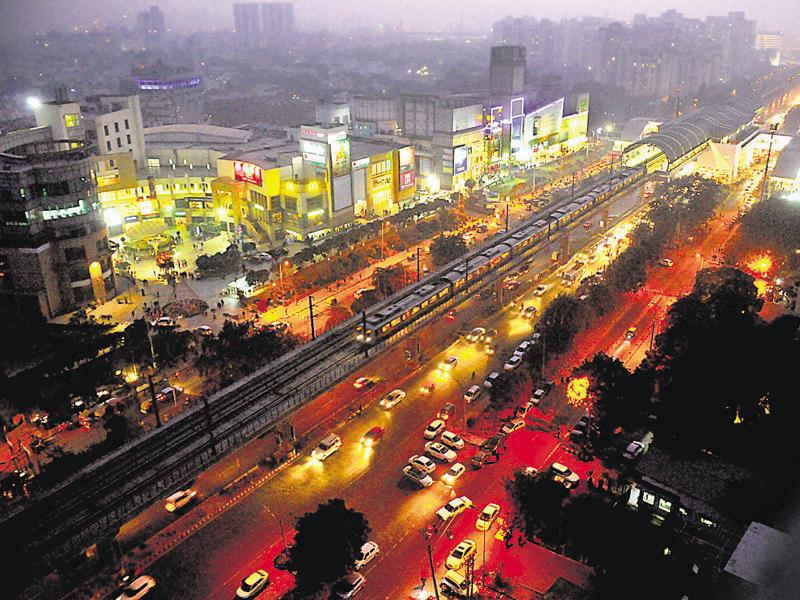
Four metro corridors have been approved under the TOD policy, which includes the existing MG Road and Golf Course Road links and the proposed Northern Peripheral and Southern Peripheral road links. The objective of the policy is to ensure that more people live along the metro corridors and use public transport.
The increased density will be achieved by giving additional floor area ration (FAR) of 3.5 and 2.5 along 800 metres on both sides of the metro corridor. Under the policy, FAR will be given to developers over and above the ceiling of 20% even if it is already consumed in a sector.
“Once the FAR is increased along the metro corridor, the population density will naturally increase as additional housing will be built along major roads and metro corridors,” RS Batth, assistant town planner, said. The DTCP officials, who made the land usage and population projections took the total area along these corridors and calculated the net planned area by excluding green belts, parks and other utilities.
Gurgaon has 33,800 hectares of land that can be developed under the Gurgaon-Manesar master plan 2031. The city also has a provision of 300 acres under the affordable housing scheme and sources said that licences for 270 acres have been approved.
In every Huda sector, 20% of net planned area is meant for normal group housing, 20% for plotted areas and 10 acres are fixed for affordable housing. Officials thereafter studied the land usage pattern of all sectors that come under the TOD policy and calculated the non-developed and underdeveloped land in group housing and plotted areas. “Our observation is that 50% of the vacant land, 50% of licensed group housing and 50% vacant area will be able to avail of higher FAR under the TOD policy,” Batth said. On the basis of this projected increase in housing, the DTCP officials have projected the population to increase by almost 26 lakhs by 2031.
Although there is a strong optimism regarding the TOD policy, there are also apprehensions that this policy is meant to benefit certain developers. A realtor said that there is a need for more level playing field. He said that there is a problem related to differential charging.
Meanwhile, deputy commissioner TL Satyaprakash said that this policy will put more focus on public transport and reduce dependence on private cars.


