
 E-Paper



Former pharma exec slits throats of wife, kids before killing himself
A 55-year-old pharmaceuticals executive who recently lost his job allegedly murdered his wife, teenage son and college-going daughter before committing suicide on Sunday night, according to police officials who also said that they found a purported suicide note but were not ruling out the involvement of outsiders.

 Prefer HTon Google


A 55-year-old pharmaceuticals executive who recently lost his job allegedly murdered his wife and two children before committing suicide on Sunday night. The dead were identified as Prakash Singh, his wife Sonu, daughter Aditi Prakash (21) and son Aditya Prakash (14). They lived in Block F of Uppal Southen, two kilometres from Sohna Road, with their four dogs, who were found sitting next to the bodies.
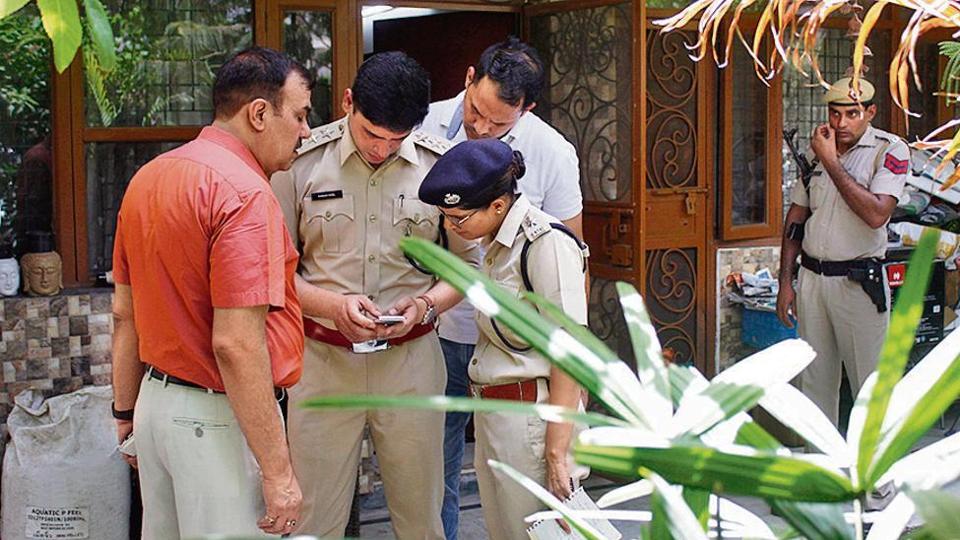
A 55-year-old pharmaceuticals executive who recently lost his job allegedly murdered his wife, teenage son and college-going daughter before committing suicide on Sunday night, according to police officials who also said that they found a purported suicide note but were not ruling out the involvement of outsiders.
The deaths were discovered early on Monday when no one answered the door for the cook, after which neighbours informed the police who eventually broke into the house, officials said. The bodies of the wife and children were found covered in blood, while the man was found hanged from a ceiling fan.
The dead were identified as Prakash Singh, his wife Sonu, daughter Aditi Prakash (21) and son Aditya Prakash (14).
They lived in Block F of Uppal Southend, nearly 2km from Sohna Road, with their four dogs, who were found sitting next to the bodies.
“He may have tried to sedate the family before killing them since there were a lot of pills in the house. An initial autopsy showed signs of a struggle on the bodies of the two women and the boy,” said Aman Yadav, assistant commissioner of police, Sadar.
Gurugram Civil Hospital forensic expert Dr Deepak Mathur, who conducted the autopsy, said Singh died due to asphyxiation from hanging.
“The wife’s throat was slit from the back of the neck and she suffered multiple, severe injuries on her head; she died of excessive bleeding. The daughter and son also suffered multiple injuries on their heads, inflicted with a hard and blunt object. The injuries suggest that they must have died within a few minutes of the attack,” he said.
A knife and a hammer were used in the crime, the police official quoted above said, adding that the analysis of the body samples was awaited to determine if the victims had been drugged.
A suicide note recovered from Singh’s pocket, seen by HT, said: “I am completely failed Taking I and my family along with me
I am completely responsible for this No one else [sic]” and bore a signature purported to be Singh’s with the date mentioned as July 1.
“The neighbours had tried calling the mobile phones of the man, his wife and their daughter but all the devices had been switched off,” Yadav said.
He added that after a police team reached the apartment they removed the iron grille of the apartment’s bathroom window for the family’s daytime caretaker to crawl in and see what happened. They did not break the door open initially as they suspected the family may have been asleep.
“I entered through the window of the bathroom which opens into the lobby. As soon as I opened the bathroom door, I saw the floor covered in blood. I got scared and ran out; I was about to faint,” said Julie Kumari, who used to care for the dogs between 8am and 5pm, for the past year.
Police then broke into the three-bedroom apartment. “Their bodies were found covered with bedsheets. The body of the woman and her son were on the floor, while the daughter’s was on the bed. Singh’s was hanging by a nylon rope from a ceiling fan,” said Yadav.
According to him, investigations will focus on what prompted such an extreme action by Singh.
“It was a struggle to find the family’s relatives, who remember Singh as a docile and caring family man. They said he did not have any differences with his wife. The family suspects the role of an outsider and we are investigating all angles,” the ACP said.
According to the relatives and neighbours, Singh was depressed since he lost his job.
On the basis of a complaint by the Singh’s sister-in-law, the police filed a case under Section 302 (murder) of the Indian Penal Code against unidentified person(s). The family’s dogs were taken in by a neighbour and are in shock, the police said.


