
 E-Paper



Gurugram lacks robust system to monitor air pollution as winter approaches
In February this year, the GMDA had revealed plans to install 15 low-cost sensors across the city by March. Later, in May, the HSPCB was ordered by the Central Pollution Control Board (CPCB) to set up two new full-fledged monitoring devices in the city’s newer sectors, which currently do not have any such facility.


With the winter pollution cycle less than a month away, and air quality already showing signs of deterioration, the city continues to suffer from a lack of robust air quality monitoring infrastructure. This is despite assurances made earlier this year by the Haryana State Pollution Control Board (HSPCB) and the Gurugram Metropolitan Development Authority (GMDA) that Gurugram would be equipped with a citywide network of monitors and particulate matter sensors before the next spate of winter pollution.
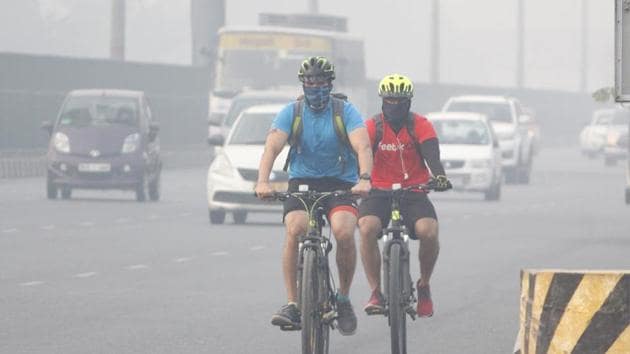
In February this year, the GMDA had revealed plans to install 15 low-cost sensors across the city by March. Later, in May, the HSPCB was ordered by the Central Pollution Control Board (CPCB) to set up two new full-fledged monitoring devices in the city’s newer sectors, which currently do not have any such facility.
Neither of these proposals has so far materialised, and the city’s air quality index (AQI) value, as reflected in the CPCB’s daily bulletin, continues to be calculated using data from just two AQI monitors. One of them is operated by the HSPCB at Vikas Sadan in Sector 11, and another in Gwal Pahari is operated by the National Institute of Solar Energy. Experts say these monitors are not representative of pollution across the city and, more importantly, remain dysfunctional several days of the year. Authorities, however, assured that the situation will see improvement before implementation of the Centre’s Graded Response Action Plan on October 15. Rajesh Garhia, a senior scientist at HSPCB, said, “We have awarded tenders last week for two new monitors in Gurugram, three new monitors in Faridabad and one in Charkhi Dadri. They will be installed within 90 days.”
The HSPCB was recently also granted a Rs 2.5 crore fund for capacity-building and laboratory development which will be used, among other things, to set up air quality monitors in the state’s NCR districts.
Rajbir Singh, advisor (urban environment), GMDA, said, “We have begun work on installing four air quality sensors across the city and are aiming at installing a total of 12 sensors by mid-October.” However, these sensors will only capture particulate matter data, and not information for gaseous pollutants like NOx, SOx, Ozone and so on.
The experts, however, remained sceptical. Guneet Singh, who runs a city-based non-profit working in the field of air pollution, said, “The same promises are made year after year, but the situation on ground has not changed. The more we wait for a robust monitoring system, the more we lose our ability to take hyperlocal measures against the sources of pollution, which is extremely crucial.” Singh further said that Gurugram needs to start maintaining a bank of historical air quality data, without which it will not be possible to gauge the success of proposed interventions. “For example, the city will soon implement its air quality management plan under the National Clean Air Programme. While the plan itself is needed, how is one going to show the value of these interventions without first collecting historical data?” Singh questioned.
This view was echoed by Niranjan Raje, a Gurugram resident and former member of the Supreme Court-appointed Environment Pollution (Prevention and Control) Authority (EPCA). “The city needs at least eight to 10 proper air quality monitors. The fact that this has not yet been done belies the administration’s attitude towards air pollution,” Raje said.

Stay updated with all the Breaking News and Latest News from Mumbai. Click here for comprehensive coverage of top Cities including Bengaluru, Delhi, Hyderabad, and more across India along with Stay informed on the latest happenings in World News.


