
 E-Paper



Guard shoots judge’s son, wife in Gurugram market
Gurugram’s police control room received a call around 3.20 pm informing them about a policeman opening fire at two persons in a parking lot of Arcadia market.

 Prefer HTon Google


The wife of an additional sessions judge died and their son was struggling for life after being shot on Saturday afternoon by their personal security officer (PSO), who claimed that he felt he had been “possessed” at the time he fired his service revolver, the police said.
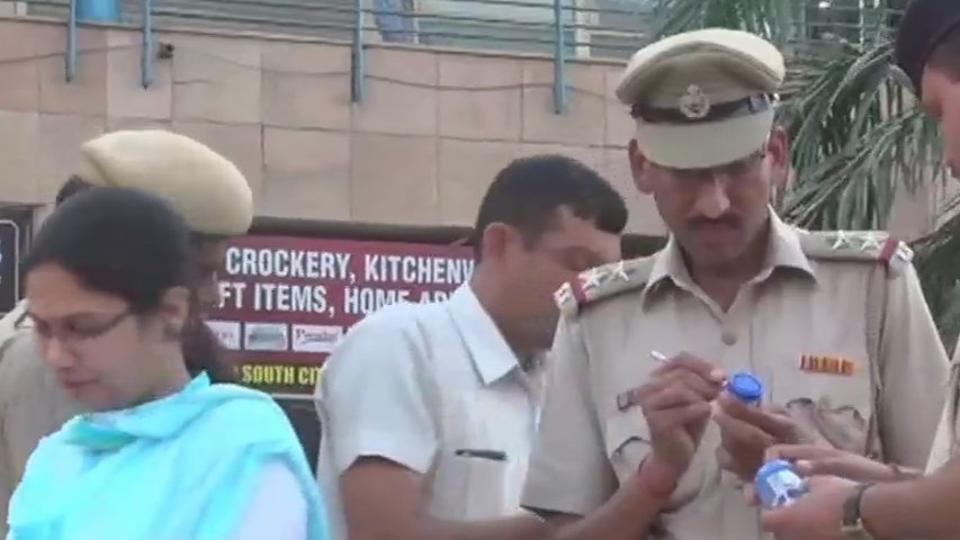
The PSO, who left the scene of crime at Arcadia market in Gurugram’s Sector 49 without being challenged by the throng of onlookers who filmed the incident on their mobile phone cameras, was arrested two hours after the shooting from the Gurugram-Faridabad road.
The victims, Ritu Garg (38) and Dhruv Garg (18), suffered gunshot injuries in the chest and head, respectively, and were rushed to a private hospital, where the woman succumbed a few hours later.
The PSO fired five rounds – three at Dhruv and two at his mother. No bullets were found in them, and only exit and entry wounds were reported. Police said a bullet did not penetrate, but left a bruise on the neck of the teenager.
Head constable Mahipal Singh (32), a resident of Bhungarka village in Haryana’s Narnaul, had been with the family since April 2017 when additional sessions judge Krishan Kant Garg was posted in a Gurugram court. He allegedly shot them with his service revolver (.38 bore) and called up the judge around 3.45 pm after the incident and told him that he had shot his wife and son.
“The accused during interrogation said he was mentally disturbed and irritated as he was asked to take them to the market and he did not like doing household chores,” said deputy commissioner of police (crime) Sumit Kuhar.
Singh, who claimed during initial questioning that he felt he had been “possessed” when he shot the victims, also had an argument with Dhruv before the incident, although the reason was not yet clear, Kuhar said. The PSO had converted to Christianity five days ago and was mentally depressed, police said. He had been watching some videos on religion for the last few months, the police added.
Gurugram’s police control room received a call around 3.20 pm informing them about a policeman opening fire at two persons in a parking lot of Arcadia market.
Rita Garg and Dhruv, who live in Vatika City, had gone to the market with the PSO to buy medicines, the police said.
Within minutes of the incident, eyewitnesses started sharing video clips on social media. In one such clip, shared multiple times, the PSO is seen trying to put the unconscious boy in the rear seat of the judge’s white car. After failing to do so, he gives up and with a gun in hand, drives away.
Eyewitnesses said he first drove towards Sohna Road and had returned within seconds to try and put the judge’s son inside the car before driving away.
The incident occurred on one of the busiest roads of the market in South City 2 connecting to Sohna Road. The video also shows commuters, shopkeepers and other visitors simply driving by or standing quietly at the scene of the crime.
“People were witnessing the incident but no one intervened or helped the victims reach the hospital. It was after the accused fled from the spot and realising that victims were alive, three men came forward and took them to a hospital 1.5 kilometres away in an autorickshaw. The accused easily drove away from the spot in front of hundreds of people, but no one came forward to get hold of him,” Kuhar said.
He said he informed the crime investigation units that followed the head constable on Sohna Road, but he went to a village, Islampur, and spent half-an-hour there with a friend named Kuku. He told Kuku that the judge’s wife and son had met with an accident but within a few minutes confided that he shot them. Kuku told police that he thought they had been killed.
Around 5.30 pm, the PSO was arrested from Gwal Pahari on Gurugram-Faridabad Road after two crime investigation teams intercepted the car.
PN Kakkar, chief executive officer of Park Hospital, where the victims were taken around 3.45 pm with a gunshot injury each, said: “The boy was shot in his head and was immediately put on ventilator. The woman was shot in the right side of the chest due to which blood collected in her lungs. The family wanted to shift them to another hospital so they were shifted from here at 5.26 pm.”
The woman was a homemaker and the boy a class 12 student of a prominent school. The judge was not available for comment.


