
 E-Paper



Dry spell takes sting out of dengue



There’s much to worry about after the severe shortfall in rain in Delhi this monsoon but there’s a silver lining on the health front. Only 28 cases of dengue have been reported in the city in August this year compared to 98 last year.
There’s much to worry about after the severe shortfall in rain in Delhi this monsoon but there’s a silver lining on the health front. Only 28 cases of dengue have been reported in the city in August this year compared to 98 last year.
This is thanks to the lack of rain. "The dengue virus isn’t in circulation in the environment this year and the mosquito that picks up the virus is not breeding as fast, owing to non-availability of sufficient water to lay eggs. This in turn means the disease is not spreading," said Dr AC Dhariwal, director of national vector borne disease control programme.
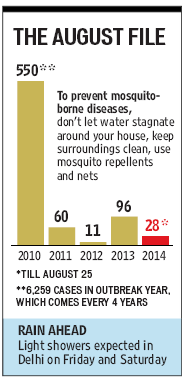
The small number of cases are especially something to cheer about as epidemiologists had expected 2014 to be an “outbreak year”. Large dengue outbreaks usually occur in four-year cycles. In August 2010, 550 cases were reported with one death and a total of 6,259 cases were registered.
“The situation is far from being epidemic this year. We are getting sporadic cases but that we treat otherwise also throughout the year. There’s nothing alarming as was the prediction,” said Dr RK Singal, a director at BLK super-speciality hospital.
The few cases that have been reported were mild and didn’t require hospital-care. “Fortunately there have been no platelet transfusions, no serious cases of dengue this year,” added Singal.
Civic agencies claim they started preparations to check spread of dengue months in advance lending to fewer cases but nature seems to have played a bigger role.

Catch your daily dose of Fashion, Taylor Swift, Health, Festivals, Travel, Relationship, Recipe and all the other Latest Lifestyle News on Hindustan Times Website and APPs.


