
 E-Paper



Nobel Prize for Chemistry: They engineered reactions to mirror life
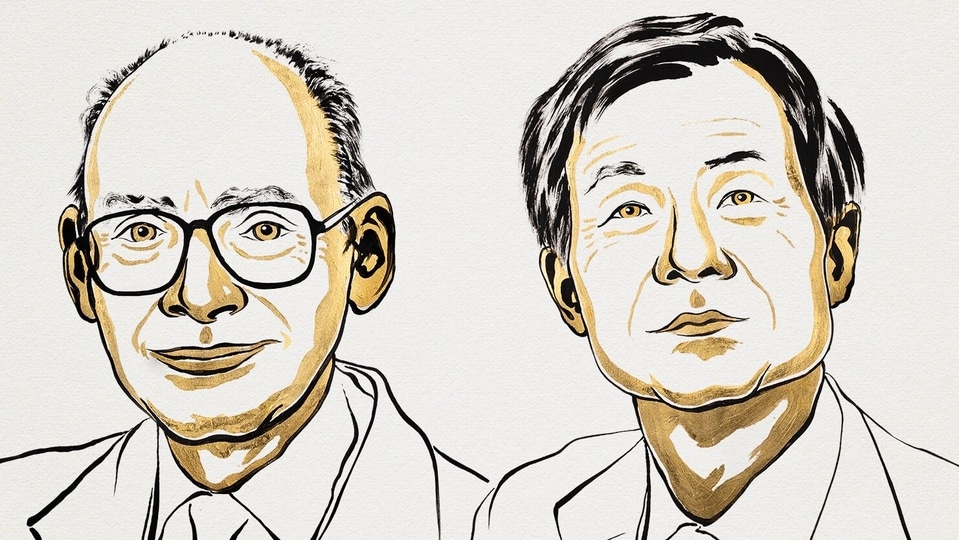
The winners of this year’s Nobel Prize in Chemistry, Henri B Kagan and Kenso Soai, separately devised methods that delivered products in asymmetric proportions.

 Prefer HTon Google


Some molecules can exist in either of two different variants, and many chemical reactions generate near-equal proportions of the two. The amino acids in living organisms, on the other hand, follow a curious asymmetry: although many of them can exist in two variants, only one dominates.
Engineering chemical reactions with similar asymmetry has implications in therapeutics. Many drug molecules can exist in forms that are mirror images of each other. If a pharmaceutical contains a mix of both variants, it is not always ideal: one variant has the desired therapeutic effect, but the other can sometimes cause harmful side effects.
The underlying cause of this is linked to the asymmetry in the chemistry of living organisms. The reason for the asymmetry itself is not fully understood, but it has long been an objective to have one variant in drug compounds.
The winners of this year’s Nobel Prize in Chemistry, Henri B Kagan (Université Paris-Sud) and Kenso Soai (Tokyo University of Science), separately devised methods that delivered products in asymmetric proportions.
To understand the significance of their solution, it is necessary to begin with the problem.
ALSO READ | Henri Kagan, Kenso Soai win Nobel for 'making chemistry choose a mirror image'
Mirror images
When we say molecules exist in two different forms, it refers to the three-dimensional arrangement of their atoms. Our hands offer an analogy of this: they look the same, but the configuration of the fingers and thumb in each hand is a mirror image of that in the other. The two variants in molecules too are “mirror images” of each other; if one is “left”, the other is “right”, although both have the same atoms with the same connectivity.
The mirror-image forms are called enantiomers. The predominance of one variant, as seen in amino acid molecules in living organisms, is called homochirality.
“The predominant form of alpha-amino acids is the L-amino acids, which are the building blocks of all proteins. The other form, D-amino acids, is much less abundant in nature. The origin of homochirality is still an unsolved problem,” said Santanu Mukherjee, professor of organic chemistry, who works in this field in his lab at IISc Bangalore. He had met Kagan when the latter visited IISc in 2010.
If only one variant dominates in amino acids, can there be chemical reactions with similar asymmetry? Kagan and Soai made pioneering achievements in this quest.
ALSO READ | Trump's Nobel Peace Prize prospects minimal, say experts ahead of Friday announcement
The two reactions
Kagan began working to refine asymmetric reactions in the early 1980s. By experimenting with the catalyst and mix of enantiomers, Kagan found a method for enhancing the formation of one of the enantiomers in the product. In 1986, he described three different asymmetric reactions, a historic breakthrough.
Chemistry Professor Kovuru Gopalaiah of Delhi University, who did post-doc research under Kagan at Université Paris-Sud from 2006 to 2008, recalled how it was like to work with him. “Although he was already internationally recognised as a pioneer of modern asymmetric synthesis and catalysis, he remained remarkably approachable, insightful, and generous with his time. He profoundly influenced my development as a researcher. Even after I joined Delhi University, he continued to provide valuable ideas and guidance,” said Gopalaiah, who has co-authored five papers with Kagan. His work with Kagan built upon the foundation the latter had already laid. Gopalaiah studied the thermodynamic and molecular basis of homochirality in enantiomer mixtures and how they affected catalytic reactions.
ALSO READ | Nobel Prize for Physics: Clues to cosmic mysteries captured deep in Antarctic ice
Soai’s contribution, in 2003, was pioneering in itself. He presented a chemical reaction that formed an excess of an enantiomer. The product itself acts as a catalyst for producing more of the same enantiomer, increasing its proportion as the reaction progressed.
“As the reaction progresses, more catalyst is produced, and the reaction becomes faster. He also showed that a small imbalance in the percentage of the mirror-image form of the product is sufficient to amplify chirality,” Mukherjee of IISc said. “Autocatalysis is not a general phenomenon. The Soai reaction is a very special case, which displayed such chirality amplification behaviour.”
Why it matters
Chemists around the world are now trying to emulate Soai’s experiments by designing reactions that would amplify asymmetry in products. And the implications on medicine cannot be understated.
“The requirement for a single mirror image of a chiral molecule in pharmaceuticals and agrochemicals has already been established, as evidenced by the large percentage of US FDA-approved chiral drugs. Their selective access has been a central theme of synthetic organic chemistry research for more than 50 years,” Mukherjee said.
“The objective is not to match the chemistry of living organisms, but at times to counter it to prevent and cure diseases. In fact, chiral drugs contain a wide range of chiral molecules, not just amino acids. The selective synthesis of one mirror image form of those molecules (known as enantioselective synthesis) has been and continues to be important,” he said.
“The catalytic method is the most economical way to make these molecules, and tremendous progress has been made and continues to be made across the globe in this direction. This year’s Chemistry Laureates’ work is more focused on the fundamental aspects of asymmetric synthesis and is connected to understanding the origin of homochirality.”


