
 E-Paper



Should maids and gig workers be restricted to service elevators? Is this prejudice or practicality?
Spotlight on residential societies again as they continue to restrict gig workers to service lifts. Residents wonder if is it practical order or class hierarchy

 Prefer HTon Google


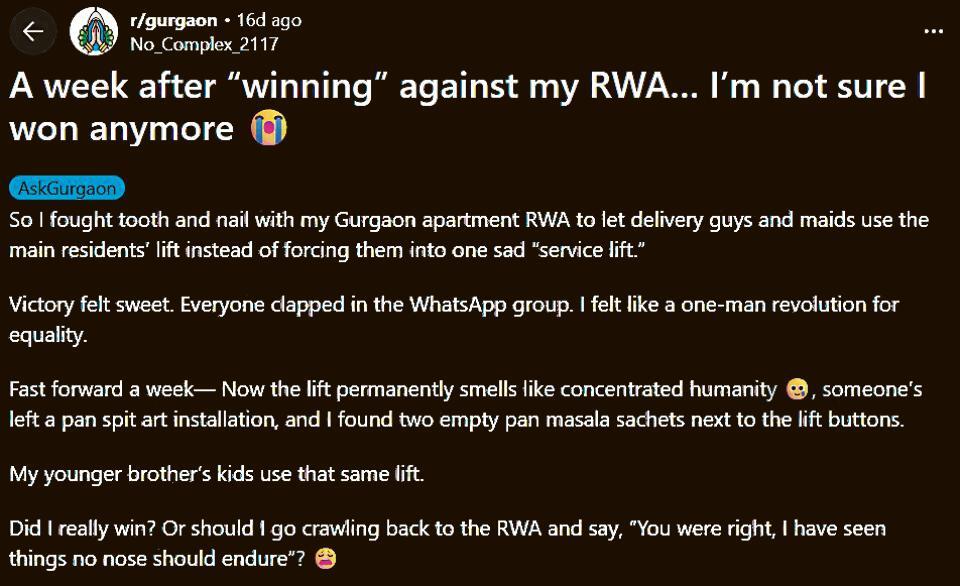
Recently, a user on Reddit shared how he fought with his housing society’s RWA (Resident Welfare Association) to allow domestic helpers to use the residents’ lift instead of restricting them to the service lift. But barely a week later, he admitted to regretting his stand, citing “pan stains” and trash left behind in the elevator.
On the same post, a user commented that the fight was meaningless because they were getting a lift anyway and not being forced to use the stairs.
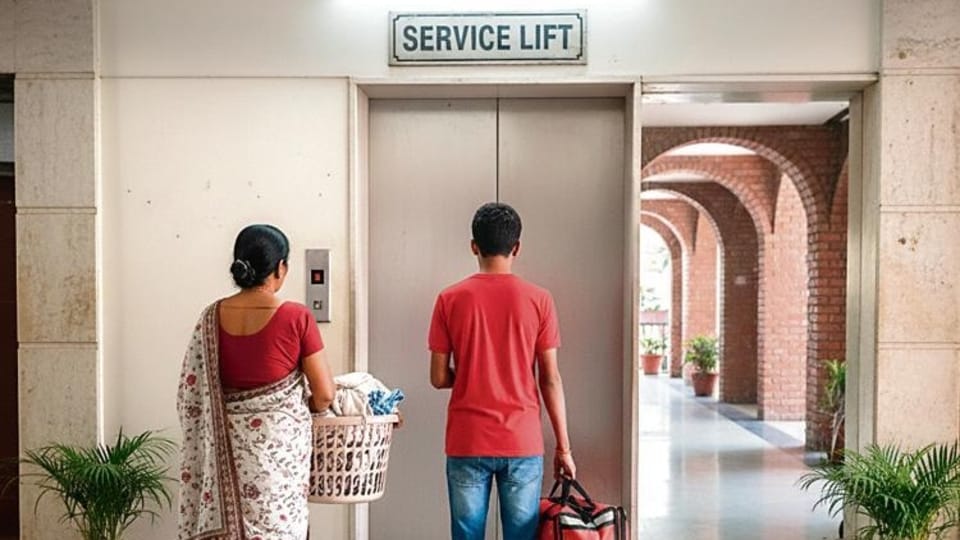
It’s a recurring debate across NCR’s, and maybe India’s gated communities, where RWA rules quietly dictate that domestic workers, delivery executives, gig workers and dog walkers must use the service lift and not the main ones.
The sleek, air-conditioned passenger lifts are often reserved for those who have “paid crores” for their condos and hefty monthly maintenance fees. What began as a “management decision” has now spiralled into a moral and social debate, one that oscillates between convenience, safety, civility and class, rarely finding common ground.
Optimising Resources
Supporters of the rule insist it’s a matter of logistics, not lineage. “It’s about crowd management,” says Mansi Malik, a resident of a high-rise in Noida, adding, “We have about 90 flats in our tower. Every day there are food delivery riders, e-commerce couriers and part-time helpers. Segregating lifts means shorter waiting time.” She adds, “Delivery boys often have 10 packages to drop across floors. They keep their bags at the door to rush back in quickly; that delays others. I’m told service lifts are designed to handle more load, whether it’s construction material or people moving houses.”
Safety, Sanity or Sanctimony?
Another popular argument is safety, especially for children. “You can’t have random men in the lift with kids. To give you an example, I send my kids unsupervised to play basketball or lawn tennis in our society’s clubhouse. If they were to meet random people or strangers in the lift, I won’t be comfortable doing that. I’d have to pause my work and accompany them. It is an added stress. Yes, there are cameras in the lift, but by the time the child alerts you, the culprit would have run away. And most importantly, the kid has been affected forever. So better safe than sorry. Oh! And before you say it, the clubhouse has many safety protocols in place,” says aviation professional Surbhi Dua, who has recently moved to Noida from Gurugram. At both her societies, the gig workers and people accompanying dogs are expected to use different lifts.
Parents also cite pets as a reason. “I support dog walkers using a separate lift because dogs can be unpredictable in confined spaces,” says Kavita Dixit, a Gurugram resident, adding, “With children, groceries, strollers and pets in the mix, separate lifts reduce chaos.”
Another resident of a luxury residential society of Gurugram says, “There is also the issue of hygiene. Delivery boys carrying food, maids and labourers do a lot of sweaty work, the lift has a stentch. And food smell also sometimes is suffocating. Then, some of them keep the elevator on hold waiting for their colleagues to come, that blocks the lift for others.”
Yet, even some residents question where this line between safety and snobbery blurs. Surbhi adds thoughtfully, “At some level, we can train our staff to use facilities properly. But they visit multiple homes, who will train them? Do gig workers even have the time or patience to adapt? It’s a tricky, almost demeaning idea, to assume they need to be trained to ‘be like us’.”
A Matter of Class, Not Just Comfort
Critics, however, say this debate is less about logistics and more about latent class divides. “What you’re seeing is class anxiety repackaged as orderliness,” says Dr Sakshi Sharma, professor at Jawaharlal Nehru University, adding, “The service lift becomes a space where hierarchy can be rehearsed without saying the word ‘class.’ If it’s really about managing traffic, why is the divide class-based? Why not rotate usage or add more lifts instead of segregating people?”
Domestic staff and gig workers echo the sentiment. “I can cook your food and clean your house, but I’m not clean enough to take the same lift as you,” smiles Prema Kumari, who works in a Noida condominium.
Even homeowners admit the issue has shades of privilege. “Yes, it’s about privacy and convenience, but it’s also about class,” says Aleem Siddique, a marketing manager and condo owner in Gurugram. “In offices too, people avoid sharing lifts with top executives, we’ve normalised it. But in residential spaces, these distinctions get personal. We need to ensure comfort doesn’t turn into discrimination,” Aleem adds.
What the law says
Advocate Akash Krishna Sharma, who has represented several RWAs across Delhi and the NCR in various courts of law, observes, “This is a sensitive matter. On the surface, it appears to reflect a class divide, but a closer look reveals it’s far more nuanced. Beyond class, it’s also about comfort and the idea of paying for a better quality of life."
He adds, "Legally, Residents Welfare Associations (RWAs) in India operate under the Model By-Laws of their respective state’s Association of Apartment Owners Act. Each RWA must ensure that its rules are not discriminatory and do not infringe upon anyone’s right to equality. However, if certain rules are framed in the interest of residents’ safety or for the optimal utilisation of a society’s resources, and are approved at the General Body Meeting, they can be lawfully implemented.” Advocate Akash Krishna Sharma has represented several RWAs across Delhi and the NCR in various courts of law


