
 E-Paper



Review: Thinking of Winter byShantanu Naidu
A book about a man and his dog that shows compassion isn’t a uniquely human trait, and touches on the anthropocentric nature of urban design

 Prefer HTon Google


Shantanu Naidu’s Thinking of Winter is the kind of book a reader wants to hug; it is like a soft, comforting pillow that gives no advice and asks no questions even as it foregrounds the idea that there is goodness in the world. A first-person narrative about “a lost adult and a special dog”, it prioritizes emotional resonance over verbal craftsmanship.

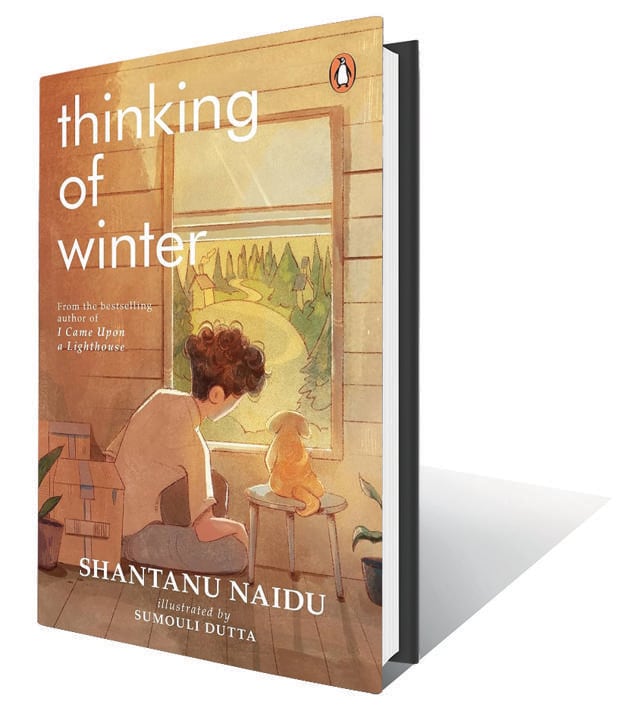
The author is the founder of Motopaws, an initiative providing glow-in-the-dark, reflective collars to keep street dogs from being run over by vehicles at night. Here, instead of his public-facing work with animal welfare and animal rights advocacy, Naidu writes about something more personal: his relationship with Winter — the golden retriever he adopted while studying at Cornell University in the United States. They have lived together for nine years.
At first, the reader might think he is just another indulgent dog parent when he says that Winter is “a special dog”. But they will think otherwise on discovering how Winter tried to save a baby deer’s life in Ithaca, and also sought the author’s help to rescue “flightless pigeons”, “lost baby crows”, a kitten and a rainbird in Mumbai. This book shows that compassion is not an exclusively human quality. Winter cannot bear to see other creatures suffer. He leads by example, teaching Naidu to look out for those who need help.
Naidu acknowledges that he adopted this “runt-of-the-litter puppy” to deal with the loneliness that had engulfed his life as an international student whose “attempts to make friends had failed” after eight months of being at the university. This book will strike a chord with anyone who finds it easier to befriend animals than humans.
“I saw and felt his attempts to let me know in the most adult way possible that the days of looking at life alone were not necessary anymore. The days of weeping alone were behind me,” Naidu writes. Anyone who has experienced the uncomplicated and unconditional love of a pet knows this to be true. Winter pushed the author to draw “courage saturated to its full glory and grace” from “the wet imprint of his cold snout left on a warm laptop edge, day after day”.
The dog that was brought home to help the author with his mental health became “a permanent fixture in [his] subconscious”. Instead of sitting at the university library to complete his academic assignments, he began bringing work home so that he could spend time with Winter. He joined group discussions virtually, and ensured that his grocery runs were quick. “...his well being [became] a big part of my conscience,” Naidu writes.
Parenting involves heartaches too. He recounts, in great detail, the harrowing process of bringing Winter from the United States to India on a flight. Apart from the paperwork involved, it was stressful for both of them. Naidu felt sorry about displacing Winter from Ithaca, “the small town that he had made home, with all its forests and gorges, and trails and rivers, and town folk and baristas that loved him”. Mumbai, with its population density and vehicular traffic, was going to be an entirely different experience.
This book persuades readers to think about the extremely anthropocentric nature of urban design when Naidu points out that “many pets feel trapped in the concrete monstrosities of our city”. He also talks about the sacrifices animals have to make when their lives are controlled by humans: “Winter following me…across the seven seas will always have me carry an unforgiving guilt. The guilt of asking a wildflower to thrive in a vase.”
Another notable aspect is the book’s emphasis on anticipatory grief, a bitter but inescapable truth that pet parents have to face. When Winter’s tail and hind leg were paralysed, he could barely feel any sensation in his posterior. Naidu recalls that he was so heartbroken that he told his mentor, the industrialist Ratan Tata, “If something happens to him, I don’t think I can live on.” Tata replied: “Should something happen…we must grieve, but you cannot say that.”
The incident revealed the poor state of medical facilities for animals in India. “India doesn’t have very many MRI clinics for pets, and Mumbai didn’t have a single one,” Naidu writes. This painful personal experience informed his work with the Tata Trusts Small Animal Hospital in Mumbai when he served on the board of directors.
READ MORE: Shantanu Naidu: “A dog’s default state is a good set of values”
Thankfully, Winter is alright now. However, as Naidu remarks, “...our time together is not unlimited. And while I might have found the most powerfully imprinted love I will ever come across, this fact will never change.” This contemplative tone is consistent with the subject.
Sumouli Dutta’s soulful illustrations of Winter make this book even more endearing. In one of these, he watches over a wounded kitten that he coaxed Naidu to rescue during the Mumbai monsoon. With the author’s scant knowledge of how to take care of the little one, “several impulsively chosen T-shirts were thrown together to make a warm bed”. A hairdryer and a napkin were used to dry her up. “Winter supervised every step,” notes Naidu.
Another memorable illustration has Naidu getting inked at a tattoo parlour; the artist is engraving the words “Thinking of Winter” on his forearm. The tattoo, like this book, is a celebration of enduring love — a love that is rare to find.
Chintan Girish Modi is a journalist, educator and literary critic who also writes poems, short stories and essays. His work has been published in anthologies like 101 Indian Children’s Books We Love (2013), Borderlines: Volume 1 (2015), Clear Hold Build (2019), Fearless Love (2019), and Bent Book (2020).


