
 E-Paper





Follow the latest breaking news, major developments and agenda-setting stories from India and around the world with the newsdesk at Hindustan Times. Operating round the clock, the desk brings together experienced editors, reporters and correspondents to deliver fast, accurate and contextual reporting across subjects that influence public policy, governance, business, society and international affairs. The HT News Desk covers politics, elections, government policies, the economy, business and markets, science and technology, the environment, law and order, infrastructure, education, climate issues and geopolitics, while closely tracking developments across states, institutions and global capitals. The team also leads coverage of major breaking news events, policy announcements, court proceedings, natural disasters, public emergencies and significant international developments. Reports published by the newsdesk are based on information gathered from reporters on the ground, official statements, government agencies, court records, regulatory filings, recognised institutions and other authoritative sources. Stories undergo editorial scrutiny and verification processes to ensure accuracy, fairness and relevance, and are updated as events evolve and additional information becomes available. Whether covering a key political decision in New Delhi, an economic policy shift affecting millions, a landmark court ruling or a major global event, the HT News Desk aims to provide readers with reliable, fact-based journalism that delivers not only the latest developments but also the context and analysis needed to understand their wider implications.
40-yr-old black hole mystery solved
Coming fresh on the heels of the first ever photo of one of the giant objects, which are scattered across the Universe, astrophysicists are now several steps closer to understanding how they form and develop.


Scientists on Thursday unveiled the most detailed simulation of a black hole yet, solving a mystery dating back more than four decades over how the star-devouring monsters consume matter.
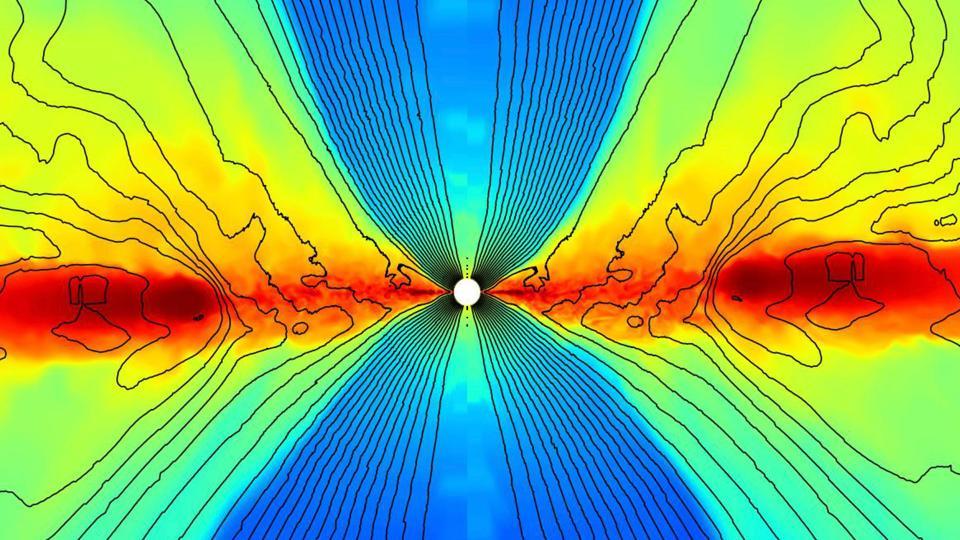
Coming fresh on the heels of the first ever photo of one of the giant objects, which are scattered across the Universe, astrophysicists are now several steps closer to understanding how they form and develop.
A black hole is born when a large star collapses in on itself. Far from being a “hole”, they are instead incredibly dense objects with a gravitational pull so strong that nothing, not even light, may escape them.
As they suck in matter such as gas, dust and space debris, they form an accretion disk — a churning mass of super-accelerated particles that are among the brightest objects in the Universe — around them.
It is the accretion disk that can be seen as a blurry halo around the image of the black hole released in April from the Event Horizon Telescope.
But accretion disks are nearly always tilted at an angle to the orientation of the black hole, known as its equatorial plane.
In 1975, Nobel Prize-winning physicist John Bardeen and astrophysicist Jacobus Petterson theorised that a rotating black hole would cause the inner region of a tilted accretion disk to line up with the black hole’s equatorial plane. But no model could ever work out how, precisely, that would happen. Until now.
A team of astrophysicists from Northwestern University, Oxford University, and the University of Amsterdam, used graphical processing units to crunch large sets of data and simulate how black holes interact with their accretion disks.
Crucially, their approach gave them the computing power to account for magnetic turbulence, which occurs when different particles churn at different speeds within the accretion disk.
Alexander Tchekhovskoy, assistant professor of physics and astronomy at Northwestern’s Weinberg College of Arts and Sciences, likened matter accumulating near a black hole to throwing a dart towards the board at random. “If you don’t really aim it will never hit the bullseye,” he said. “In the same way, when (matter) falls into the black hole it has some rotation but this rotation will have nothing generally to do with how the black hole rotates.” Previous simulations predicted the additional friction their creators believed was needed to make matter move towards the black hole.


