
 E-Paper



4-tier workforce to oversee vaccination drive
Assisted by committees, task forces and control room personnel, an army of government officials and representatives of foreign aid agencies will monitor the complex immunisation drive at every level and act quickly to keep the programme on track if anything goes amiss.


The authorities have put in place a four-tier supervisory and management system that stretches down to the district and block levels to ensure a smooth roll-out of the world’s largest Covid-19 vaccination programme, which will begin on January 16.
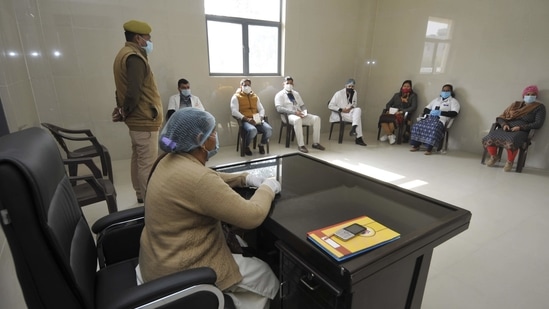
Assisted by committees, task forces and control room personnel, an army of government officials and representatives of foreign aid agencies will monitor the complex immunisation drive at every level and act quickly to keep the programme on track if anything goes amiss, people familiar with the matter said.
This command structure will also include dedicated units to tackle any adverse events following immunization that include side-effects of the vaccines. At the state as well as district levels, special committees on adverse events have been formed, in line with the official guidelines.
The National Expert Group on Covid Vaccine (NEGVAC), the nerve-centre of the Narendra Modi government for all vaccine-related issues, has played its role since August 202. Now, as the vials started reaching the hinterland of India and vaccination, it is the turn of the rest of the machinery to get into the act.
Every state will have a steering committee as well as a task force and a control room to monitor the immunisation drive. The steering committee will be headed by the chief secretary and the health secretary will head the task force.
The steering committee, comprising representatives of several departments, has been assigned tasks such as oversight on the creation of a database of health-care workers, review of the preparedness of the cold chain, operational planning and even to devise strategies to tackle “anticipated state-specific challenges,” the people cited above said.
This panel will also be in charge of financial planning and explore the use of Corporate Social Responsibility (CSR) funds to pay for activities related to the Covid-19 vaccination drive.
The state task force, which meets at least once a fortnight, will oversee the roll-out of the vaccines, develop a media plan to address rumors and will be responsible for social mobilization of the vaccine recipients. It will resolve issues of micro-planning, logistics, human resource availability, training and waste management.
The control rooms, with a clear chain of command, will be involved in day-to-day planning for mobilization of workforce as well as logistics. The guideline issued by the Centre said: “They need to oversee that while planning for the sessions and session site allocation” and “ensure that there is no delayed decision making.”
The urban centres, which are expected to see a higher concentration of vaccine recipients and vaccination sites, will have their own separate task forces. Headed by the municipal commissioner, their work will be similar to that of their district counterpart.
The block task force, headed by a sub-divisional magistrate or a block development officer, will meet every week and are entrusted with identifying vaccinators across government and private sectors, monitor the roll-out of Covid-19 vaccines at the block level and ensure minimal disruption of other routine health services.
The immunization will see a mega workforce—mostly comprising government officials—with specific duties.
“For us, it is an extension of the ongoing universal immunization programme. But this is the first time, a vaccination of such a large scale is taking place in a time-bound manner. No wonder there will be several backroom boys and managers playing crucial roles behind each vaccination,” an official familiar with the matter said.


