E-Paper



Number theory: A caste-wise analysis of all chief ministers in India
A look at the overall, intertemporal and state-wise caste breakup of chief ministers.

 Prefer HTon Google


Caste is a driving factor in Indian politics. While Indian politics has definitely become more socially egalitarian in the post-Independence period, it continues to play a crucial role in electoral arithmetic. The question to ask then is: Have politicians from deprived castes been more successful in getting themselves to leadership positions?
Read here: Petitions against Bihar caste survey to be taken up on Friday: Supreme Court
One way to answer this is by analysing the caste composition of the top executive post (prime minister and chief minister). When it comes to prime ministers, only two of them, HD Deve Gowda and Narendra Modi, are from the other backward classes (OBCs). No member from the Scheduled Caste (SC) or Scheduled Tribe (ST) communities has ever been prime minister.
State-level
What about leadership at the level of states? HT has built a caste-wise database of chief ministers from 21 major states from 1952-2023 to answer this question. A caveat may be in order here. Castes are incredibly complex in India. A sub-sect of a caste may be considered a so-called upper caste while the caste itself is considered an OBC. An OBC in one state may not be an OBC in another. While HT’s data team has vetted its database, and our regional bureaus have carried out their own due diligence, it is possible that the classifications of a few are erroneous. That does not change the findings, though (and in the interests of making sure the database improves on account of the wisdom of crowds, it will be made public after this two-part series runs).
There were 20 states and the Union territory of Delhi included in this analysis. Manipur, Sikkim, Tripura, Nagaland, Arunachal Pradesh, Mizoram, Meghalaya, Goa and the erstwhile state of Jammu & Kashmir are excluded. The database has 471 chief ministers. People who have become chief ministers more than once are counted multiple times in the database. Social profile is based on the listings of castes in the OBC/SC/ST lists of the states.
Read here: Inside the survey to enumerate India’s oldest fault line
This two-part data journalism series will present summary findings from this database. It looks at overall, intertemporal and state-wise caste breakup of chief ministers.
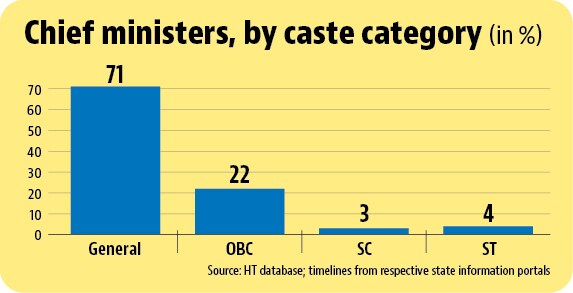
 71% of chief ministers in India have come from groups which are not OBC or SC/STOf the 471 chief ministers in the database, 70.3% come from subcastes which do not belong to OBC, SC or ST groups. The share of CMs from OBC groups in the list is 22.7%, while only 2.5% of chief ministers in the database belong to the SC category. Of the total 471 chief ministers in the database, only 129 (this also includes CMs serving currently) had a full five-year term. Among these, 68.2% are from non-OBC/SC/ST groups. The share of OBC chief ministers who completed a full five-year term is 27.9%. Mayawati, who was the chief minister of Uttar Pradesh from 2007-12 is the only Dalit CM to have completed a full-term in office in India. Because the analysis excludes northeastern states which have a high ST population, it is prone to underestimate the share of ST chief ministers in India.
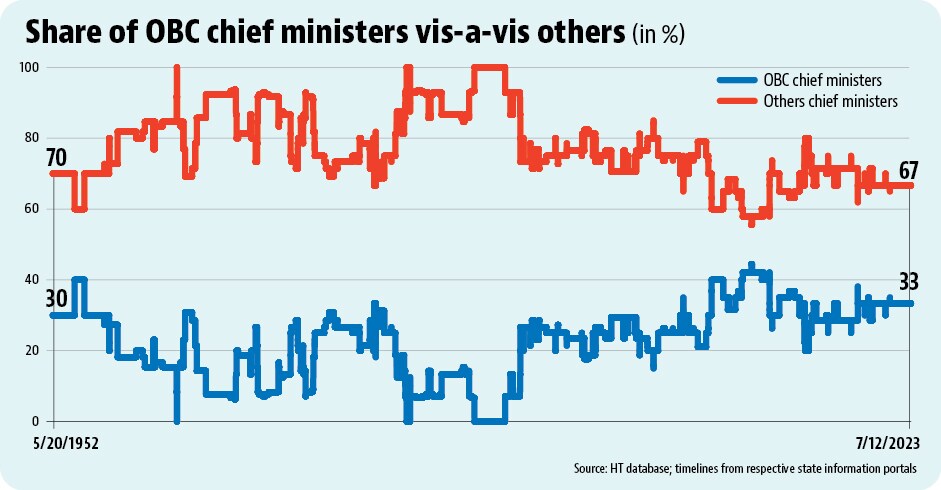
- The share of OBC chief ministers peaked around 2008-09The database shows that the caste composition of chief ministers has been changing over the years. As is to be expected, this was very low between the 1950s and 1970s and started increasing in the late 1980s and 1990s. From December 2008 to May 2011, the percentage of OBC chief ministers remained greater than 40% (it reached an all-time high of 44.4% on 16th October 2009). Currently, one-third of the states in the database are headed by OBC chief ministers.
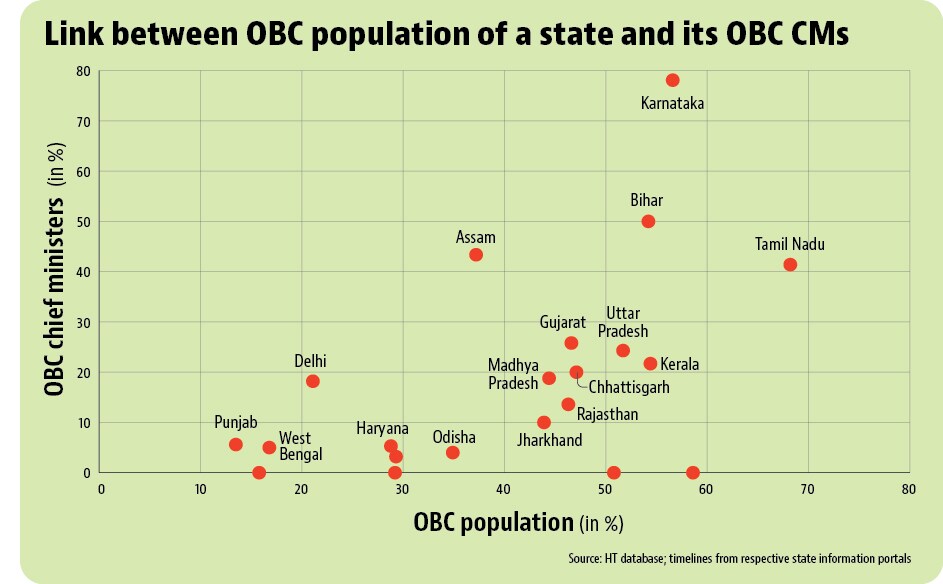
- There is a big state-wise asymmetry between share of OBC population and OBC CMsWhile OBCs are expected to have a population share of somewhere between 40-50% at the all-India level, their population share varies significantly across states. It is as high as 68.2% in Tamil Nadu, greater than 50% in Telangana, Karnataka, Kerala, Bihar, Uttar Pradesh, and Andhra Pradesh, and as low as 13.8% in Punjab, 15.8% in Himachal Pradesh, and 16.8% in West Bengal. The OBC population share numbers have been taken from the 2019-21 National Family and Health Survey report 2019-21. A comparison of the share of OBCs in population with the share of OBC chief ministers in a state suggests that the share of OBCs chief ministers jumps significantly once the population share of OBCs goes above a certain level. For example, OBCs constitute 35% of Odisha’s population but only once in 1977 did an OBC become the chief minister (Nilmani Routray) of the state. On the other hand, states such as Karnataka and Bihar (the OBC population share is more than 50% here) have had a high share of OBC chief ministers.
This is the first of a two-part series based on HT’s own caste database of chief ministers in India. The second part will look at the questions of party-wise social background, subcastes and dynasties.