
 E-Paper



‘Aggressive testing, tracing those infected is key’: South Korean envoy
South Korea’s 3T or “test, trace and treat” policy figured in Prime Minister Narendra Modi’s video conference with 130 Indian envoys on Monday as one of few successful approaches to tackling the spread of the virus.


Aggressive testing among those at high risk, tracing people infected by the Coronavirus and quarantining them is key to preventing the mass spread of Covid-19, South Korean ambassador Shin Bong-kil said.
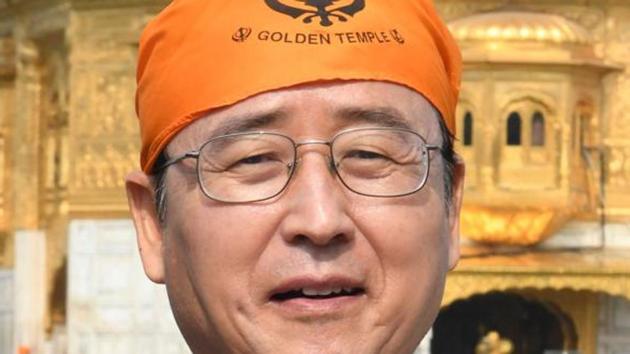
South Korea’s 3T or “test, trace and treat” policy figured in Prime Minister Narendra Modi’s video conference with 130 Indian envoys on Monday as one of few successful approaches to tackling the spread of the virus. Shin said the situation is his country had stabilised, with the number of new confirmed cases showing a steady decline and fluctuating around 100 a day.
“The Korean government’s Covid-19 control strategy consists of robust testing to identify confirmed cases, tracing their contacts to prevent further spread, and treating those infected at the earliest possible stage,” Shin said in an interview with HT.
South Korea’s current diagnostic testing capacity is up to 15,000 tests per day. While it has performed more than 400,000 tests, it continues to test at near-full capacity, he said. Identifying and isolating the contagion and treatment in the early stages is the only viable method because no vaccine is available, he said.
Asked if the “test, trace and treat” can be applied in India, which has a much larger population, Shin replied: “In India’s case, the lockdown of the entire nation was a necessary step considering India’s sheer size and demographic. However, in order to prevent mass spread of the virus, it is important to identify those at high risk, carry out aggressive testing, then trace those infected by the virus and quarantine them.”
More than half of South Korea’s more than 9,600 cases were traced to the Shincheonji Church of Jesus, and Shin said his country had faced a mass outbreak in the initial stage “due to a gathering of a religious congregation in” a province. “The Korean government acquired the list of all members of the religious organisation and aggressively proceeded to test and quarantine them. We were thus successful in controlling the spread of the virus at an early stage,” he said.
Shin said the South Korean government was prepared to fully share all information and insights garnered from its fight against Covid-19 with India. “President Moon Jae-in and Prime Minister Modi exchanged ideas through the virtual G20 Summit,” he added.
In the long run, South Korea and India, with their advanced information technology, bio and pharmaceutical industries, can cooperate in research and development in the fight against virus-related diseases, he said.
Shin also expressed the hope that the Indian government will take speedy steps to address the concerns of South Korean firms once the 21-day lockdown ends.
“As you are well aware, Korean companies such as Samsung, LG, Hyundai and Kia closed their plants due to the lockdown…Well aligned with the ‘Make in India’ policy, our companies have invested heavily in the country and a complete shutdown incurs massive losses for them,” he said.
“Once the shutdown is lifted, new personnel will have to be dispatched for handling new equipment and installing new facilities. I hope the authorities expedite visas for engineers from Korea who wish to enter India.”
Shin said a crisis often “leads to chance” and “India must not lose the opportunity to emerge as a world top manufacturing hub”.
With hundreds of South Korean nationals stranded in India, Shin said a special Korean Air flight is expected to evacuate residents and tourists who desire to return in the first weekend of April. “Further evacuation will be dependent on the future pandemic situation and the status of the shutdown, which is currently imposed till April 15,” he said.


