E-Paper



Ahom Moidams now Unesco heritage site
Moidams, 700-year-old burial mounds of the Ahom dynasty in Assam, added to UNESCO World Heritage List, marking first cultural site from northeastern state.

 Prefer HTon Google


Moidams, the 700-year-old burial mounds of the Ahom dynasty in Assam, were on Friday included in the Unesco World Heritage List, the UN agency announced, making them the first cultural site from the northeastern state to get the coveted tag.
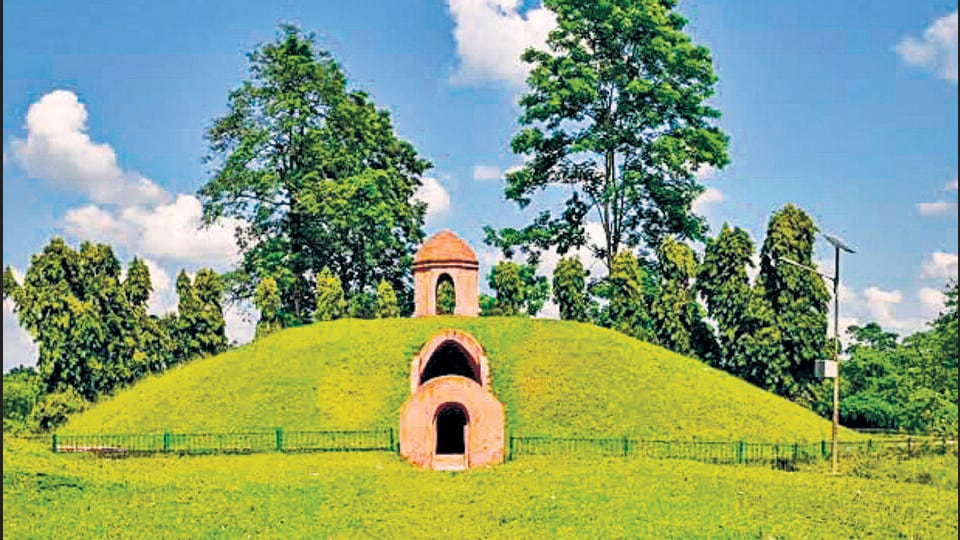
The decision to include Moidams in the list was taken during the ongoing 46th session of the World Heritage Committee (WHC) in the Capital.
“New inscription on the UNESCO World Heritage List: Moidams – the Mound-Burial System of the Ahom Dynasty, India,” UNESCO or the United Nations Educational, Scientific and Cultural Organization posted on X.
Prime Minister Narendra Modi welcomed the decision, calling it a matter of “immense joy and pride” for India.
“The Moidams at Charaideo showcase the glorious Ahom culture, which places utmost reverence to ancestors. I hope more people learn about the great Ahom rule and culture. Glad that the Moidams joined the World Heritage List,” he posted on X.
Located in the Patkai Ranges in eastern Assam, the unique burial mounds — represented by pyramid-like structures known as Moidams — were used by the Ahom dynasty that ruled Assam for around 600 years. Also known as the “pyramids of India”, Moidams were first included in the tentative list of Unesco’s World Heritage Sites in April 2014.
“Moidams are vaulted chambers (chow-chali), often double-storied, that have an arched passage for entry… They contain the remains of kings and other royals together with grave goods such as food. Eventually, the mound would be covered by a layer of vegetation, reminiscent of a group of hillocks, transforming the area into an undulating landscape,” according to the UNESCO website.
The word Moidam is derived from the Tai word Phrang-Mai-Dam or Mai-Tam. Phrang-Mai means to put into the grave or to bury and Dam means the spirit of the dead, according to an Assam government portal.
The designated site contains 90 Modiams of different sizes, and includes other cultural features like ceremonial pathways and bodies of water, according to people aware of the matter.
There are a total of 1,204 sites from across the world on the list, with 43 of them now being from India. The sites are categorised under “cultural”, “natural” and “mixed” labels. Assam’s Kaziranga Kaziranga National Park and Manas National Park are also included in the list under the “natural heritage” label.
Tim Curtis, the director of Unesco South Asia Regional Office, said the Moidams were a unique site of cultural significance.
“I would like to congratulate the government of India, the people of India, and the people of Assam for this significant inscription. The Moidams are a unique site, which holds immense value for the local communities, who continue to practice ceremonies there, as well as for all of humanity. It is our collective responsibility to ensure the safeguarding of this heritage for generations to come,” he said.
The Ahom clan established their capital in different parts of the Brahmaputra River Valley between the 12th and 18th centuries, after migrating from China, according to the UN cultural agency’s website. They established the first capital at the Patkai hills in eastern India and named it Charaideo, which means “a dazzling city above the mountain” in their language. Even though the clan moved across cities, the burial site was considered as the most sacred place. The site has the largest concentration of these vaulted mound burials, according to UNESCO, and reflects the sculpted landscape of the surrounding hills.
Union culture and tourism minister Gajendra Singh Shekhawat said it was a moment of “immense pride for India” as the global recognition will help highlight “the rich cultural heritage of Assam and Bharat”.
“In the last few years, our capacity in the archaeological ecosystem has increased so much that there are 57 sites pending for addition to the Unesco heritage site list. The inscription of these new sites in the World Heritage list will help boost tourism across the country. We have now proposed the Maratha Military Landscape for the list,” he said.
Historian and author of ‘The Ahoms: A Reimagined History’ Arup Kumar Dutta said the recognition will help make Moidams more popular among tourists and the people of the state.
“I am optimistic that the UNESCO tag will give [Moidams] more popularity and more people will get to know about the rich legacy of the Ahom dynasty,” he said.
Assam chief minister Himanta Biswa Sarma thanked the central government for ensuring that the mound-burial system is included in the Unesco list.
“This is great news for Assam as the Charaideo Moidam is now officially a UNESCO Heritage site... Assam will always remain indebted to the Centre for this honour. This inclusion is a great honour for the country and not for Assam alone.
Other sites included on Friday in the list included the Colonies of the Moravian Church in Germany, the US and UK; the Umm Al-Jimal in Jordanu and the Badain Jaran Desert in China.
(With inputs from Vrinda Tulsian and agencies)