E-Paper



Air India plane crash: Tragedy spotlights history of migration from Diu
Diu’s deep links with Europe were in the spotlight when it emerged that 14 of 241 people on board the London-bound Air India flight were either from Diu or had roots in the region

 Prefer HTon Google


Firangi Wado, the foreigners street, of tiled homes and chapels near Diu Fort dates back to 16th-century Portuguese settlements on India’s west coast. There are barely any foreigners there now, but the connection to Europe remains strong.
Diu remained under Portuguese rule until 1961, although India gained its independence from the British 14 years earlier. For decades, Portugal allowed people from Diu citizenship, allowing visa-free access to Britain until Brexit, the country’s exit from the European Union (EU) in 2020.
Diu’s deep links with Europe were in the spotlight when it emerged that 14 of 241 people on board the London-bound Air India Boeing 787 Dreamliner flight, which crashed shortly after take-off from Ahmedabad airport on June 12, were either from Diu or had roots in the region. Seven of the 14 were Portuguese, three were British nationals, and four were Indian passport holders. They were travelling to rejoin family or return to work.
The lone survivor, Vishwash Kumar Ramesh, a British citizen, who lost his brother Ajay Ramesh in the crash, also has roots in Diu. The Ramesh brothers were flying back after spending time with their family and relatives in Diu.
At least eight of the 14 had roots in Diu’s Bhusalwada. “Our village has a population of 4,000. In the last two decades, at least 6,500–7,000 people have migrated to the UK and Portugal. Earlier, it was easy to become a UK citizen through Portugal. Now, after Brexit, things have changed,” said Bhusalwada village head Deepak Solanki.
Brexit marked a shift for the people of Diu. For years, the Portugal-UK pathway was the most common migration route. Portuguese passport holders could no longer freely enter Britain after Brexit. Some managed to register under the EU Settlement Scheme. Others never made it. Still, the dream persists.
Vrushank Bamaniya, a resident, said people in Diu continue to pursue the dream of emigrating to the UK. “Even a councillor in Leicester [Luis Fonseca] was from Diu a few years ago. There is a mini-Diu there. However, things changed after Brexit.” He said the entire island was in mourning after the crash. “Every funeral had hundreds of villagers in attendance as it is a small and close-knit society,” he said.
Dui’s nodal officer, Asker Ali, said the region was still coming to terms with the enormity of the tragedy. “This island has not faced such a tragedy in a very long time.” He said nine families of the 14 killed in the crash were mourning. “There has been migration to countries like the UK and Portugal in the past, but in the last five years, the trend is slowly reversing. The focus on development, health, and livelihood has been a major reason for this.”
He said Diu, a part of the Union Territory of Dadra, Nagar Haveli, Daman and Diu, has been transformed in recent years. “This year alone, it welcomed 400,000 tourists, operates entirely on solar power during daylight hours, and boasts new educational institutions alongside five-star hotels. Just months ago, it hosted the Khelo India Beach Games on Ghoghla Beach,” said Ali.
A second government official said people from Diu keep travelling to the UK and other European countries, mostly for work. “If the flight was in July or August, you may have found almost one-fourth of it with Diu passengers.” He added that people from Diu would travel abroad mostly via Mumbai until Ahmedabad emerged as the preferred port of departure in recent years.
The official said at least 15,000–20,000 people from Diu are estimated to have settled in the UK and Portugal and obtained citizenship over the last two decades. “They mainly go there for livelihood purposes and work in stores or other such labour-intensive jobs, including as crew members on ships. They return almost once every year to Diu.”
Portuguese nationals Devji Lacmane, 60, and his wife, Vanita Cana, 55, were among those who were killed in the crash after visiting the Kumbh Mela and extending their stay in Diu. Faizan Rafique, 25, who was travelling to London on the Air India flight to work as a cab driver, was the only earning member of his family.
Manav Bhamaniya, in his 20s, was returning to the UK after spending time with family in Diu. “My son Manav got his UK visa about a year and a half ago, and he was selected for a job there from among 3,000 candidates. My brother’s son and others from our family are already in the UK…What else is left for me to say? Everything I had is now gone,” said his father, Amrtulal Bhamaniya, a fisherman in Diu.
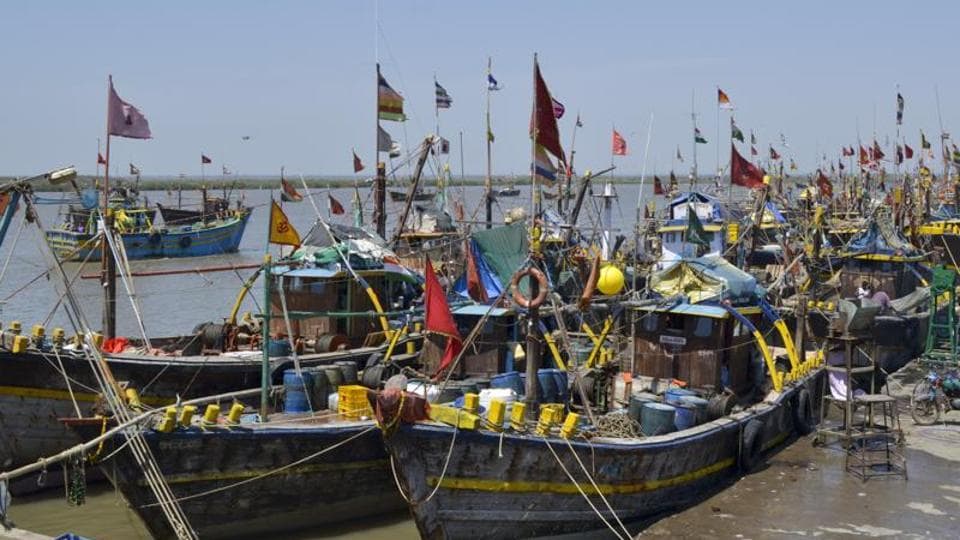
Nearly 70% of Diu’s population (51,000 as per the 2011 census) belongs to the fishing community. The fishing halts during the monsoon, leaving few avenues for livelihood.