
 E-Paper



Air toxic for young lungs but schools to remain open in Delhi
Authorities in Delhi and Noida have advised schools to cut down on outdoor activities, though no order has been given to shut schools for now.

 Prefer HTon Google


The air in the national capital appeared set to enter the emergency zone on Friday but officials dithered on announcing a shutdown of schools citing a technicality, even as experts said young children should be kept indoors till pollution levels ease.
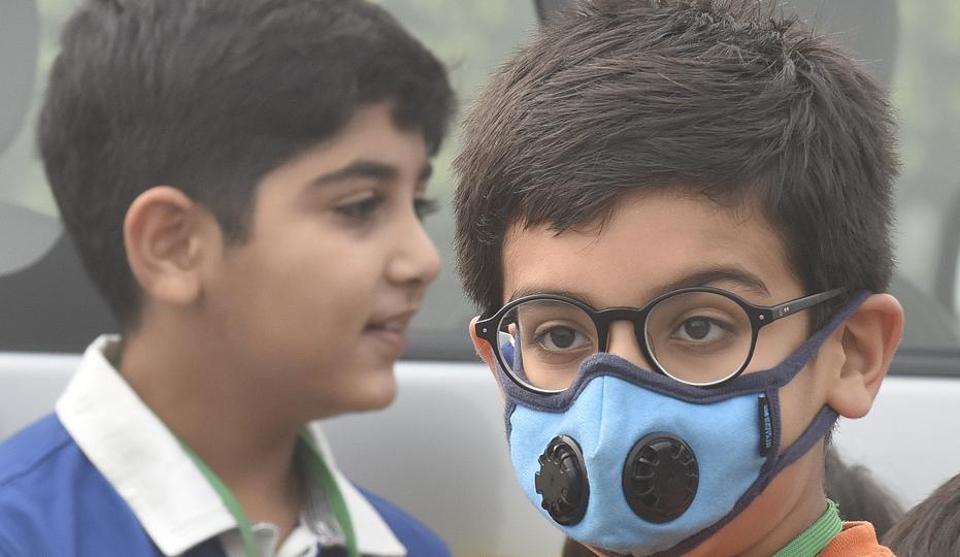
The 24-hour average concentration of PM2.5 ultra-fine particles reported by the Central Control Room for Air Quality Management-Delhi NCR’s dashboard was at 296.7µg/m3 at 11pm on Thursday, close to the 300µg/m3 level that is regarded as the threshold beyond which the pollution is considered to be at emergency levels.
The rise, which was consistent since the afternoon, coincides with a rapid rise in the number of farm fires reported in the neighbouring states of Punjab and Haryana – a key source of the pollutant that is considered to be the deadliest of all particles in the air. Since Wednesday, there were at least 5,300 incidents of farm fires – the effects of which are expected to be felt in the national capital region (NCR) soon.
“Morning time is worse for children to be outdoors since pollution is at its peak around that time. Their airways are developing, and are narrower, so they are prone to more injury when breathing in heavy pollutants,” said Dr JS Bhasin, senior Paediatrician, BLK Hospital.
“Apart from throat and lungs, pollution also affects their eyes and skin,” he added.
Authorities in Delhi and Noida have advised schools to cut down on outdoor activities, though no order has been given to shut schools for now. Pollution control authorities have cited a slight improvement that is expected in pollution levels by Sunday to resist from ordering more serious curbs such a ban on schools.
But experts said this showed the inadequacy of the air pollution plan, and highlighted how it was reactive rather than proactive in nature.
“It is time to have a re-look at the Graded Response Action Plan (Grap). In most countries, actions are taken based on forecast. But if we go by Grap, then we would have to wait for the “severe+” category air to last for at least two days to shut down schools,” said environment expert Chandra Bhushan, who asked: “What if pollution doesn’t reach the “severe+” category and remains few notches below in the severe category for a week? Shall we not take any extreme action and wait for the emergency category?”
Grap lays down sets of curbs that are enforced when AQI crosses certain thresholds – the most serious of these include a ban on trucks, odd-even road restrictions, an embargo on construction work, and an advisory to governments to shut schools.
According to CPCB officials, air quality is likely to improve gradually but will remain in ‘very poor’ to ‘severe’ zone over the next two days. It is expected to improve “significantly” on November 3, when surface wind speed is expected to pick up.
Sunita Narain, a member of Environment Pollution (Prevention and Control) Authority – the agency that orders governments to enforce curbs, said, “While shutting down of schools is listed under Grap and there is clearly a pollution emergency, the fact remains that children will still play outside even while at home.” The best option, she added, “is to reduce their [children’s] exposure to outdoor activities, which schools are already doing”.
“We are watching with great concern, as pollution is almost at emergency levels. We may have to come up with more measures,” Narain said.
The Delhi government had shut down all schools on November 8, 2017 for five days after the pollution remained in severe category.
This year, the air quality crisis has hit with similar intensity as recent years despite the problem being an annual crisis and leading to several efforts -- laws, fines and cleaner fuel -- to combat it. On Sunday, people flouted a Supreme Court-ordered rule to set off illegal fireworks, adding to the toxic combination of gases that has lingered on in the city since then.
Some measures of Grap had been applied pre-emptively last week, but benefits, if any, lasted only till the afternoon of Diwali before emissions from celebrations and smoke from farm fires covered the capital in a haze.


