E-Paper



All 8 cheetahs in good health, stayed calm during the flight
However, the cheetahs were ‘stressed’ to see the crowd that had gathered to see them released into the quarantine enclosure in Madhya Pradesh's Kuno National Park, where they are scheduled to stay for a month.

 Prefer HTon Google


All eight cheetahs that flew overnight from Windhoek in Namibia to Gwalior and Kuno National Park in Madhya Pradesh on Friday were doing well, their vital parameters normal, zoologists who travelled with the big cats said on Saturday. “They did very well on the flight and slept. They were calm,” said Laurie Marker, executive director, Cheetah Conservation Fund. “It’s all good with the cats.”
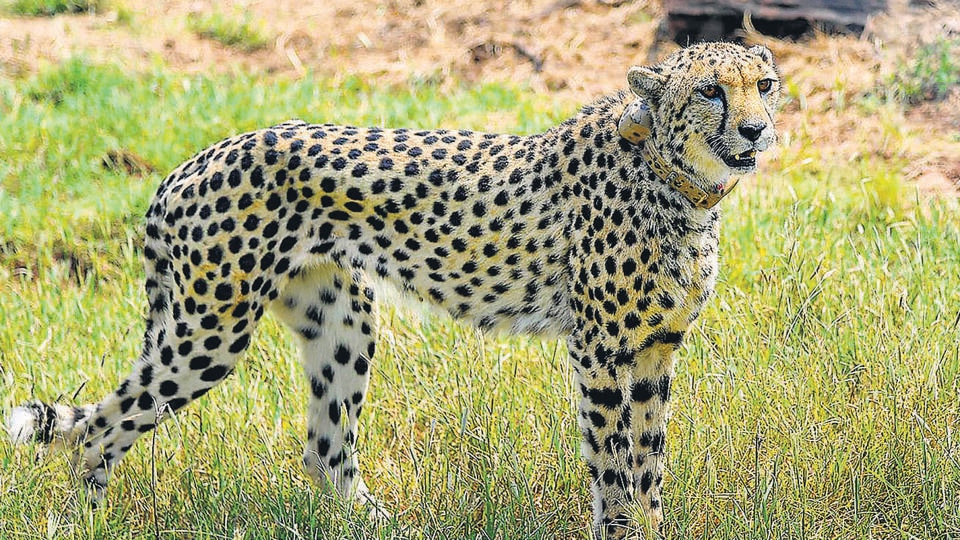
The cheetahs were stressed to see the crowd that had gathered to see them released into the quarantine enclosure in Kuno, where they are scheduled to stay for a month. “They were stressed to see crowds. We couldn’t explain this to everyone. Such moments are stressful for them,” Marker said. “But overall, their travel to India was a huge success.”
Also Read | You imagine PM Modi to focus on jobs, inflation. He's photographing cheetahs: Rahul Gandhi
The animals were lightly sedated to reduce anxiety during travel, said Marker. “It’s good that I got to see them again this evening. I will be leaving for the US soon, so it was an opportunity to meet them and see them,” she said. “We will see them again in the morning, but there are students from Wildlife Institute of India who will be observing them from big towers near the enclosure.”
A couple of staff members from CCF Namibia are likely to stay in Kuno for around a month until the cheetahs complete their quarantine period. They will then be moved to a bigger enclosure of around 6 sq km for some more time. They will not hunt till then.
Several wildlife experts and environmentalists have criticised the cheetah translocation project. CCF members said establishing a self-sufficient population of cheetahs in India is a long process that may take years and a lot of dedication.
“It is a very difficult process and we have to be realistic about it. As far as Kuno is concerned, I don’t see any problems in them adapting to this region. It is very similar to Namibia or any other habitat,” said Eli Walker, conservation biologist with the CCF who has been working on the project and helped prepare the enclosures.
Also Read | 'Collar ID' will track movement of cheetahs inside Kuno: All you need to know
There might be conflict situations in the future, among other challenges, Walker warned. “Cheetahs move a lot. Its hard to get them to stay. We have to be realistic about what’s being done. It can be labelled as a failure as soon as there is conflict, but its important to be realistic,” he said. “Conflict situations may arise and we have to have a plan to deal with such situations.”
Cheetahs are sometimes killed by other predators like lions and leopards in Africa, but there have been no instances when they have attacked humans, Walker said. “The moment they see people, they run. They are the fastest land animal and their instinct is to run as fast as they can,” he said. “If a situation arises, they will try to defend themselves by slapping or something, but they will not attack on their own.”
Marker has recommended that CCF educational material be translated for local communities and schools to sensitise them better about the animal.
The small crates that carried the eight cheetahs, three male and five female, made several people wonder whether they were too small. but experts said they were small for a reason. “This is because the size allows them to stand and turn around and stretch. It allows them to be in a comfortable position,” Walker explained. “If the size is bigger, they can move too much and hurt themselves.”
Also Read | Cheetahs now have a grand home in Kuno National Park, but not all are happy
The conservationists anticipated that the cheetahs will be stressed once they saw the crowd. “We expected that and we were accommodating,” Walker said. “There was a lot going on, but the event was over soon.”
“Nature is same everywhere, so I don’t think the change of environment affected them,” Walker said. The big cats have been radio collared before their travel to India so their movements can be monitored at all times.