
 E-Paper



Army Gen who oversaw surgical strikes to head Congress task force on national security
The announcement came hours after the Congress launched a sharp attack on Prime Minister Narendra Modi and the ruling BJP over last week’s Pulwama terror attack that killed 40 soldiers in Jammu and Kashmir.

 Prefer HTon Google


Former chief of the army’s northern command, Lt Gen DS Hooda (retired), under whose watch the 2016 surgical strikes were conducted, will head a Congress task force on national security, a party statement said on Thursday.
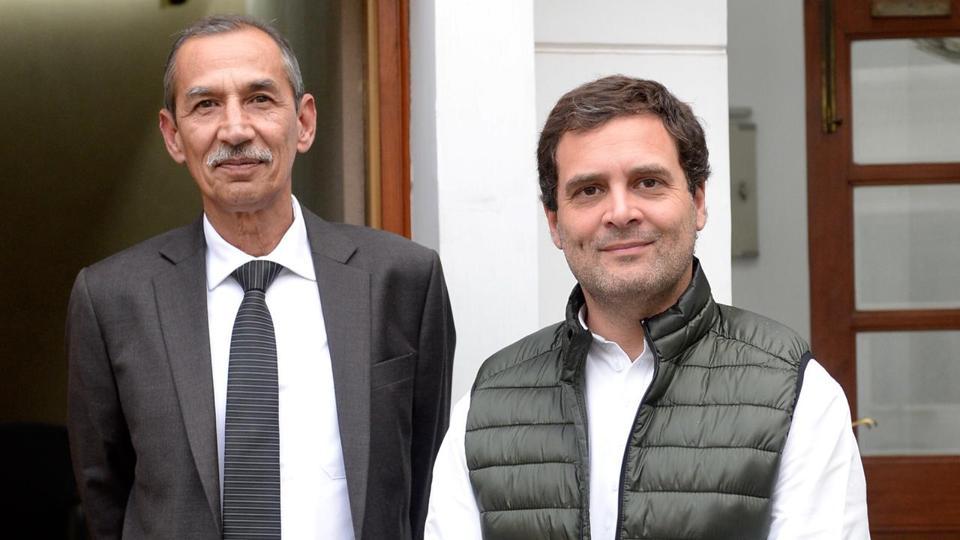
“The Congress president is setting up a task force on national security to prepare a vision paper for the country. Lt Gen DS Hooda (retd) will lead the task force and prepare the paper in consultation with a select group of experts,” the statement read.
Hooda, however, maintained that he has not joined the Congress party and there is no such plan in the near future.
Hooda was the main architect of the surgical strikes carried out by the Indian Army on September 29, 2016, on terror launch pads along the Line of Control (LoC) in retaliation to an attack on its base in Uri earlier that month, in which 19 Indian soldiers were killed.
He had met the Congress president some time ago and agreed to head the panel that will also comprise professionals such as diplomats and senior police officers.
“I will head the task force which is basically going to look at national security challenges, give recommendations and prepare a national security strategy for the next five years,” Hooda said.
Asked if there is a specific timeframe to submit the report, he said, “There is no timeframe but I am looking at one month.”
Hooda will now pick the members of the task force with relevant expertise in the area. “We are looking at a mix of security professionals, including diplomats, uniformed people and police members,” he said.
In December, Hooda had remarked that it would have been better if the 2016 surgical strikes were carried out secretly. The Congress president used the remarks as a handle to attack Prime Minister Narendra Modi, alleging that he used the strikes for political capital.
“In hindsight, it would have been better had we done it secretly,” he had said, responding to a question during the Military Literature Festival in Chandigarh on December 7 last year.
He had also said that it was natural to have “initial euphoria about the success but the constant maintenance of hype around the military operation was unwarranted”.
Hooda had underlined that the military leadership must guard against becoming a tool in the hands of politicians.
Gandhi took to Twitter to hail Hooda. “Spoken like a true soldier General. India is so proud of you. Mr 36 has absolutely no shame in using our military as a personal asset. He used the surgical strikes for political capital and the Rafale deal to increase Anil Ambani’s real capital by 30,000 Cr,” he tweeted.
Hooda retired from service a few months after the surgical strikes.
Last year, when the National Security Advisory Board, which analyses internal and external security issues, wanted someone to take a hard look at ways to optimise resources for the armed forces, it had turned to Hooda.
In his report, the officer had recommended the possibility of cutting down the size of India’s 1.2-million strong army by creating a reserve force and making the special forces a strategic resource.


