
 E-Paper



As Maoist violence returns, decoding the rise of ultra left insurgency
The manner in which the 400-strong Maoist battalion in Chhattisgarh reportedly lured security forces into a trap showed that the Maoists have gained the technical knowledge to fight a direct battle, according to experts

 Prefer HTon Google


The killing of 22 security personnel belonging to the Central Reserve Police Force (CRPF), District Police Guard and a Special Task Force in one of the deadliest attacks by Peoples Liberation Guerilla Army of Communist Party of India (Maoist) at Jonaguda village in Chhattisgarh’s Bijapur district has raised questions about claims that left-wing extremism in the country is on the wane.
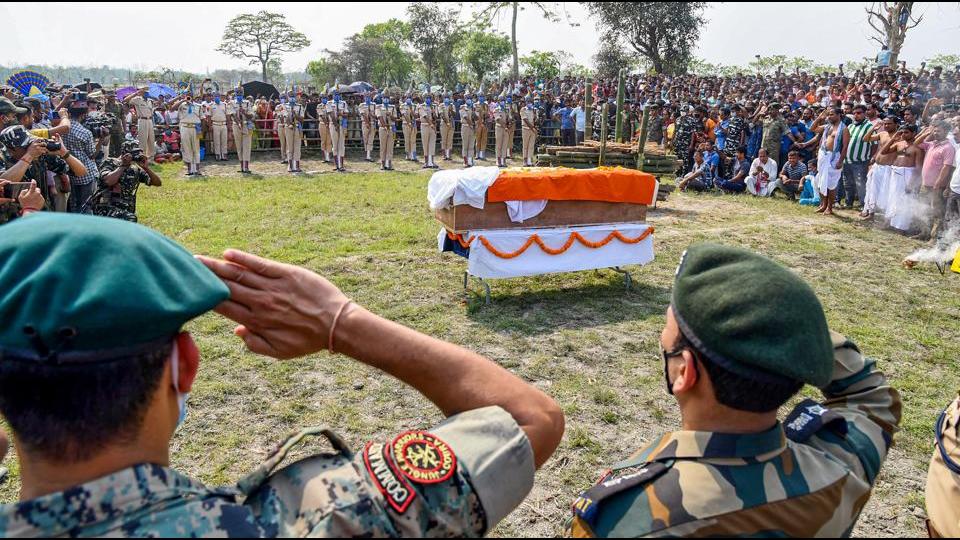
The manner in which the 400-strong Maoist battalion No. 1 led by Madvi Hidma, chief of the Maoist party’s Central Military Commission, reportedly lured security forces into a trap and directly encountered them with assault rifles, rocket-launchers and fusillade of grenades, showed that the Maoists have not only grown in strength in some respects, but also gained the technical knowledge to fight a direct battle with the security forces, according to experts who have followed the trajectory of left-wing extremism.
“The Maoists may have suffered heavy losses over a period of time, but have bounced back every time with the support of the Adivasis in the forests of Chhattisgarh,” said Ginugu Narasimha Reddy alias Jampanna, a former central committee member of Maoist party and head of its military commission in Chhattisgarh, before he surrendered to the Telangana police in December 2017. He said the fact that the Maoists could vacate the villages around the encounter spot within 20-30 minutes before the attack on the security forces,which would not have been possible without the support of the local people. “They have developed a strong information network,” Jampanna said.
But how have the Maoists continued to retain their strength — if not wholly, then substantially — despite setbacks and a strong government offensive, especially in the south Chhattisgarh belt? The answer lies in returning to the past and tracing the evolution of the rebellion both in Chhattisgarh and its neighbouring regions.
The Andhra experience
Before 2005, the Nallamala forests encompassing Telangana and Andhra districts was an impregnable fortress of Maoists (who were earlier known as People’s War Group). This was more or less similar to the present Abujhmad region of Chhattisgarh, with police forces hardly having any access to the area. The killing of security forces and Maoists in exchange of fire was a routine affair.
Also Read | Maoists cross a red line, again | HT Editorial
After the lifting of the ban on Maoists and talks between the rebels and the then YS Rajasekhar Reddy government in combined Andhra Pradesh in October 2004, things changed in favour of the security forces. Talks failed despite initiatives of civil society groups, but it gave an opportunity to the security forces to access the Nallamala forests to help gain complete control over the region.
After the failure of talks, the Greyhounds, a specialised force, and other security forces launched an all-out attack on Maoists, based on pointed intelligence, and inflicted heavy casualties. Top Maoist leaders, including Akkiraju Haragopal alias Ramakrishna and Sudhakar, who took part in the talks, fled to Chhattisgarh and Andhra-Odisha borders. Many other top leaders such as Madhav, Shyam, Mahesh, Murali, Chandramouli, Prasad, Patel Sudhakar Reddy and Sakhamuri Appa Rao were killed in encounters. And some other central committee members such as Kobad Ghandy and Malla Raji Reddy were arrested from different parts of the country.
“Between 2004 and 2009, nearly 400 Maoists, including top leaders and state secretaries were killed in encounters. The Nallamala forests were liberated from Maoists,” a senior police official, who played an active role in the talks with the Maoists in 2004, said.
The implementation of a socio-economic agenda, coupled with effective police action and field level intelligence, led to the decline in Maoist activity in the then unified Andhra Pradesh after 2005. The setting up of tribal welfare residential schools even in the remotest areas, setting up of health care centres in every panchayat, development of road infrastructure to interior villages, various other programmes through Integrated Tribal Development Agencies (ITDA) and implementation of Mahatma Gandhi National Rural Employment Guarantee Scheme also helped lead to the decline in Maoist activities in Telangana and Andhra districts, bordering Chhattisgarh and Odisha.
“Young people are not inclined towards Maoists anymore and have become career-oriented. They are looking towards towns and cities, rather than jungles,” observed S Venkatesh, an NGO activist in Bhadrachalam.
Renewed focus on Chhattisgarh
After facing reverses in erstwhile Andhra Pradesh, the Maoists began consolidating their position in Chhattisgarh. Although they entered in Chhattisgarh in early 1980s, the region was initially used only as a buffer zone, but since the 1990s, the rebels stepped up their offensive against security forces.
“Geographically, the Maoists have found Chhattisgarh forests very convenient to gain hold, compared to Telangana and Andhra. They could easily gain the support of the local Adivasis, who were agitated over the plundering of mineral wealth by the big companies with the support of the governments,” Jampanna, the former Maoist leader, said.
Also Read | Maoists issue statement, say their fight not against security forces
There were other factors that enabled the rise of Maoists in the region.
According to senior police officials, the development strategy adopted by the combined Andhra government (and later Telangana government) did not work out in Bastar district due to a vacuum in administration and poor penetration of developmental agencies. “The massive corruption in the lower-rung revenue and forest officials also led to alienation of tribals,” a police official said.
Chhattisgarh was also a newly formed state (it was carved out of Madhya Pradesh in 2000) and had limited police strength — there were just about 1,000 policemen in undivided Bastar district. Unlike the Greyhounds of Andhra, the police personnel in Bastar were initially not trained adequately to fight the guerrilla warfare of Maoists.
And then there was the Salwa Judum experiment, which, by all independent accounts, only deepened alienation among tribal communities in the region and led to human rights violations, providing a fertile ground to the Maoists to recruit and spread their ideology. The Salwa Judum was essentially a counter-insurgency group formed from within Adivasis to take on the Maoists. It was supposed to be a peace mission, and was launched by Mahendra Karma, a former Communist-turned-Congress leader in June 2005.
The failed Judum experiment
Projected as spontaneous uprising of tribals against the violence unleashed by Maoists, the Judum comprised mostly local Koya or Dorla tribes, who are believed to be semi-urban, compared to Muriya or Gothikoya tribes, who live deep inside the forests. While the Gothikoyas had become supporters of Maoists, the Koyas were exploited by the security forces in the name of Salwa Judum.
Between 2005 and 2010, 644 tribal villages were evacuated and 100,000 brought into the Salwa Judum camps and provided with arms by the police to counter the Maoists. This led to massive armed conflicts between Salwa Judum tribals and Maoists, leading to countless deaths. The Salwa Judum experiment failed subsequently and it had to be wound up following a direction from the Supreme Court in July 2011. Its founder Mahendra Karma was brutally killed by Maoists on May 25, 2013.
Also Read | Maoists release photograph of missing CoBRA commando
After the failure of Salwa Judum experiment, the Maoists stepped up their recruitment drive. Top Maoists leaders, mostly from Telangana, mingled with the local tribals and assimilated their distinct culture and tradition.
The Maoists also started taking care of the needs of the tribals in the deep forests by setting up Janatana Sarkars (people’s governments) in the tribal hamlets, which are essentially local self-governments – they set up schools and banks run by local tribals, created irrigation facilities by constructing check dams on local streams, introduced collective farming and run revenue administration.
“For the tribals, the Maoists are the real government, since they have not seen any other official coming to them so far. Naturally, they are prepared to lay down their lives for Maoists and fight with the police forces,” a teacher in a Bastar village, who did not want to be named, said.
The absence of roads and bridges on rivers like Indrawati and its tributaries like Chintavagu and Sabri also helped Maoists isolate villagers for over six months in a year, thus giving them opportunity to “brainwash” the tribals.
At the same time, the Chhattisgarh Police did not have a specialised anti-Naxal force like the greyhound of Telangana, while Maoists were able to create a specialised army in the form of PLGA with batallions, companies and platoons. Its approach of winning over tribals was coupled with coercion, which took the form of direct attacks on security forces and political leaders, as well as a reign of coercion over people in areas they controlled.
The most significant Maoist attack on security forces was when they killed 76 CRPF personnel near Chintalnar village in Dantewada on April 6, 2010. A month later, they killed 36 persons, including 12 special police officers in an attack on a bus at Dantewada and 26 more CRPF jawans at Narayanpur on June 29, 2010.
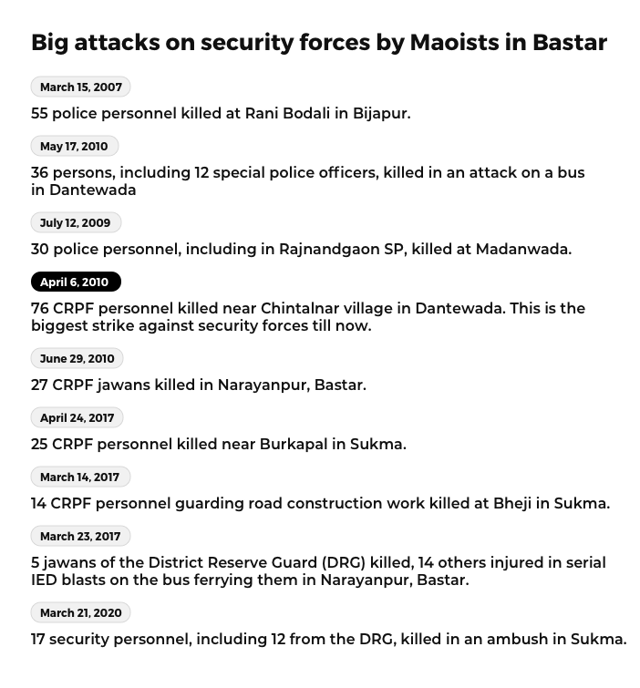
Earlier, they had killed 55 armed Salwa Judum forces and policemen at Rani Bodli in Bijapur on March 15, 2007 and 30 policemen, including Rajnandagaon superintendent of police, at Madanwada on July 12, 2009.
In 2013, in one of their most audacious attacks, the Maoists wiped out almost the entire top leadership of the Congress in the state in an attack in Jiram Ghati, killing senior Congress leaders such as Nand Kumar Patel, Mahendra Karma, Dinesh Patel and VC Shukla.
In the meantime, Operation Green Hunt, which was believed to have launched in November 2009 by the Central government simultaneously in five states — Maharashtra, Chhattisgarh, Bihar, Jharkhand and West Bengal — but was never officially confirmed, played a role in containing the Maoist movement to a large extent, but it did not completely weaken the left-wing extremism as these attacks showed.
The response from Raipur
Officials believe that the Raman Singh government was more aggressive in tackling Maoists, with a higher number of anti-Naxal operations planned by the police and Central forces during the Bharatiya Janata Party’s rule. But this, civil liberties activists claim, was accompanied by greater human rights violations.
In 2014, a controversial Inspector General SRP Kalluri was posted in Bastar. While human rights activists alleged that the violation of human rights was at its peak during Kalluri’s tenure, his supporters lauded him as a superhero in containing Maoist activity — and spoke of his strategy of forcing the surrender of Maoists and enhancing the state’s penetration in rural areas. He was subsequently removed from Bastar in 2017.
The Congress government, led by Bhupesh Baghel, which succeeded the Raman Singh government in December 2018, has claimed that the Maoist violence in the state has gone down. There are two views on this decline.
On one hand are officials in the field who believe that the decrease in violence in 2019 and 2020 because of the reduced engagement of security forces in core areas with Maoists and “defensive strategy” of forces in the last two years.
On the other side of the debate are senior police officials who claim this decline is because of a set of measures — including “offensive and intelligence-based operations” by state police and other paramilitary forces; the opening up of new operational base camps in the affected areas which has helped the police regain control over more than 8,000sqkm area in Bastar Range; and policies and programmes to provide employment to tribals of Bastar.
The dip in Maoist strength
According to official figures tabled in the Chhattisgarh state assembly during the recent budget session, there has been a decline in the encounters in the state – from 211 in 2016 to 198 in 2017, 166 in 2018, 121 in 2019 and 84 in 2020. The Maoists have made a tactical retreat due to stepping up of combing operations.
“The Maoists were also short of funds due to lockdown and demonetisation, and thus wanted road construction and other activities to continue in lieu of levy, so there is a marked decrease in arson,” said an IPS officer posted in Bastar.
A section of intelligence officials believe that the death of key Maoist leaders like Ramanna due to medical illness and poor health of other ageing top Maoists working in the state have decreased their mobility, thus leading to a vacuum, especially at the level of strategists. Top leaders are not able to move freely as in the past.
However, despite the widespread sense that the Maoist forces have weakened, the PLGA remains strong. “They still have more than 1,000 automatic weapons looted from policemen,” a senior police official said.
In the last two years, two serious incidents — the Minpa attack in 2020 and Tarrem in 2021 — occurred when forces were in operations. The PLGA forces rehearsed their ambush plans many times, and when forces arrived, they rearranged themselves in very short time, thus surprising security forces.
“Although Maoists are now not in a position to attack police camps and police stations as they did in past, they still possess the capability to ambush security forces in their core areas due to their terrain knowledge, village support, civil recce teams leaking all movements of security forces and their fearless lightening attacks,” the police official said.
Is there a way out?
After Saturday’s encounter at Bijapur, Union home minister Amit Shah who called on the injured CRPF jawans at Jagdalur and Raipur declared that the Centre would decisively crush the Maoist movement.
Experts offer different prescriptions.
Ramesh Kanneganti, a Hyderabad-based internal security expert and executive director of Centre for Human Security Studies, said, “There is an urgent need to work on more robust state-level and Central-level multi-agency coordination to achieve greater operational and strategic alignment to weed out Maoists. National security and human security approaches should be blended to liquidate the menace with more emphasis on technology and human intelligence merger.”
Professor G Hara Gopal, rights activist and former professor of Hyderabad Central University, who played a major role in the AP government-Maoist talks in 2004, said the whole problem lies in the Central government dealing with the issue as a “law-and-order problem, instead of socio-economic problem.”
“As long as the government follows this path, the problem is going continue for a long and there is going to be loss of human life on both sides. This is very unfortunate. There is a need to engage Maoists in dialogue and the government should try to resolve the fundamental issues being raised by them,” he said. He added that there was also a need for a vibrant civil society which should take the initiative in bringing about a dialogue between the government and the Maoists. “Before the 2004 talks, there was a big exercise by such civil society groups, including former IAS officer S R Sankaran. Now, there is no such atmosphere in Chhattisgarh,” he regretted.
Irrespective of what approach the government adopts, or the mix of strategies it weaves together, the battle against Maoists is entering a new phase in India. The past offers lessons.


