
 E-Paper



Assam starts uprooting 3 million tea plants to build airport amid protest
Assam chief minister Himanta Biswa Sarma in February announced construction of a greenfield airport in Cachar using a part of the Daloo tea garden.

 Prefer HTon Google


SILCHAR: After days of tension and speculation, the Assam government on Thursday started clearing tea bushes at Daloo tea garden in Cachar district to make way for a greenfield airport.
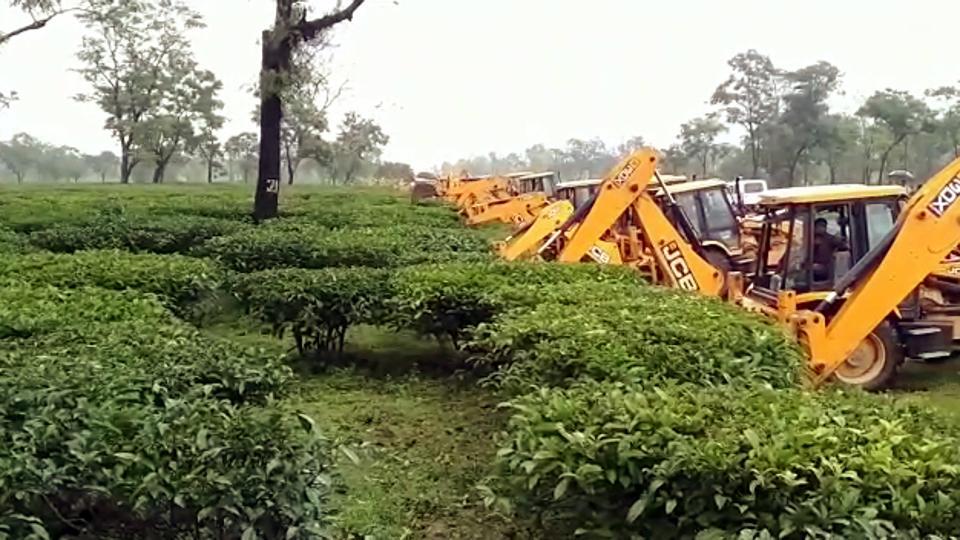
Hundreds of bulldozers started uprooting tea-plants in the presence of a large number of police, security force and other government officials on Thursday morning. Over three million plants are to be uprooted to construct the greenfield airport, according to authorities.
Assam chief minister Himanta Biswa Sarma in February this year announced that an airport will be built using a part of Daloo tea garden. The government has estimated to pay a sum of ₹50 crore to build the airport using 2500 bigha land of the tea garden. The owner has agreed to go ahead with the deal but workers are unhappy with the decision.
More than 2,000 workers of Cachar’s Daloo Tea Garden are protesting against it and they once said, the government has to kill them before destroying tea plants. They have been protesting since the announcement of the project and officials of the Cachar district administration reached out to them several times to convince them.
Administration after consulting with the tea garden owners, distributed pending money of Provident Fund ( ₹1.57 crores) and Gratuity ( ₹80 lakhs) among the workers. But the workers said, “This is our money which the owners are giving back, we can’t let them destroy tea bushes in return.”
Amid protest, the police started a huge flag-march in the tea garden led by deputy inspector general (DIG), southern Assam Kankanjyoti Saikia and superintendent of police of Cachar district Ramandeep Kaur.
Kaur assured that the Flag March was not to terrorise the garden workers, rather to build confidence. “It was done to build confidence because the government is planning to construct a huge airport. We do not intend to create fear amongst workers at all,” Kaur said on Tuesday evening.
There were speculations about when the uprooting process will commence. Thousands of workers continued the protest in front of the police’s flag march every day. On Wednesday evening, the deputy commissioner of Cachar district, Keerthi Jalli suddenly imposed 144 CrPC in Daloo Tea Estate and surrounding areas with a hint that eviction will begin soon.
Just after the notice surfaced, hundreds of JCB excavators were seen rushing towards Daloo tea garden. At around 5am on Thursday, police surrounded the selected part of the garden so that no worker could enter inside and the excavators started uprooting tea bushes.
The workers who attempted to stop the process looked helpless at one point. They started crying and begging in front of the security personnel and government officials. Police pushed them back from the area which was acquired by the government to build the airport.
Special DG (law and order), Assam police, GP Singh and SP Cachar Ramandeep Kaur are supervising the process. Kaur warned the workers not to disobey the government order.
She said that the agitating workers should talk to the administration about their demands clearly instead of agitating. “Some demands have already been addressed by the government and if there are more demands, the workers should talk. I am sure legitimate demands will get addressed,” she said.
An independent airport in Silchar (Cachar) has been in talk for quite a long period because the existing airport is old and acquired by the Defence ministry. Silchar MP Rajdeep Roy met the union minister for civil aviation Jyotiraditya Scindia several times with this demand before the Assam government officially announced the project.
According to the manager of Dalu tea estate, Supriya Sikdar, there are over nine thousand tea plants in each hectare and for construction of airport, 325 hectares of such land will be used. “Approximately 30 lakh tea bushes will be uprooted in this process but we have plans to use new areas for fresh plantation,” he said.
He claimed that rejuvenation is important for improving productivity of tea bushes, particularly of ageing ones. They agreed to go ahead with the government’s proposal because in this process, they’ll select a different area to plant new tea bushes.
MP Rajdeep Roy recently said that there are possibilities of Maoist connection behind the protest because all the recognised unions signed the MoU between the government and tea garden workers which allows clearing tea plants. Police officials, however, denied any Maoist link behind the agitation.


