E-Paper



At 150, IMD eyes hyperlocal forecast for climate extremes
IMD plans to enhance predictions of localized extreme weather through Mission Mausam, improving forecasts and resilience against climate change impacts.


The prediction of highly localised extreme weather events resulting from the climate crisis will be at the heart of India Meteorological Department’s planning for coming years, the agency’s head Mritunjay Mohapatra said Monday, ahead of celebrations of its 150th anniversary, which will also see the launch of an ambitious project, Mission Mausam, to help the country deal with extreme weather events, often the result of the climate crisis.
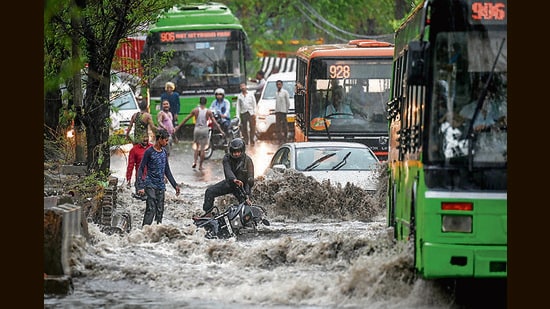
He added that while, overall, weather forecasts have improved by 40- 50% since 2014 , a new, more dynamic challenge has emerged. “Due to climate change, highly localised significant weather events are occurring so their prediction is also essential. These are very small scale, localised events. In one part of the city we are seeing extreme rain and no rain in other parts, these are difficult to predict and we wish to address it,” said Mohapatra, director general, IMD.
The impact of such events could be catastrophic.
For instance, at 1.30am on June 28, IMD issued a nowcast (immediate forecast) warning that said intense rain was approaching the city . Hours later, the city woke up to the highest rain it recorded in a day since 1936.
“The government announced Mission Mausam to make India weather ready. That is the comprehensive overall vision,” added Mohapatra.
The Union Cabinet, chaired by the Prime Minister Narendra Modi, approved “Mission Mausam“ with an outlay of ₹2,000 crore over two years in September last year.
Mission Mausam will be implemented by the Ministry of Earth Sciences and aims to boost India’s weather and climate-related science, research, and services. “It will help to better equip stakeholders, including citizens and last-mile users, in tackling extreme weather events and the impacts of climate change. The ambitious program will help broaden capacity and resilience across communities, sectors, and ecosystems in the long run,” a government statement said after the cabinet decision.
In some ways, the launch of Mission Mausam -- by Prime Minister Narendra Modi on Tuesday -- will mark another chapter in IMD’s history.
While India’s first meteorological observatory was established in 1793 (in Madras, now Chennai), it was only in 1875 that IMD was set up; soon after, in 1875, IMD set up a postal service based process for the collection of daily weather data at the national level. The first daily weather report was published in 1878.
As part of the Mission Mausam, India plans to improve the functioning of its weather office by integrating advanced observation systems, high-performance computing, and cutting-edge technologies such as artificial intelligence and machine learning. The mission is expected to benefit agriculture, disaster management, defence, environment, aviation, water resources, power, tourism, shipping, transport, energy, and health sectors.
“For localised events, we will mainly be using a dense network of radars, wind profilers, hydro-radiometers. There will be augmentation of observations, and hence we can expect further improvement in forecasts,” said Mohapatra.
Thus, from forecasting weather and documenting famines during the British era to significantly improving India’s cyclone prediction capabilities in the early 2000s, IMD will now focus on climate change.
“The British , while ruling the country, had a natural fascination for meteorological observations. By 1874, there were about 80 observatories across India. On January 15, 1875, IMD began an era of dedicated service to the nation. IMD was established against the backdrop of the havoc caused by a tropical cyclone in 1864 and two famines in 1866 and 1871. When IMD was established, its two priority areas were shipping and agriculture. In a country suffering from chronic droughts and erratic rainfall, IMD recognized the need to improve agricultural productivity and established a Division of Agricultural Meteorology as early as 1932,” recollects M Rajeevan, former secretary, ministry of earth sciences and climate scientist.
The accuracy of cyclone forecasts by IMD has increased from about 20% in the early 2000s to over 80% by 2020. “One of the best examples of IMD’s exceptional services is its tropical cyclone forecasts and warnings. After the devastating 1999 Odisha super cyclone, IMD’s cyclone forecasting capabilities improved substantially. In 1999, approximately 10,000 lives were lost in Odisha. But, in 2013, when a similar intense cyclone (Phailin) struck Odisha, fewer than 10 casualties were recorded,” added Rajeevan who hopes that IMD will improve forecasts of extreme rain events.
That’s one of the objectives of Mission Mausam.
For the first two years, IMD’s focus will be on full radar coverage and use of effective models.
“We want full radar coverage. No area should be left without radar. No weather system should go unnoticed including cloudburst disaster, lightning etc. We will install more wind profilers at least 15 in a year and radiometers. This will give temperature, humidity and wind profile till upper troposphere and we can understand diurnal variability. This will have a larger impact in weather forecasting. Finally, we wish to fuse numerical models, AI and machine learning (AIML) which will better predict local rhythm. Our aim is to provide highest resolution prediction up to panchayat level to help agriculture also,” said M Ravichandran, secretary, ministry of earth sciences.