E-Paper



Deepen regional ties: PM amid Ukraine war
Each member of Bimstec – the grouping includes Bangladesh, Bhutan, India, Myanmar, Nepal, Sri Lanka and Thailand – will lead activities under one pillar. India will handle the security pillar.

 Prefer HTon Google


NEW DELHI: India will take the lead in fostering security cooperation within a revamped Bimstec, with Prime Minister Narendra Modi on Wednesday emphasising the need to focus on regional security in the context of the conflict in Ukraine.
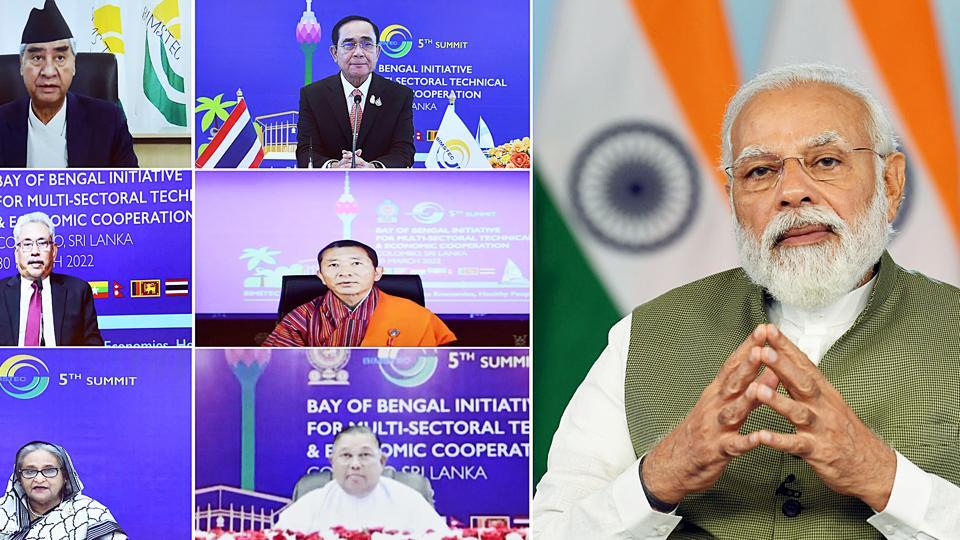
The main outcome of the virtual summit of the Bay of Bengal Initiative for Multi-Sectoral Technical and Economic Cooperation (Bimstec) was the adoption of the grouping’s charter. The seven member states also adopted a master plan for transport connectivity and decided to completely reorganise cooperation activities by focusing on seven pillars or specific areas.
Each member of Bimstec – the grouping includes Bangladesh, Bhutan, India, Myanmar, Nepal, Sri Lanka and Thailand – will lead activities under one pillar and India will handle the security pillar.
Addressing the televised opening session of the summit, Modi said the region has not remained untouched by the challenging global scenario, including the fallout of the Covid-19 crisis and the situation in Europe. He called for more active regional cooperation under Bimstec to address these challenges.
Also Read; At Bimstec meet, Jaishankar underlines new challenges due to Ukraine
“Our economies, our people are still suffering the effects of the Covid-19 pandemic. The developments in Europe over the last few weeks have raised a question mark on the stability of the international order...It has also become imperative to give more priority to our regional security,” Modi said, speaking in Hindi.
Modi described the adoption of the Bimstec charter as an important step towards an institutional architecture that envisages the holding of summits every two years and an annual meeting of foreign ministers. “Now we should focus our attention on how to make this architecture stronger,” he said.
He stressed the early implementation of the master plan for transport connectivity, which was prepared along with the Asian Development Bank (ADB). “Better connectivity is the mainstay of better integration, better business, better people-to-people relationships between us,” he said.
The member states have to simultaneously move on ongoing initiatives in connectivity and develop a legal framework to establish a “coastal shipping ecosystem” in the Bay of Bengal, Modi said. The time has come to “take electricity grid inter-connectivity ahead of discussions” and implement it on the ground, he added.
Modi welcomed a suggestion to form an eminent persons ‘group to prepare a vision document for Bimstec, and called for enhancing the grouping’s secretariat in Dhaka. “For this important work to be completed on time and as expected, India will provide financial assistance of $1 million to increase the operational budget of the secretariat,” he said.
He announced a separate contribution of $3 million to revive the BIMSTEC Center for Weather and Climate in Noida. The centre fosters cooperation in disaster management, especially disaster risk reduction.
Modi also called for early progress on a proposed Bimstec free trade agreement to enhance mutual business, and the adoption of international norms in trade facilitation to boost intra-Bimstec trade and economic integration.
The summit witnessed the signing of three agreements – the Bimstec convention on mutual legal assistance in criminal matters, a memorandum of understanding on mutual cooperation in diplomatic training, and a memorandum of association on establishing a Bimstec technology transfer facility.
Bimstec was established in June 1997 as BIST-EC (Bangladesh-India-Sri Lanka-Thailand Economic Cooperation) but cooperation among the member states moved slowly and the greater focus was on the South Asian Association for Regional Cooperation (Saarc). With Saarc becoming largely moribund because of differences between India and Pakistan, New Delhi began shifting its focus to other regional groupings such as Bimstec and Indian Ocean Rim Association (IORA).
Rudrendra Tandon, the additional secretary in the external affairs ministry looking after the Bimstec and Saarc divisions, told a media briefing that the adoption of the charter had capped a “process of formalising this grouping into a proper regional organisation”.
He added, “Bimstec now has an international personality, an emblem, a flag, a formally listed purpose and principles that it is going to adhere to, and an architecture. So that represents a fairly significant evolution of this grouping process which was happening since 2004 or so, but actually gained a lot of traction after 2014.”
Explaining how India will lead security cooperation under Bimstec, Tandon said New Delhi’s approach will focus on establishing the “highest quality norms” for combating terrorism, trans-national crime and other non-traditional crimes, and putting in place legal mechanisms needed to enable law enforcement agencies to collaborate closely to tackle these issues.
This includes agreements such as the convention on mutual legal assistance in criminal matters and establishing training collaboration among law enforcement agencies. The convention won’t “contradict” any bilateral mutual legal assistance treaties, and will instead supplement or do better than bilateral arrangements, Tandon said.
Asked about Myanmar’s presence at the virtual summit at a time when the country’s military junta has been shunned by other groupings, Tandon said the members of Bimstec are countries that are either geographically littoral to or dependent on the Bay of Bengal. “For the success of cooperation activities on this platform, we require all countries to be present and to participate in cooperation activities. Myanmar is an important constituent member of the Bimstec and it has very important geography,” he said.