
 E-Paper



Biden heads to his last Quad meet with a legacy of transforming, elevating group
Biden’s most steady partner in making the group what it is today has been PM Narendra Modi as a fellow-leader and agenda-setter

 Prefer HTon Google


In March 2021, within two months of taking over as America’s president, Joe Biden attended the first Quad leaders’ summit as he got together with the leaders of Japan, Australia and India in a virtual format. In September 2024, four months before he leaves office, Biden will head to New York where he will, in all likelihood, attend his final leaders’ summit of Quad.
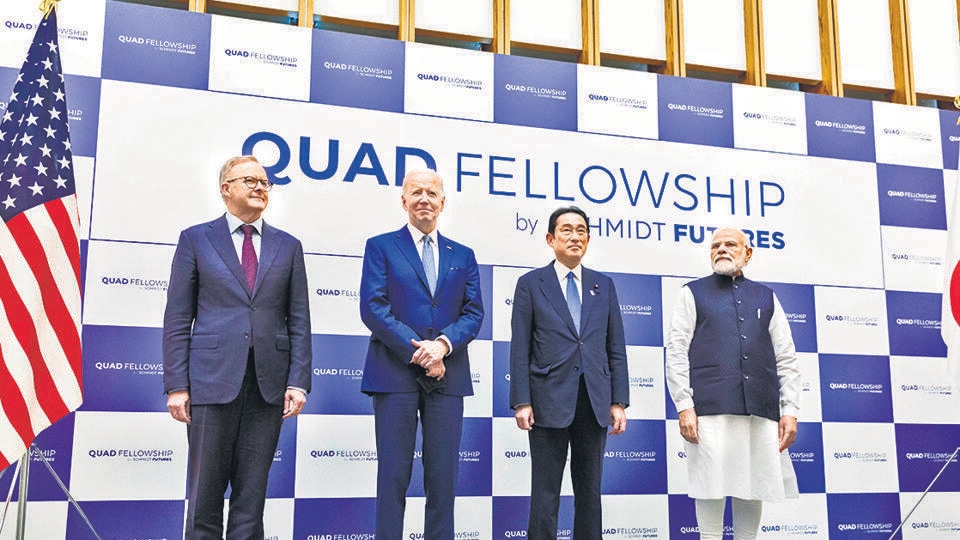
Elevating and transforming Quad, American officials believe, will be among Biden’s most important achievements. And Biden’s most steady partner in making the group what it is today has been PM Narendra Modi as a fellow-leader and agenda-setter, and the representative of the country that isn’t already an American treaty ally.
To be sure, the origins of Quad go back to 2004 tsunami, it went dormant in 2007, and the Donald Trump administration played a key role in reviving Quad at the official and ministerial level. But it is in the last four years that the loose grouping of the four countries — all united by the unstated objective of keeping Chinese belligerence at bay and stated objective of maintaining a free, open and prosperous Indo Pacific — has qualitative transformed because of its focus on what officials call “concrete deliverables”.
ALSO READ- Quad countries agree to expand maritime domain awareness initiative to Indian Ocean
In a recent interview, two US State Department officials told HT that since 2021, Quad has built on the “strategic alignment” between partners to focus on what the region says it needs and then deliver on it either “collectively or in a coordinated manner”. The US views the Indo-Pacific Maritime Domain Awareness (IPMDA) initiative; Quad’s work in the cyber, digital, infrastructure and training realm; and the humanitarian assistance and disaster relief (HADR) cooperation as significant milestones among Quad’s other achievements.
The US insists that the group is not an anti-China club, but that it offers choices to the region in terms of public goods, and claims this has helped erode the skepticism in Southeast Asia about Quad that China had deliberately encouraged. The US also believes that Quad’s current loose structure leaves room for flexibility, but that there are enough regular institutional exchanges to keep Quad’s momentum going. And the US, both State Department officials indicated, has been enthused by India’s role and participation.
ALSO READ- After Biden accused Russia of poll intervention, Putin 'endorses' Kamala Harris
The three big achievements
Asked about the three key achievements of Quad in recent years, a State Department official suggested that during the Trump administration, Quad had commenced discussions about strategic issues. “What we have seen in the past three years is a real move towards concrete deliverables. There are of course discussions on strategic issues and deeper alignment. But there is also focus in identifying the things that the region says it needs, and how Quad partners can deliver it collectively or in a coordinated manner.”
Among the most significant achievements, a second official said, is IPMDA. “It allows countries to have a better sense of what’s happening in their territorial waters. It allows them to track illegal fishing and criminal activity and crack down on them. It is a concrete way in which we are helping countries secure their economic interests and promote a free and open Indo-Pacific.”
In a joint statement released after they met in Tokyo at the end of July, Quad foreign ministers had said that they intended to expand IPMDA to the Indian Ocean. “We are working for early operationalization of the South Asia program through the Information Fusion Centre-Indian Ocean Region (IFC-IOR) in Gurugram, India.“ During defence minister Rajnath Singh’s visit to Washington last month, this effort got a further boost with India set to collaborate with HawkEye 360, a geospatial analytics company. A Pentagon statement said that secretary of defense Lloyd Austin and Singh had discussed the initiative meant to provide “unclassified, commercial satellite data to enhance their maritime security and ability to detect illicit activity”.
The strategic subtext is obvious, given the concerns about China’s activities across the Indian Ocean and Pacific Ocean and the first step to countering it is knowing what’s happening in the waters.
The second major achievement that US officials cited was work in the cyber and digital realm. This, according to the first official quoted above, included deploying open radio access network (ORAN) in Palau with the intention to do the same in the other countries. It included training with a number of exchange programmes “focused on building professional skill sets in the region”. Under the Quad partnership for cables connectivity and resilience, 1100 telecom officials and regulators have been trained; under the Quad infrastructure fellowships, which can also include digital infra, 2200 project developers and managers will be trained, with 720 fellowships already awarded; the second round of Quad fellowships in STEM disciplines have been awarded and include researchers from Southeast Asian countries.
The Tokyo statement also highlighted the establishment of the Quad cyber ambassadors meeting “to discuss responsible state behaviour in cyberspace”, a cyber capacity building conference in Philippines, a Quad cyber boot camp in India, collaboration on “mutual recognition of Quad partners’ labeling schemes for cybersecurity of Internet of Things”, a second Quad cyber security challenge to strengthen awareness across the region, discussions on supply chain security and resilience of critical infrastructure that has a strong cyber component, and examining “the transformational opportunities of secure digital public infrastructure to boost sustainable development while respecting human rights”. All of this, once again, has an unsaid component of taking on China’s threat in the cyber realm.
And a third achievement was Quad’s work in HADR, in a way returning the group to its roots when the four countries came together in the wake of the tsunami. “There has been great progress in bringing together the countries to announce a framework for HADR standard operation procedures,” said the first official. A tangible example of this was when Quad partners came together to help Papua New Guinea in the wake of a landslide in May. This again has an unsaid China component, for as climate shocks intensify and disasters increase, the first responder to help countries in distress will gain goodwill.
ALSO READ- Hunter Biden intends to plead guilty in $1.4m federal tax case, defence attorney says
The limits, the structure, the future
One critique that the Quad has faced is that it is torn between its security role and its developmental role, with the latter having become more prominent than the former. But officials have suggested that this assumption ignores the complexity of the intertwined strategic-technological-economic-developmental challenges in the region. Both strategic conversations can coexist with a focus on delivering public goods so that it didn’t become a “talk shop”, a danger that political leaders have warned officials to avoid.
In fact, this approach, US officials believe, has helped in allaying the second challenge that the group encountered — of early skepticism in parts of Southeast Asia about Quad. Recent surveys have shown a greater comfort level among the region’s elites with the group.
The first official said, “The skepticism itself was initiated by the very intentional narrative that PRC (People’s Republic of China) was putting out to the region. By delivering on tangible progress, we have come a long way in allaying those concerns. But it is important to note that those concerns come from narratives driven by PRC that Quad was aiming to undermine the existing regional architecture. What we have worked hard to do is demonstrate that Quad is meant to complement that architecture, address things that aren’t being addressed, fill spaces where there is a gap.”
A third issue Quad has faced is whether to create a more permanent institutional infrastructure or keep the group it as a somewhat loose arrangement. The second State Department official quoted above said that by keeping it the way it is at the moment, Quad has been “nimble”, it hasn’t been hampered by bureaucracy, and it has displayed “flexibility”. At the same time, there is a degree of slow institutionalisation that is already happening. Leaders are meeting annually, and countries have shown a willingness to adjust venues to factor in everyone’s convenience, as Australia did when Quad summit got shifted to Hiroshima in 2023 or India may do it if Quad is held in New York. Foreign ministers have met not only separately, but also on the sidelines of UN General Assembly in September every year. Quad ambassadors meet in different capitals. There are over ten Quad working groups on specific subjects that meet regularly.
“All these connections have helped develop habits of cooperation. As Secretary of State Antony Blinken says, there is diplomatic variable geometry at work — start with a problem, then work backwards. We talk to our Quad counterparts about the problem, what each country can bring to the table, and then address it,” said the first official.
ALSO READ- Russia's Vladimir Putin promises immediate ceasefire in Ukraine if…
The Indian role, Biden-Modi legacy
In all of this, American officials have been heartened by India’s warm embrace of Quad. The second official quoted above said, “India is a lot more invested than it ever was before. What I have seen is India’s increased engagement and commitment, and increase in ideas that India brings to the table.”
The official said that each sub region in the Indo-Pacific — Pacific Islands, Southeast Asia and South Asia — has its own unique challenges and while India is involved across the board, it plays a central role in identifying needs and how best to address them in South Asia and the Indian Ocean region. But India also performs a second role, as a voice of the global south, a fact that US appreciates.
Asked whether differences with India on the region affect cooperation, the second official said that it “reflects the maturity in ties” that both sides can have “honest conversations”, listen to each other and “agree to disagree” on specific issues. “We don’t agree all the time. But we are respectful of each other’s sensitivities”.
Given where Quad was in 2021 when Biden took over, and where it is as he wraps up, the US believes that this will be among his most lasting achievements. “What we are trying to do is drive forward what we stand for, examine what the region is looking for and what we can collectively deliver, and push forward a vision of what we are for, not what we are against. That gets us to a place where countries in the region welcome Quad,” the first official said.
This diplomatic creativity — of a group rooted in shared concerns about China that can frame its work as going beyond China to make all partners and others outside the fold comfortable — is the true Biden-Modi Quad legacy.


