
 E-Paper



BJP names tribal leader Mohan Charan Majhi as party’s 1st Odisha CM
BJP announces Mohan Charan Majhi as the next CM of Odisha, replacing Naveen Patnaik. Kanak Vardhan Singh Deo and Pravati Parida named deputy CMs

 Prefer HTon Google


Keonjhar lawmaker Mohan Charan Majhi will be the next chief minister of Odisha, the Bharatiya Janata Party (BJP) announced on Tuesday, making the 52-year-old tribal leader the first person from the party to helm the eastern state after winning a resounding victory in recently concluded assembly elections.
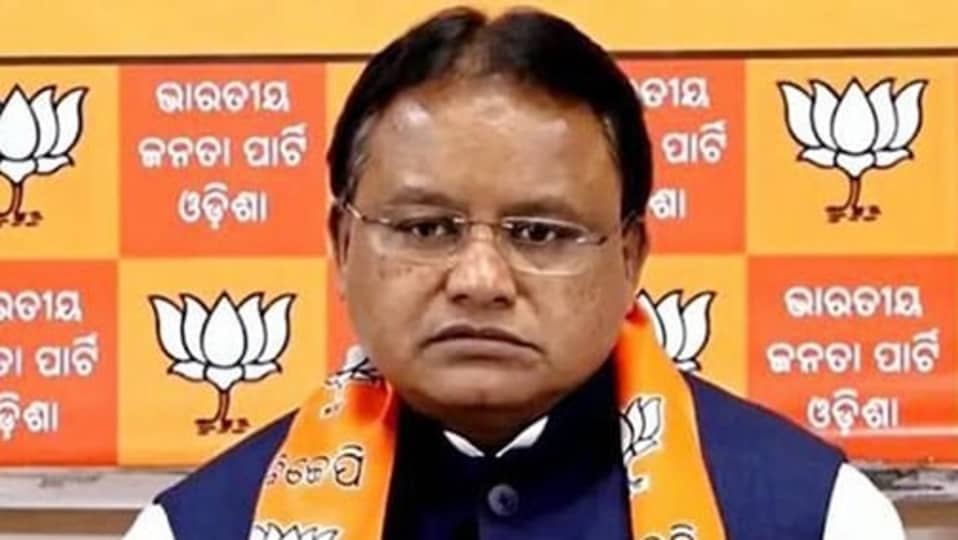
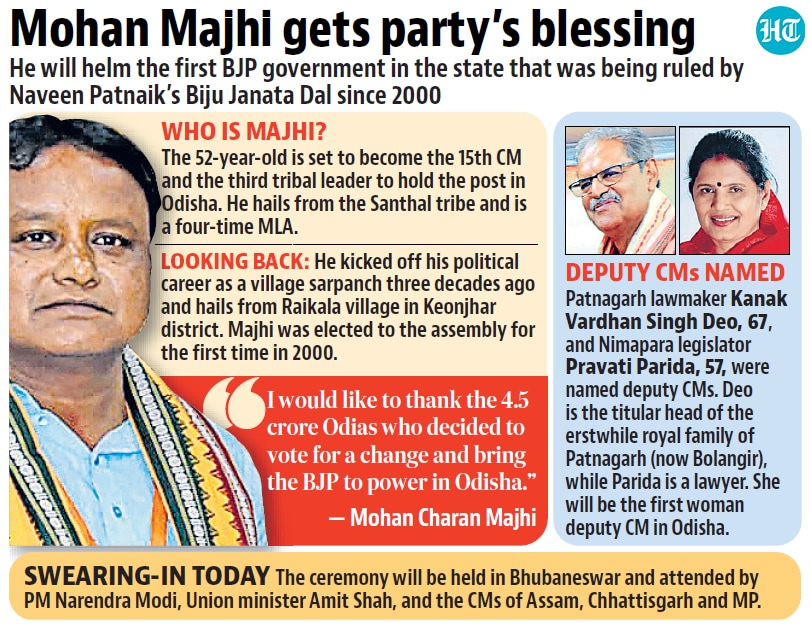
Majhi, who hails from the Santhal tribe and is a four-time MLA, will replace outgoing CM Naveen Patnaik who bowed out after ruling the state continuously for 24 years. The party also named Patnagarh lawmaker Kanak Vardhan Singh Deo, 67, and Nimapara legislator Pravati Parida, 57, as deputy chief ministers. While the former hails from the western part of the state, a BJP stronghold, the latter is from the coastal Puri district.
An emotional Majhi said the BJP will definitely honour the trust that the people of Odisha have shown. “Due to the blessings of Lord Jagannath, the BJP has achieved a majority in Odisha and is going to form the government in the state. I would like to thank the 4.5 crore Odias who decided to vote for a change and bring the BJP to power in Odisha. I thank Lord Jagannath, the reigning deity of Odisha,” he said.
The MLA from Keonjhar Sadar, a reserved constituency for tribals in the mining belt of Keonjhar, was unanimously chosen as the BJP’s legislature party leader at a meeting held at the Bhubaneswar party office in the presence of Union defence minister Rajnath Singh and Union environment minister Bhupender Yadav.
“Delighted to announce that Shri Mohan Charan Majhi has been elected unanimously as the leader of Odisha BJP legislature party. He is a young and dynamic karyakarta who will take the state forward on the road to progress and prosperity. Many congratulations to him,” Singh posted on X.
He will be the eastern state’s 15th CM and the third tribal leader to hold the post after Hemanand Biswal and Giridhar Gamang in a state where tribals form 22% of the population.
Majhi will helm the first BJP government in the state that was in the grip of Patnaik’s Biju Janata Dal since 2000. In the recently concluded assembly elections, the BJP won an impressive victory with 78 out of the 147 seats, with the BJD managing only 51. The BJP also won 20 out of the 21 Lok Sabha seats on offer, its biggest haul in the eastern state.
The chief whip of the BJP in the previous assembly, Majhi defeated Mina Majhi of the BJD by 11,577 votes from the Keonjhar Sadar constituency. Singh Deo defeated Saroj Kumar Meher of the BJD by 1,357 votes from Patnagarh, and Parida beat BJD leader Dilip Kumar Nayak by 4,588 votes from Nimapara.
ALSO READ- After poll debacle, Pandian says quitting active politics
Soon after he was declared the leader of BJP legislature party, Majhi met Odisha governor Raghubar Das as the CM-designate and was handed a letter appointing him as the new CM.
The swearing-in ceremony would be held on Wednesday afternoon at Bhubaneswar’s Janta Maidan which would be attended by Prime Minister Narendra Modi, Union home minister Amit Shah as well as the chief ministers of Assam, Chhattisgarh and Madhya Pradesh.
People familiar with the development said a factor that influenced Majhi’s selection was upcoming assembly polls in neighbouring Jharkhand where Santhals are a majority. By elevating a Santhal person as the country’s President and another a CM, the BJP wants to send a clear signal to the tribal community, a senior party leader said.
Majhi is considered among the state’s most articulate tribal leaders.
The tribal politician, who kicked off his political journey as a village sarpanch nearly three decades ago, hailed from Raikala village in the tribal-dominated and mineral-rich Keonjhar district. The son of a watchman, he was elected to the assembly for the first time in 2000.
The appointments followed the BJP’s recent strategy of naming CMs and deputy CMs in states it wins — as seen in Chhattisgarh, Madhya Pradesh and Rajasthan. Majhi comes northern Odisha, while Singh Deo and Parida belong to the western and coastal regions of the state respectively.
Deo is the titular head of the erstwhile royal family of Patnagarh (now Bolangir), while Parida is a lawyer. She will be the first woman deputy CM of the state.
ALSO READ- 'True Sevak never arrogant': RSS chief Mohan Bhagwat says decorum was not maintained during polls
Majhi began his career as a teacher in Saraswati Shishu Mandir, a chain of schools run by the Rashtriya Swayamsevak Sangh in Keonjhar. He started political career in 1997 after being elected as the chief of Raikala gram panchayat of Keonjhar district. The same year, he was appointed as the general secretary of BJP’s state adivasi morcha, and continues to hold that post.
In 2000, he won Keonjhar Sadar by defeating Congress candidate Jagdish Nayak. He retained the seat in the 2004 polls and again in 2019. He lost in 2009 and 2014.
ALSO READ- BJP begins process to elect new party chief, review Lok Sabha poll verdict
In 2008, Majhi was the first to raise voice on mining of iron ore and manganese from the Joda and Barbil area of Keonjhar that led to investigation by retired Supreme Court judge, justice MB Shah. “He played a key role in uncovering the scam that ran into nearly ₹60,000 crores as estimated by the Shah Commission. He asked so many questions in the assembly that then CM Naveen Patnaik once asked him why he was so keen on mining issues,” said wildlife activist Biswajit Mohanty.
Singh Deo was a minister in the Naveen Patnaik government when the BJD and BJP were in alliance between 2000 and 2009. Parida, a senior leader of the party’s women’s wing, is a debutant MLA.



