
 E-Paper



Can’t abandon victims: Govt to seek additional aid in Bhopal tragedy
The government was conveying its decision after it had sought some time from the five-judge bench on September 19 to make up its mind on pursuing the petition.

 Prefer HTon Google


Emphasising that it cannot abandon the victims of the 1984 Bhopal gas tragedy, the Union government on Tuesday told the Supreme Court that it has decided to pursue the case against Union Carbide for additional compensation.
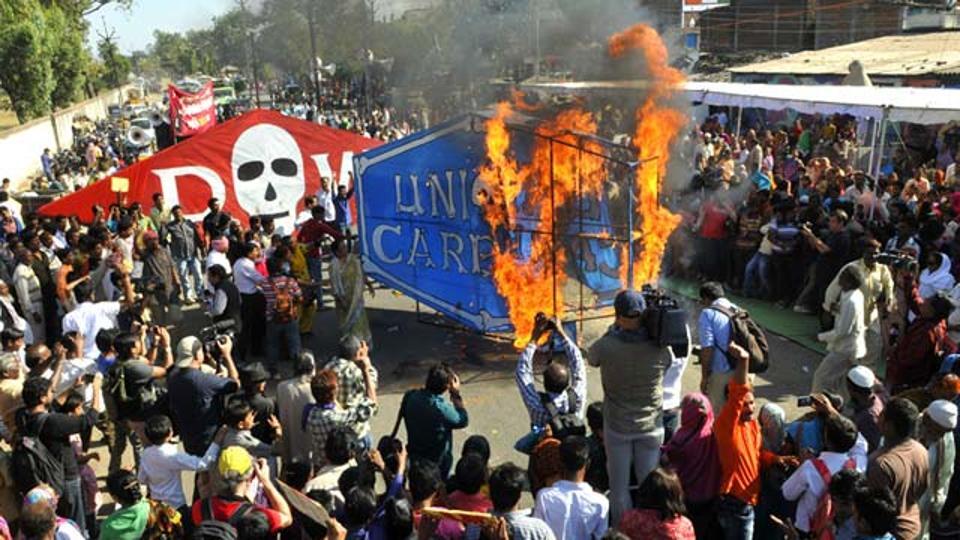
A constitution bench, headed by Justice Sanjay Kishan Kaul, was informed by Attorney General R Venkataramani that the Centre will press its curative petition that was filed in 2010 seeking compensation over and above the $470 million already paid by Union Carbide, which is now a wholly owned subsidiary of The Dow Chemical Company.
“We are keen on pursuing the curative petition. The government cannot abandon the victims. It is a tragedy unfolding everyday,” Venkataramani submitted before the bench, which also comprised justices Sanjiv Khanna, AS Oka, Vikram Nath and JK Maheshwari.
The government was conveying its decision after it had sought some time from the five-judge bench on September 19 to make up its mind on pursuing the petition.
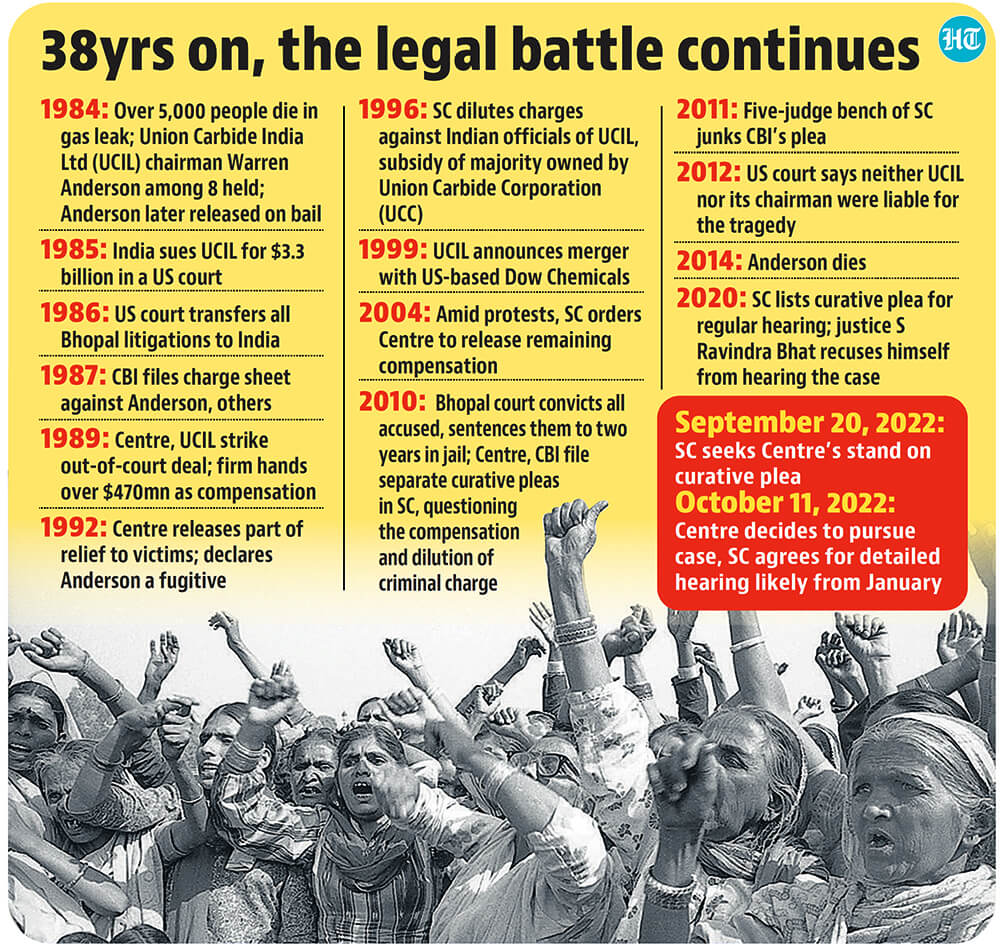
Through the curative plea in 2010, the government sought a reconsideration of the May 1989 judgment and a 1991 order of the Supreme Court, arguing that the 1989 settlement was grossly inadequate. It sought additional funds of over ₹7,400 crore from the chemical company, which was held accountable for the loss of more than 5,000 lives on the night intervening night of December 2-3, 1984 when the highly dangerous and toxic gas, Methyl Isocynate (MIC), escaped from company’s plant in Bhopal.
Appearing before the bench on behalf of the Union government on Tuesday, AG Venkataramani further submitted that there is a lot of materials and literature on various aspects of liabilities and damages that he would want to cite when the case is finally argued.
“The government wants to proceed but will need some time to put all the materials on record. I have gone through considerable literature on the reopening of settlement and I would wish to place a note for my lords,” the law officer added.
Appearing for some NGOs and victims’ organisations, senior counsel Sanjay Parikh and advocate Karuna Nundy commended the Centre’s stand while making their request to be heard in the matter. They argued it were such organisations which had filed the review petition against the top court’s main judgment in 1989, and thus kept the case alive.
Representing the chemical company, senior advocate Sidharth Luthra and some other lawyers questioned the maintainability of the pleas filed both by the Union government as well as other organisations.
The company pointed out that while the government never filed a review petition, it chose to pursue a curative petition 19 years later. “On the other hand, the NGOs and other groups filed a review petition but did not file a curative petition. We object to the maintainability of both the curative petition as well as the applications of impleadment by the organisations,” argued the lawyers.
On this issue, AG Venkataramani submitted that the Centre does not have any objection to anyone arguing the matter. “It is a question of adequacy of compensation. On what parameters the adequacy of compensation can be reopened is something that the Union government will have a larger role to argue on,” he added.
The constitution bench then proceeded to record in its order , the Centre’s willingness to pursue the matter against Union Carbide for additional compensation, and laid down other modalities for the detailed hearing which is expected to begin from January 10. All parties have been asked to prepare a joint compilation that will comprise case records, judgments to be relied upon and other relevant materials, besides the written submissions of the chief points to be argued. The AG also sought a liberty to place on record the updated factual position regarding the victims and the compensation given so far.
In 2010, separate curative petitions were filed by the Centre and the Central Bureau of Investigation questioning the compensation and the dilution of the criminal charge against the accused. The government sought enhancement of damages, claiming the compensation decided in 1989 was on the basis of a preliminary assessment that there were 3,000 deaths, 20,000 people suffering from serious injuries and 50,000 from minor ones. It said the death figure had risen to 5,295, with 35,000 people suffering from serious injuries and 5.27 lakh from minor ones.
CBI, in its petition, questioned the “colossal failure of justice” in 1996 when the top court chose to dismiss the 1984 Bhopal gas tragedy as a result of an act of negligence, and not culpable homicide, by former Union Carbide chairman Warren Anderson and his Indian employees. Anderson died in 2014.
While the curative petition by the Centre remained pending, a five-judge bench junked CBI’s plea in May 2011 noting no fetters were placed by the Supreme Court on a trial judge to approve prosecution of accused under any charge if the prosecution could adduce appropriate materials and that its 1996 judgment was based on the evidence till that stage. The court also held that “no satisfactory explanation has been given to file such curative petitions after about 14 years from the 1996 judgment.”



