
 E-Paper



Central teams review Covid-19 crisis in Kerala; suggest tracing, containment
The target of the central team was to specifically look at areas of testing, contact tracing including surveillance and containment, Covid-19 appropriate behaviours, availability of hospital beds, sufficient logistics including ambulances and Covid-19 vaccination progress.


The central teams which were recently sent to Kerala to review the coronavirus disease (Covid-19) crisis in the state suggested enhanced testing, contact tracing, containment measures to deal with the recent surge in infection. Along with these steps, proper hospital infrastructure like ICU and ventilator beds also need to be augmented on an urgent basis, said the multi-disciplinary teams sent by the central government to Kerala.
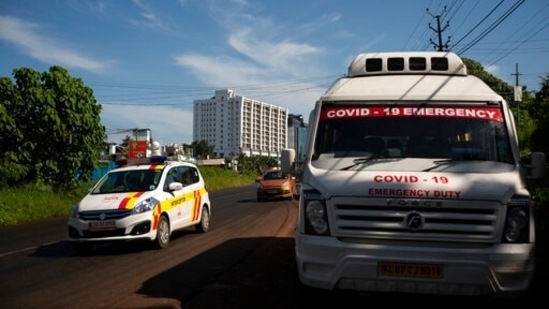
"Kerala's 14 districts are presently reporting more than 20,000 cases per day and according to May' 2021 data, over 80 per cent of circulating strains are of the Delta variant," read a draft report published by the central multi-disciplinary team that reached Kerala on July 30, 2021.
News agency ANI accessed the aforementioned report on Wednesday and revealed the observations made by the central teams during its review.
The target of the central team was to specifically look at areas of testing, contact tracing including surveillance and containment, Covid-19 appropriate behaviours, availability of hospital beds, sufficient logistics including ambulances and hospital-wise case fatality analysis, and Covid-19 vaccination progress.
In their report, the central teams recommended that clusters and super events, whenever suspected or reported should be investigated by district-level RRT. They also recommended that "RAT testing at an expanded level should be implemented to ensure saturation testing and reduce lag in the report, the re-categorisation exercise should ideally be undertaken every 14 days, vaccination, the system of whole house isolation to break the chain."
"It was indicated by State officials that due to effective home isolation and containment strategies followed after the first wave of Covid-19, the population remained largely unexposed. This is also suggested by a recently conducted sero-surveillance study by ICMR. In it, Kerala ranked last with only about 44 per cent of the population showing antibodies against Covid-19," said the report.
According to the report, in Kollam, the Positivity rate is relatively lower in coastal and tribal areas but the bed occupancy rate in the district is quite high with nearly 80 per cent of O2 beds occupied (in government setup).
Samples sent for whole-genome sequencing (WGS) were lowest in Kollam among all districts of the State.
However, in Thiruvananthapuram as per the report and data shared by the State, as of July 30 with the central team, the number of cases/deaths reported was 331147 and 3229 deaths. The Case Fatality Rate (CFR) of the district was highest at 0.98 per cent.
In the Malappuram District, the report stated, "case detection is mainly through testing of those reporting to health facilities with Covid like illness. There is no active surveillance to detect cases." "The contact tracing is abysmally low with a case contact ratio of 1:1.5. This is more so important as the average family size in this district is above 5, implying even the primary contacts are being missed out. This lack of contact tracing results in an undetected pool of asymptomatic/ mildly symptomatic individuals in the community," the report stated.
In Kozhikode District, as per the report, the case detection is mainly through testing of those reporting to health facilities with Covid like illness.
"There is no active surveillance to detect cases. The contact tracing is abysmally low with a case contact ratio of 1:1.2. The lack of contact tracing results in an undetected pool of asymptomatic or mildly symptomatic individuals in the community," the report said.
Among those who tested positive, over 85 per cent are in home isolation.
In the Kannur district, there are 5998 active cases. The Test Positivity Rate (TPR) is 13.72 per cent (for the week ending 31st July 2021). The case detection is mainly through testing of those reporting to health facilities with Covid like illness. There is no active surveillance to detect cases.
The team was divided into Team - 1 for Southern districts of Kerala and Team - 2 for Northern Districts.
While Team 1 visited Alappuzha, Kollam, Pathanamthitta, and Thiruvananthapuram districts of Kerala, Team 2 visited Malappuram, Kozhikode, Kannur, and Kasargod districts of the state.
The Central teams included the following experts, Dr Sujeet Singh, Director, NCDC, Dr P Ravindran, Former DDG, Dr S. K. Jain, Advisor (PH), NCDC, Dr K. Regu, Addl. Director, Kozhikode Branch, NCDC, Dr Pranay Verma, Joint Director, NCDC, and Dr Ruchi Jain, Public Health Specialist.
Kerala on Tuesday recorded 23,676 new Covid-19 cases and 148 deaths.


