
 E-Paper



Centre’s detailed security planning ensured peace post-Ayodhya verdict
Three days after the Ayodhya verdict and serious concern among both communities of a possible breakdown of law and order, peace is holding despite continuous instigation from Pakistan-based terror groups, particularly the Jaish-e-Mohammed (JeM).

 Prefer HTon Google


Exactly 24 hours after Saturday’s historic Ayodhya judgment by the Supreme Court, Uttar Pradesh director general of police (DGP) Om Prakash Singh sent a message to all his 75 district police chiefs to go and pat the backs of men deployed at five static police posts of their choice for upholding law and order. He also directed the district chiefs to ensure adequate rest for men of the overstretched 300,000-strong police force.
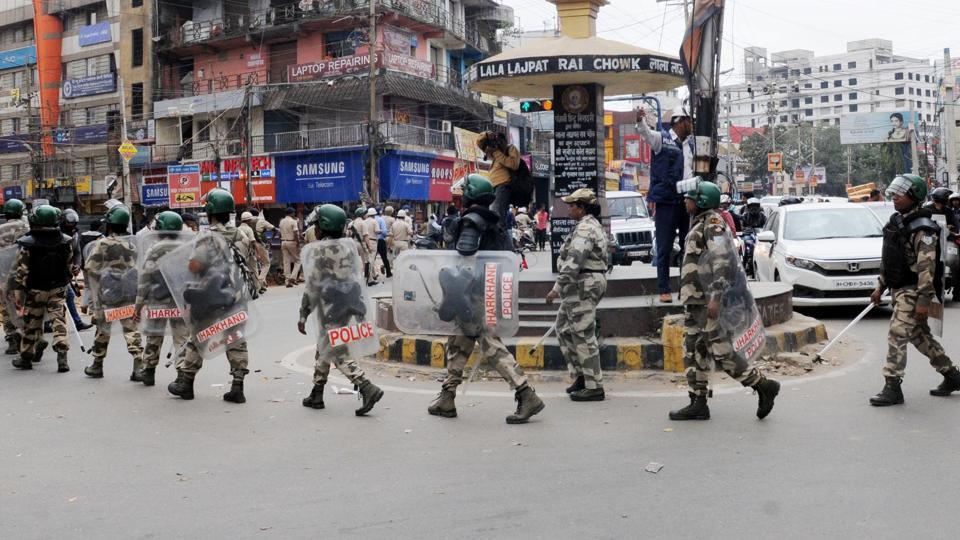
Three days after the verdict and serious concern among both communities of a possible breakdown of law and order, peace is holding despite continuous instigation from Pakistan-based terror groups, particularly the Jaish-e-Mohammed (JeM). Unlike the aftermath of the December 6, 1992 demolition of the disputed structure in Ayodhya, when large parts of the country erupted in communal violence, the Ayodhya court verdict has been taken as closure by the two communities.
The peace was achieved through meticulous security planning and clear-cut directions from both Prime Minister Narendra Modi and home minister Amit Shah to the state administration, paramilitary forces and intelligence agencies.
Also Watch | Ayodhya ruling | PM to Opposition, litigants to babas: How India reacted
The national security apparatus was galvanised by National Security Advisor Ajit Doval, who is not accompanying PM Modi to the BRICS (Brazil, Russia, India, China, South Africa) summit in Brazil this week and staying put in Delhi to monitor the situation in both Ayodhya and Kashmir.
UP chief minister Yogi Adityanath, along with DGP Singh, handled the law and order in a state which had over 16,000 communal hot spots and 31 districts categorised as ultra-sensitive and 16 as sensitive. The state police identified 1,700 places where religious radicalization or communal incidents had taken place. Simply put, the state is a security nightmare for planners.
The plan to ensure peace and tranquillity post the Ayodhya judgement was put in place by the Centre, including the minority affairs ministry, and the state administration at least a month in advance with all sides engaging religious and intellectual leaders of both communities. Muslim community leaders had proved their mettle in the past when they engaged their flock in ensuring that their youth did not join the rabid Islamic State. It is to their credit that hardly 100 men were won over by the group in a country with over 180 million Muslims.
With 24 X 7 backup from the Research and Analysis Wing (RA&W), Intelligence Bureau and Military Intelligence, the UP state police led from the front, with more than 10,000 meetings being held with community leaders at the level of police stations and districts. The communication plan app, or C-PLAN, developed as a pilot by UP police, came to the aid of police stations with over 20,000 volunteers linking to the app and keeping in touch with police stations. Reinforcing them were 283,000 digital volunteers , who acted as the eyes and ears of the law enforcement agencies so that ground intelligence was obtained in real time. For each police station, there were 200 digital volunteers and 10 C-PLAN app users to help secure peace.
UP police also mounted aggressive cyber patrolling to ensure that no misinformation or fake news was spread through content platforms via the internet. Barring a planned five-hour outage in Aligarh, the internet was working in UP as the state police engaged more than 300,000 users for trying to disturb the peace. As many as 600 accounts were blocked, 42 cases registered and 77 persons taken into custody for posting objectionable material by the state police as cyber cells in all districts went into hyper drive. The objective was clear -- that no communal incident should take place; human lives took precedence over cyber liberty.
With the law and order situation under control as of now, the state police, aided by security agencies, have not gone back to their barracks but is actively engaged in patrols on the ground and in cyber space to prevent any communal flare-up. Law enforcement has been helped by leaders of the two communities, who have been successful in sending a message of peace and communal harmony.
The Ayodhya chapter, it seems, has finally closed, with the past burying its dead.


