
 E-Paper



Chhattisgarh seals kiln after probe finds safety lapses in Balodabazar steel plant blast
An explosion at M/s Real Ispat and Energy Pvt. Ltd.’s dust-settling chamber around 9.40 am on Thursday killed six workers and left five with serious burn injuries


Raipur: The Chhattisgarh government has sealed Kiln No. 1 of a steel plant in Bakulahi village of Balodabazar-Bhatapara district after a preliminary investigation by the industrial health and safety department found violations of safety norms at the site of the explosion that killed six workers and injured five on Thursday.
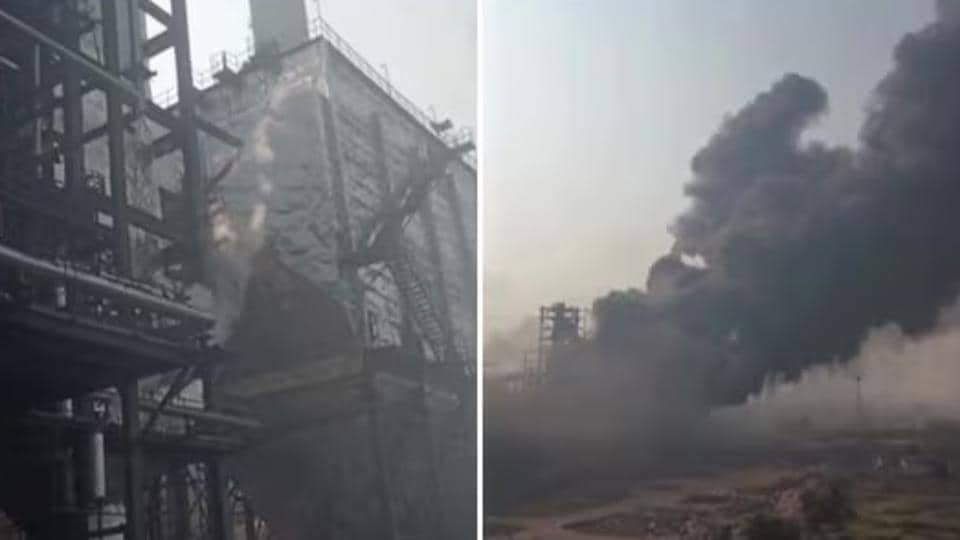
The explosion took place at M/s Real Ispat and Energy Pvt. Ltd.’s dust-settling chamber on Thursday around 9.40 am. Six workers died on the spot, while five others sustained serious burn injuries, said district collector Deepak Soni.
Acting on the directions of chief minister Vishnu Deo Sai, authorities ordered an immediate ban on the operation and maintenance of the kiln under the Factories Act after a preliminary probe found that standard operating procedures were not followed at the site of the explosion.
“The probe found that workers were made to carry out high-risk operations without shutting down the kiln. The hydraulic slide gate of the dust-settling chamber was not closed, proper work permits were not issued, regular maintenance was lacking, and mandatory safety gear such as heat-resistant aprons, safety shoes and helmets was not provided. Adequate safety training and supervision were also absent,” an official statement said.
According to officials, the explosion took place on the second floor of the dust-settling chamber of Kiln No. 1 during maintenance work. “A sudden blast, followed by a shower of hot ash at temperatures ranging between 850 and 900 degrees Celsius, killed six workers on the spot and caused severe burn injuries to five others,” an official said.
A joint team of deputy directors and officers from the Industrial Health and Safety Department inspected the factory and the accident site in the presence of representatives of the factory management.
The statement added that manufacturing and maintenance activities at Kiln No. 1 posed an “imminent danger”. Consequently, under Section 40(2) of the Factories Act, 1948, all operations and maintenance work related to the kiln have been prohibited. The ban will remain in force until the management ensures all required safety measures and submits certified compliance documents. The order also mandates that workers be paid their due wages and allowances during the prohibition period.
Meanwhile, the factory management has announced compensation of ₹20 lakh to the family of each deceased worker and ₹5 lakh to each injured worker. In addition, families of the deceased will receive an average of ₹10 lakh from the Employees’ Compensation Fund and an average of ₹15 lakh in pension benefits over the coming years from the Employees’ State Insurance Corporation (ESIC). Injured workers will also receive subsistence allowance through ESIC until they are declared fit to resume work. Overall, the family of each deceased worker will receive an average compensation of about ₹45 lakh, officials said.
Authorities said prohibitory action has been taken in the interest of safety and that law and order remains peaceful in and around the factory premises.
The deceased were identified as Vinay Bhuiya (39), Badri Bhuiya (52), Sundar Bhuiya (49), Shravan Bhuiya (22), Jitendra Bhuiya (37) and Rajdev Bhuiya (22), all residents of Gotibandh village in Bihar. The injured include Ramu Bhuiya (37) and Kalphu Bhuiya (45) of Gotibandh village in Bihar, and Sarafat Ansari (32), Mumtaz Ansari (26) and Sabir Ansari (34), residents of Rajhara village in Jharkhand.
The injured workers were admitted to the Chhattisgarh Institute of Medical Sciences (CIMS), Bilaspur, on Thursday, with one later referred to Raipur for further treatment.
A probe team headed by the sub-divisional magistrate, comprising officials from the industry department, industrial health and safety, police and revenue departments, is investigating the incident.
-kW0H-U20214218012MgB-250x250%40HT-Web.jpg)


