
 E-Paper



CJI-led top court bench to hear Sabarimala petitions
Besides CJI Bobde, the bench will comprise justices R Banumathi, Ashok Bhushan, L Nageswara Rao, Mohan M Shantanagoudar, S Abdul Nazeer, R Subhash Reddy, BR Gavai and Surya Kant. The hearing in the matter is slated to commence on January 13.


A nine-judge bench headed by Chief Justice of India SA Bobde will hear the petitions concerning the entry of women between the age group of 10 and 50 into the Sabarimala temple in Kerala.
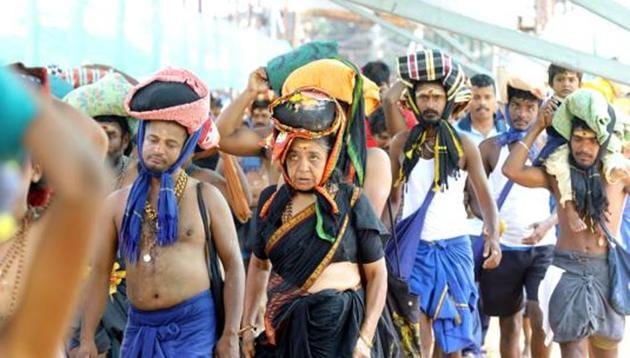
Besides CJI Bobde, the bench will comprise justices R Banumathi, Ashok Bhushan, L Nageswara Rao, Mohan M Shantanagoudar, S Abdul Nazeer, R Subhash Reddy, BR Gavai and Surya Kant. The hearing in the matter is slated to commence on January 13.
On September 28, 2018, a five-judge Constitution bench of the Supreme Court headed by then Chief Justice Dipak Misra struck down Rule 3(b) of the Kerala Hindu Places of Public Worship (Authorisation of Entry) Rules, 1965, which was the basis for barring entry of women between the ages of 10 and 50 years into the Sabarimala temple. The rule was held to be violative of the right of Hindu women under Article 25 to practice their religion.
Women of reproductive age were restricted from entering the shrine in south Kerala’s Pathanamthitta district because its presiding deity, Lord Ayyappa, is considered to be a celibate.
Nearly 60 review petitions were filed against the 2018 judgment, which were heard in open court by the Supreme Court.
The court eventually passed an order on November 14 last year stating that review petitions will be kept pending till the court answers similar issues in three other cases pending before the top court.
One was on entry of Muslim women in a Mosque and another case was on entry of Parsi women married to non-Parsi men into the holy fire place of an Agyari. The third case, the court noted, was regarding the practice of female genital mutilation amongst the Dawoodi Bohra community.
Thus, the court said that the issues concerning women’s rights vis-à-vis religious practices require consideration by a larger bench of not less than seven judges so as to ensure that a judicial policy is evolved to do substantial and complete justice.
“The decision of a larger bench would put at rest recurring issues touching upon the rights flowing from Articles 25 and 26 of the Constitution of India,” the judgment had stated.
As per the causelist, available on the Supreme Court website, the hearing before the 9-judge bench will be limited to the legal issues referred to the larger bench by the 5-judge bench in its November 2019 judgment. Rule 3(b) of the Kerala Hindu Places of Public Worship (Authorisation of Entry) Rules, 1965, was challenged before the Supreme Court in 2006 for violation of right to equality of women under Article 14 and the right to practice religion under Article 25.
The Left front government in Kerala which attempted to implement the judgment of the court by facilitating the entry of women into the temple came under fire from devotees, and the Bharatiya Janata Party and the Congress which accused it of hurting religious sentiments of Hindus.
After the court’s 2019 verdict was delivered, two women from Kerala petitioned the apex court seeking police protection to enter the temple. When those petitions came up for hearing on December 13 last year, the court despite acknowledging that there is no stay of its 2018 judgment, refused to pass any directions to facilitate entry of women into the temple for the time being stating that it is an “emotive issue” which could escalate tensions in the state. The bench headed by CJI Bobde, however, agreed to constitute a bench at the earliest to hear the matter.


