E-Paper



‘Cong, its ecosystem angry’: PM Modi slams backlash on puja with CJI
Prime Minister Narendra Modi on Tuesday said the Congress and its “ecosystem” were angry with him for participating in Ganesh Puja.

 Prefer HTon Google


Prime Minister Narendra Modi on Tuesday said the Congress and its “ecosystem” were angry with him for participating in Ganesh Puja and dismissed the Opposition’s criticism of his presence at Chief Justice of India (CJI) Dhananjaya Y Chandrachud’s residence for this last week.
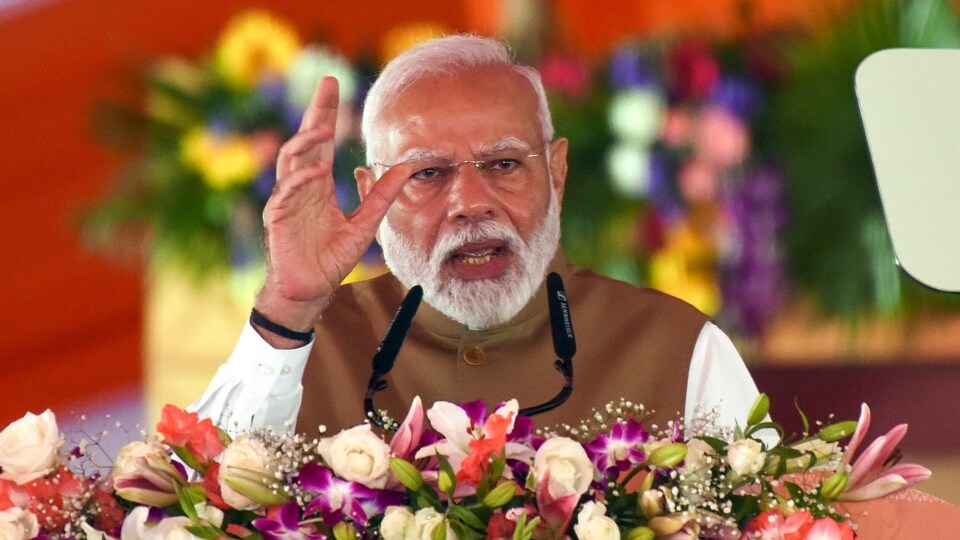
“Ganesh Utsav is not just a festival of faith for our country. It played a very important role in the freedom movement,” Modi said at a rally in Bhubaneswar, where he inaugurated a slew of projects to mark 100 days of the National Democratic Alliance (NDA) government’s third term at the Centre.
The Prime Minister’s reference is to the fact that it was Bal Gangadhar Tilak who elevated the festival to a public one, facilitating interaction between people from various strata of society at a time when such gatherings were strictly regulated by the British or not possible because of the country’s rigid caste system.
Equating the Congress with the British, Modi said, “Even at that time, the British who followed the policy of divide and rule used to hate Ganesh Utsav. Even today, the power-hungry people, who are busy dividing the society, are having problems with Ganesh Puja. You must have seen that the people of Congress and its ecosystem are angry because I participated in Ganesh Puja.”
Read more: Modi calls oppn 'power hungry' on row over attending Ganesh Puja at CJI's house
The Prime Minister’s visit to CJI Chandrachud’s residence in Delhi for a Ganesh Puja on September 11 triggered a massive controversy and sparked divisions within the legal community. Opposition parties and some lawyers have questioned the propriety of such a meeting even as the PM’s Bharatiya Janata Party (BJP) and other lawyers have dismissed the criticism as unwarranted.
Modi, during his address to the gathering in Bhubaneshwar, also said that Lord Ganesh was “put behind bars” in Congress-ruled Karnataka. “The whole country is disturbed because of the picture,” he said, referring to a viral photo of a Ganesh idol in a police van in the southern state.
“We cannot let these hateful elements move forward,” he added.
He was referring to the recent communal clashes in Nagamangala town of Mandya in Karnataka during a Ganesh idol immersion. Public works department minister Satish Jarakiholi earlier slammed Modi when he made similar remarks. “What else does he have to talk about? We have over 60,000 Ganesha idols installed in the state. There might be isolated incidents, but the police will handle them,” Jarakiholi said.
Modi said when the British tried to divide the country based on caste and religion, Tilak organised Ganesh Utsav (festival) and awakened the soul of the country. “Ganesh Utsav teaches us how to remain united and rise above caste and religion… even today, all sections of people in our society participate in Ganesh Utsav without any discrimination. The entire society stands united during the festival,” he said.
The Congress hit back at Modi over his remarks and accused him of misusing religion for political gains ahead of the assembly elections in Maharashtra, where Ganesh Chaturthi is one of the most significant and widely celebrated festivals.
“The difference between true bhakti (faith) and misuse of religion for politics is not hidden from anyone. Just when Maharashtra elections are around the corner, the non-biological PM decides to go with an elaborate camera crew, in full Maharashtrian attire, for the Ganesh Puja. Not only that, this is to the CJI’s house, in contravention of all principles of judicial separation. Did the PM not think about the message that will go across?” Congress general secretary, in-charge organisation K C Venugopal said.
Such proximity between the chiefs of the executive and the judiciary raises doubts about the Prime Minister’s intentions, he added.
On Tuesday, which was also his 74th birthday, Modi unveiled railway and national highway projects worth over ₹3,800 crore to mark 100 days of the third term of the NDA government.
He also launched the Odisha government’s flagship women-centric programme Subhadra Yojana that seeks to provide ₹50,000 to all eligible women between the age of 21-60 years over a period of five years between 2024-25 and 2028-29. The scheme, which was a part of the BJP’s manifesto in the run up to the elections, is expected to cover more than 10 million beneficiaries. On Tuesday, 2.5 million women got the first tranche of ₹5,000 under the plan.
Modi also released the first installment of assistance to nearly one million beneficiaries under the Pradhan Mantri Awas Yojana (Gramin) across 14 states.
He said the promises made by the BJP before the elections in the state earlier this year were being fulfilled at a “rapid pace”. “In the first 100 days of the third NDA government, major steps were taken for uplift of the poor, farmers along with empowerment of women,” he said. “I am happy that Odisha government started its work by announcing the Subhadra Yojana for women. Women’s empowerment will be the key to Odisha’s development,” he added.
Sharing his experience after he was offered ‘kheeri’ (a rice-based sweet dish) by a tribal family on the occasion of his birthday, Modi said, “When my mother was alive, I used to visit her and seek her blessing on my birthday. She used to give me jaggery. Today, I got the blessings of a tribal mother who offered me ‘kheeri’. The happiness of tribals gives me strength to work for them,” he said.
Modi also spoke about the efforts of Sardar Vallabhbhai Patel in uniting the country, to mark Hyderabad Mukti Divas or ‘Hyderabad Liberation Day’, on September 17.
“Foreign powers wanted to break the country while opportunists agreed to break the country into pieces. In that situation, Sardar Vallabhbhai Patel came forward and united the country by showing extraordinary willpower. Hyderabad was freed by curbing the anti-India fundamentalist forces there,” he said.