
 E-Paper



PFI-like ban on Bajrang Dal in Cong’s manifesto
In its election manifesto, the Congress also pledged to work on the aspirations of marginalised caste groups and hike the quantum of reservation to 75%

 Prefer HTon Google


The Congress on Tuesday likened the Bajrang Dal to the now-banned Popular Front of India (PFI) and said the party was committed to taking decisive action, including imposing a ban, on outfits spreading hatred among communities, stoking a political row just a week ahead of the high-stakes Karnataka assembly elections.
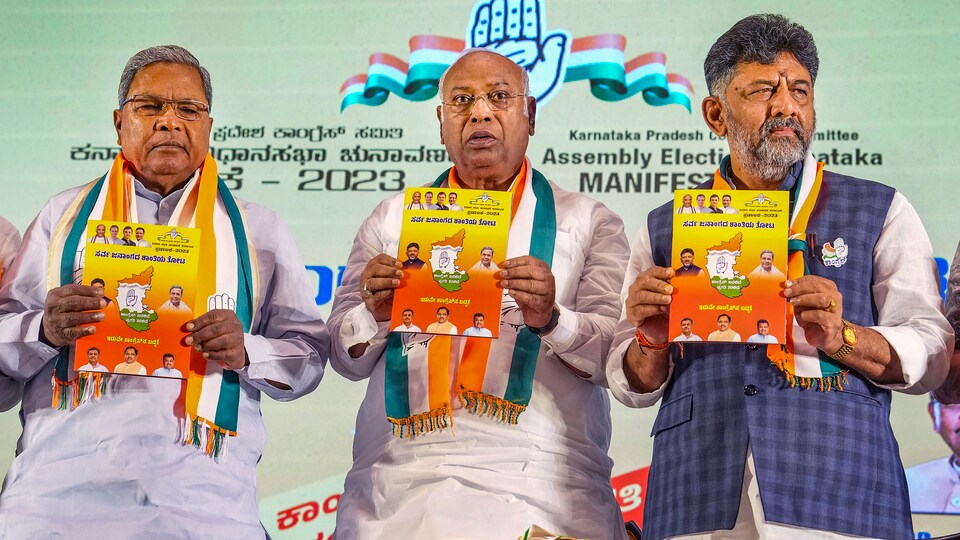
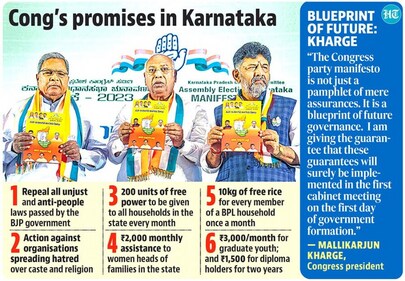
In its election manifesto released on Tuesday, the Congress also pledged to work on the aspirations of marginalised caste groups and hike the quantum of reservation to 75%, extend the old pension scheme to government employees, give 200 units of free power to all households, free rice to poor families, and cash allowances to women and educated young people.
But a promise on page 11of the 62-page document garnered the most attention.
The Congress said it is committed to take “firm and decisive action” against individuals and organisations “spreading hatred amongst communities on the grounds of caste and religion”.
Read here: Tejasvi Surya's 'I am Bajrangi, ban me' challenge after Cong manifesto release
“We believe that law and Constitution are sacrosanct and cannot be violated by individuals and organisations like Bajrang Dal, PFI or others promoting enmity or hatred, whether among majority or minority communities. We will take decisive action as per law including imposing a ban on such organisations,” the document added.
The pledge triggered a political storm with the Bharatiya Janata Party (BJP) criticising the Congress for comparing the Bajrang Dal to the PFI, which was banned by the Union government last year under the Unlawful Activities Prevention Act (UAPA) for radicalising young people and pushing them towards terrorism. Bajrang Dal is the youth wing of the Vishva Hindu Parishad, an affiliate of BJP’s ideological fount, the Rashtriya Swayamsevak Sangh.
Prime Minister Narendra Modi led the attack, saying that the Congress was ready to lock up devotees of Lord Hanuman, who is also known as Bajrangbali. “First they (Congress) locked up Lord Rama and now they have vowed to lock up those who chant Jai Bajrangbali. It is the misfortune of the country that the Congress had a problem with Lord Rama and now it has difficulty with those who say Jai Bajrangbali,” the PM said at Hospet.
Assam chief minister Himanta Biswa Sarma accused the opposition party of appeasement politics. “PFI is already banned. Siddaramaiah government withdrew cases against PFI. So, they are saying that to appease Muslims, they will ban Bajrang Dal,” he said. Bajrang Dal members protested outside the Congress office in New Delhi.
The Congress defended itself.
Congress leader and former Union minister P Chidambaram said, “When did ‘Bajrang Dal’ become ‘Bajrangbali’? The BJP has a special talent to twist words and facts. Those who find fault with the Congress manifesto should at least read the words of the manifesto without distorting the words.”
Several Bajrang Dal members have been booked over moral policing in the past, mainly in Dakshina Kannada. In April, five people, including a Bajrang Dal activist, were arrested in connection with the killing of a cattle trader near Sathanur in Ramanagar district’s Kanakapur, 50 km from Bengaluru.
Karnataka goes to the polls on May 10 and the results will be announced on May 13. The Congress is hoping to dislodge the ruling BJP and win power on its own in only the fourth state. Its manifesto came a day after the BJP released its poll document, promising the implementation of the uniform civil code and the national register of citizens, in addition to a raft of welfare schemes for the poor.
The Congress’s Sarva Janangada Shanthiya Thota (peaceful garden for all communities) also made a major pledge on reservations. Citing the “hopes and aspirations” of Scheduled Caste (SC), Scheduled Tribe (ST), Other Backward Classes (OBC), minorities, Lingayats, and Vokkaliga communities, the party said it was committed to increase the reservation ceiling from 50% to 75%.
“To increase the ceiling and reservation from 50% to 75% to accommodate the hopes and aspirations of the SC/ST/OBC/Minority/ and other communities like Lingayat and Vokkaligas, the Congress is committed to increasing reservation for SCs from 15% to 17%, for STs 3% to 7%, restore minority reservation of 4%, and increase reservation for Lingayats, Vokkaligas, and other communities while pursuing [quota] inclusion in the 9th Schedule of the Constitution [to protect it from judicial review],” it said.
The cap on reservation is set at 50% on the basis of a landmark 1992 Supreme Court ruling, but last year, while defending the 10% quota for economically weaker sections, the Union government told the apex court that the ceiling was not sacrosanct. To be sure, some states have a reservation quantum in excess of 50%, such as Tamil Nadu which guarantees 69% quotas, but some of these have been placed in the ninth schedule of the Constitution, which makes it immune from judicial review. In some other states, such as Chhattisgarh and Madhya Pradesh, the decision to breach the 50% cap has been challenged in the courts.
“[In the] Indra Sawhney case [the Supreme Court] said reservation should not exceed 50%. But it can be increased under special circumstances... We will increase it from 50-75% and accommodate everyone based on their population,” said former chief minister Siddaramaiah.
Apart from 200 units of free power to all households, the Congress reiterated its promise of ₹2,000 monthly assistance to the women heads of families, 10kg of free rice to every member of a Below Poverty Line household, ₹3,000 monthly for graduates, and ₹1,500 for diploma holders in the age group of 18-25 for two years and free public bus travel for women. It pledged to fill up all sanctioned vacant government posts and extend Old Pension Scheme (OPS) to the employees who joined the service after 2006.
The promise to roll back the market-linked new pension scheme and revert to the more secure OPS for government employees has become a key plank for the Congress, which promised a similar move in its successful Himachal Pradesh campaign last year.
Party chief Mallikarjun Kharge said the promises made in the manifesto will be implemented at the first cabinet meeting on day one of the government formation in Karnataka.
The Congress also promised to repeal all “unjust laws and anti-people laws passed by the BJP government” within a year of assuming power. Among the laws Congress promised to repeal were amendments made to the Factories Act which enhanced the working hours of employees from eight to 12 hours. It also promised to repeal anti-farmer laws introduced by the BJP and “withdraw all politically motivated cases against farmers”.
The manifesto also sought to reverse the changes made by the BJP to school textbooks in the state. The party said it will form a State Education Policy and reject the National Education Policy (NEP), if it forms government in the state.
The party promised to enact a Karnataka Whistleblowers Protection Act and set up a ₹3,000 crore welfare fund for gig workers on the line of one being proposed in Rajasthan.
It pledged to streamline payments to contractors, abolish corruption in public works and create a transparent tender system for projects of various government departments. It promised a “special law to punish the perpetrators of corruption”.
Read here: ‘Want to become prime minister’, PM Modi asks kids in Karnataka. Watch
For Bengaluru, the party said it will enact a “comprehensive legislation exclusively for the management of the Bruhat Bengaluru Mahanagara Palike (BBMP)”, take up suburban railway project on priority, revive the controversial elevated corridor project, and proposed tunnel roads to decongest traffic.


