
 E-Paper



Convergences, divergences: Jaishankar outlines crux of US relations
Asked about the convergences, Jaishankar said that India and US were “aligned in a geostrategic way”.

 Prefer HTon Google


India and the US are geostrategic aligned in the way they see the world, the national security systems of both countries have moved from being suspicious of each to being most enthusiastic about working together, India is non-West but isn’t anti-West, and there is convergence on the Indo-Pacific, connectivity projects, economy and technology issues, external affairs minister S Jaishankar has said.
At the same time, he said that while India and the US “dealt” with each other, they were just beginning to “work” with each other in recent areas. Flagging areas of possible challenges, Jaishankar warned that the fact that political conversations have become global without a corresponding cultural understanding of each other can cause friction, as can viewing each other’s societies through one’s own templates.
What are on WhatsApp now. Click to join.
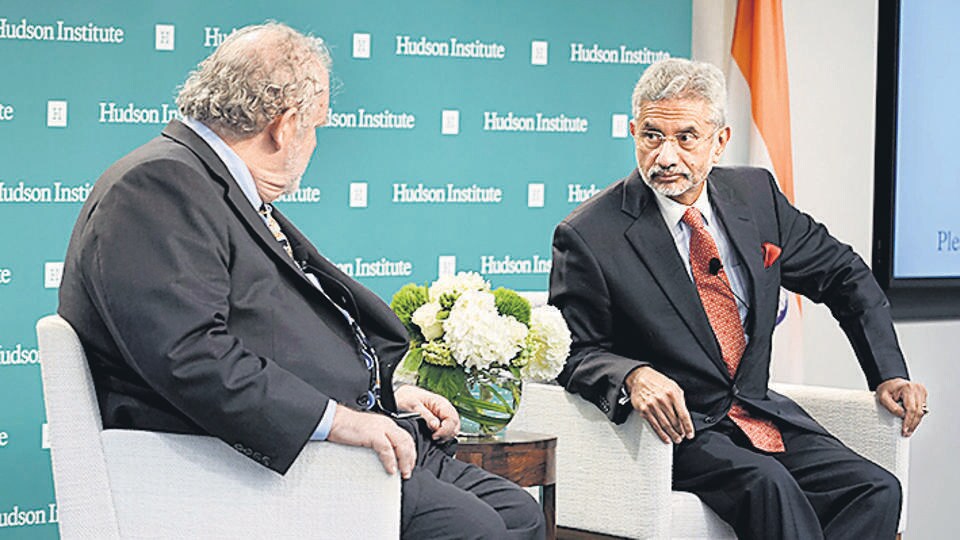
The minister was in conversation with American foreign policy scholar and commentator Walter Russel Mead at the Hudson Institute in Washington DC on Friday.
Also Read: Those responsible for Nijjar murder need to be held accountable: Blinken after meeting Jaishankar
The story of convergences
Asked about the convergences, Jaishankar said that India and US were “aligned in a geostrategic way”.
In what appeared to be allusion to shared anxieties about China, Jaishankar said, “We both want to see a certain stability, a certain set of rules, a certain distribution of power which is advantageous to both of us. And our interests are not clashing in that respect. At the biggest picture level, there is a powerful case for India and the US to work together.”
He then pointed out that within both systems, the national security side historically had “the greatest suspicion or reservations” about each other in the past but were today the “most enthusiastic about working together”, at a time when both NSAs, Jake Sullivan and Ajit Doval, have shepherded the initiative on critical and emerging technologies, a key framework to deepen ties on defence, space, semiconductors, telecom, quantum, artificial intelligence, among other domains.
Jaishankar referred to the economic convergence, particularly the focus on tech which is shaping the direction of global economy as well as everyday lives. “This is the knowledge economy, information embedded economy. And there is again new and powerful convergence between us. At a global level, US will need partners and India will need opportunities and possibilities.”
Jaishankar spoke of India’s vision of the world as one which sought reforms and improvements in the existing global architecture rather than dismantling them. This is a significant explanation given the commentary about how the US seeks to retain its dominance and the existing world order, while India seeks a multipolar world order with concerns about the existing institutional framework. The minister’s comments, without taking names of countries, squarely distinguished India’s “non-Western” approach to the world order from that of China which is seen as bringing in an “anti-Western” approach.
Asked about what India was looking for and whether it was “reformist” approach rather than the “revisionist” approach pushed by China and Russia, Jaishankar pointed out that the list of G20 countries was itself a good way to get a sense of the changes in the world, compared to which were the major economies in the world in the 1940s and 1950s. “For India, when we confront a largely Western-created architecture, we would like to encourage, facilitate, induce and pressurise changes which are badly needed. But it is done to add a non-western layer as an input. I make this very important distinction. India is non-Western. But India isn’t anti-Western.”
Offering an example, he spoke about how to meet both climate and sustainable development goals, there was need for better financial muscle, and for India, at the core of this, were international financial institutions particularly World Bank and the International Monetary Fund.
“What we are seeking to do is improve and refresh institutions, make them fit for purpose. And this applies to the UN. We believe that a UN where the most populous country isn’t in the Security Council, when the fifth largest economy isn’t there, when a continent with over 50 countries isn’t there, that UN lacks credibility and to a large degree effectiveness.” Jaishankar said that when India approached the world, it wasn’t with a “pull down the pillars” approach but it is to make it more “better, fitter purposeful and efficient”.
The minister also picked from a point made by an earlier speaker and acknowledged that while India and the US had been “dealing with each other”, it wasn’t the same as “working with each other”. “We have always dealt with each other, sometimes not entirely happily. But working with each other is uncharted territory that we have entered in the last few years. It has required both of us really to overcome, what my Prime Minister has called the hesitations of history when he spoke to the Congress a few years ago. How do we create the ability and convergences and hopefully comfort to work together is what’s crucial.”
The centrality of Indo-Pacific
Given that the theme of the discussion was India and the Pacific order, Jaishankar, in his opening remarks, spoke about the Indo-Pacific. He pointed out that for many in the US, it is probably a new idea to think of India in terms of the Pacific region, Pacific order and Pacific community of nations, but the fact that today, there was such a title, and that it seemed natural, was an indication of how things had changed.
“Viewed from India’s perspective, we today do much more business to the east of India than we do to the west of India historically. We look at our key trade partners, important economic partners, our strategic interests -- and a lot of it is extending eastwards into the Pacific and beyond. What this has given rise to in the last few years is the concept of Indo-Pacific. That too has been readily embraced by many and contested by a few, but again, it’s a concept that has gained ground.” The minister said that this separation of the Indian Ocean and Pacific region was an outcome of the World War II, and before that, the two were dealt with in an integrated way in the global understanding, with an emphasis on the Indian Ocean.
“What you are seeing today is Indo-Pacific coming together and the idea of India contributing to the Pacific order reflects the rebalancing that’s taking place in the world, in which the changed capabilities, positioning and attitude of the US is the central driving factor. And one in which the rise of China and its implications is obviously a very, very crucial factor. And there are other moving parts, an important part of which is India.”
The minister then spoke of Quad, tracing its history as a grouping that was attempted in 2007 but didn’t work, and then was revived in 2017 at the bureaucratic level, 2019 at the ministerial level, and in 2021 at the leaders’ level. “At every stage people said this is where it will fizzles out. But it is growing from strength to strength. And we will have the privilege of hosting the summit next year.”
Outlining the specific issues of convergence in the Pacific where global concerns are “most acute”, Jaishankar pointed out one issue was how go maintain stability, once again in a seeming reference to China. “Sharp changes in balances of power, interests and influences can create risks whose management therefore becomes a crucial issue.” He then flagged the creation of reliable and resilient supply chains as another issue given the experiences of the past few years. The third issue he mentioned was “trust and transparency” on “anything to do with digital”, and the importance of “trusted providers, trusted sources, trusted geographies” in all domains from AI to telecom to the cars. And he mentioned the dangers of over-concentration of production, especially manufacturing.
“If you have over-concentration that’s liable to be leveraged, had it happened in national economies, it would have attracted anti-trust provisions. But it happens in the world and we are blissfully sanguine about it. What are the implications of over-concentration, how are they leveraged and weaponised is a very big issue in the world.”
Jaishankar said all of this meant that world was badly in need for some form of “reglobalisation”. “Globalisation is undeniable. It has struck deep roots. It has tremendous benefits. No one counts that but the particular model of globalisation has a lot of risks inherent in it. And today how to address those risks and create a safer world is part of the challenge facing the Pacific order.”
Areas of divergences
On the areas of possible divergences, the minister said that both India and the US were democratic societies, both were “incredibly diverse” but diverse in different ways, and both were internally and externally argumentative (“which may be a mild word”, he joked), and there will be occasions where both will rub against each other and friction.
“It will happen because in a globalised world, our arguments aren’t contained in the national sphere. People who have viewpoints in India will reach out to people in the US with a similar viewpoint and vice versa. Political arguments are very global. Often, if you are having global conversation but not necessarily a global cultural understanding of each other, there is plenty of room for friction.” He said that he often read arguments both in the US and India where both were looking at each other’s societies through their own templates and that is an issue.
Asked about the treatment of minorities and the question of religious freedom in India, the fact that a few members had boycotted PM Narendra Modi’s address to the US Congress, and the fact that it had been raised by respected Christian leaders, Jaishankar said, while pointing out that only a few had boycotted the address, that he was more familiar with American politicians and members of the Congress, and many of them had “strong views, often electorally driven, sometimes culturally driven”.
But he said, as a broad proposition, “The underlying culture of India is deeply pluralistic. I can’t think of any society in the world and I have lived in many of them — Europe, North America, Russia and China — the diversity and layers you get in India, and you can slice it in different ways, it could be faith, ethnicity, languages, traditions, it is actually unique. On multiple axis, it is most diverse space in the world.”
He said that if there was such diversity, it will produce its own conversations, own efforts to get a balance right. And, Jaishankar claimed, if one didn’t have this, it would either reflect a lack of diversity of an effort to impose a strong thing from the top where everyone had been forced or conditioned to agree. Saying India is a much looser society, he added there was a natural inclination to disagree — “that’s our national character”.
The minister said that people who didn’t come through that experience didn’t quite get it. “It’s like listening to the next room, you don’t know people in the room, you are picking snatches of conversation, and you are make judgment or opinion on that sound bite.” Jaishankar pointed out to the creation of a robust social welfare system in a society with less than $3,000 per capita income, and the delivery of benefits in an absolutely non-discriminatory manner, as proof of the government’s fair governance.
Jaishankar once again pointed out that in the globalised world, there will be “griping”. And much of the griping is also political. We have had a culture of vote banks. There are sections which had, in their own eyes, privileged access and they resent that they don’t. And this will be the turbulence of democratic societies.”


