
 E-Paper



Covid-19: What you need to know today
Neither Moderna, nor Pfizer/BioNTech has published a peer-reviewed paper on the findings of the Phase 3 trials of their vaccines.


India’s drugs regulator met on Wednesday to consider applications by Serum Institute of India (SII) and Bharat Biotech for approval of the Covid-19 vaccines developed by them — the first on the basis of trial data of Phase 3 trials conducted outside India, and the second on Phase 1/2 trials conducted in India.
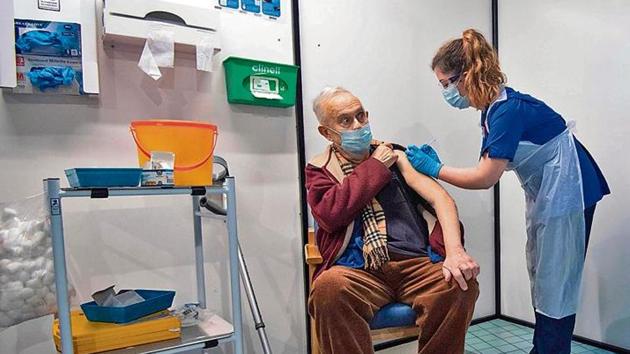
The vaccine developed by AstraZeneca/Oxford and made locally by SII will likely be India’s first line of defence against a disease that, till Tuesday night, had infected 9.7 million people and killed 141,415 in the country. On Tuesday, The Lancet published a peer reviewed paper detailing the findings of trials showing the vaccine’s efficacy and safety. Given this vaccine’s importance to India, it makes sense to take a close look at this.
Neither Moderna, nor Pfizer/BioNTech has published a peer-reviewed paper on the findings of the Phase 3 trials of their vaccines. The UK approved the Pfizer/BioNTech vaccine last week and started its vaccination drive on Tuesday. The UK will also likely approve the AstraZeneca/Oxford vaccine shortly. The US FDA indicated on Tuesday that it would likely approve the Pfizer/BioNTech vaccine soon. As for the AstraZeneca/Oxford one, confusion surrounding the results of its own Phase 3 trials will probably mean that the US FDA awaits the results of an ongoing Phase 3 trial in the US before signing off on it.
The paper published in The Lancet combines the results of four trials — a Phase1/2 one in the UK; a Phase 2/3 one also in the UK; a Phase 3 one in Brazil; and a Phase 1/2 one in South Africa — to show the vaccine’s safety. Of the around 23,700 people covered in these studies, three developed adverse effects, including one who developed transverse myelitis, a neurological disorder that involves the inflammation of the spinal cord. The trials were halted because of this, but later allowed to resume.
So far, so good.
The efficacy bit is more complex.
This is based on two of the four trials listed above — the Phase 2/3 one in the UK and the Phase 3 one in Brazil. Together, these involved around 11,600 people. It is irregular to combine two trials for the purpose of analysis of efficacy, but it can be done. It is also irregular to combine two trials with different protocols — the placebo used in one was saline and in another a meningitis vaccine. And finally, one of the studies, the UK one, involved a subset of people who were given a smaller first dose (by mistake), and then a very late booster second dose (almost three months later in most cases). This mistake was then written into the revised trial protocol; all the participants in this subset were 18-55 years old. It is in this (much smaller) subset that the vaccine was 90% effective.
There were two other subsets in the UK leg of the study — 18- to 55-year-olds who were given two standard doses; and people between the ages of 56 and 69, who were given two standard doses.
The results of these were combined with those of the Brazil study, covering health workers and those with a high risk of being exposed to the infection, and all older than 18. These people were given two standard doses, 12 weeks apart.
It is the combined reading of these two subsets of the UK study and the Brazilian study that showed that the vaccine is 62% effective in preventing infections.
Since the trials are still ongoing, these results are interim, but it is on their basis that the UK, and India, will grant the vaccine approval. SII is conducting its own Phase 3 trials of the vaccine, but that data hasn’t been released yet.
A 62% efficacy level exceeds the 50% floor set by the US FDA and would have likely been cheered in any other context other than the one in which the AstraZeneca/Oxford vaccine trial results were announced — in the wake of announcements by Pfizer/BioNTech and Moderna that showed a 95% effectiveness of their own vaccine candidates.
But what the AstraZeneca/Oxford vaccine lacks in effectiveness it makes up for in terms of cost and ease of storage and transportation (it doesn’t require the sub-zero temperatures of the other two).


