
 E-Paper



Covid-19 testing options enhanced in India: ICMR
India has tested about 700 million samples to detect Covid-19 in the past two years, across 3,128 laboratories.


Indian Council of Medical Research (ICMR) has significantly enhanced availability of testing products in the country as part of its purposive strategy for Covid-19 tests, said its director general on Wednesday.
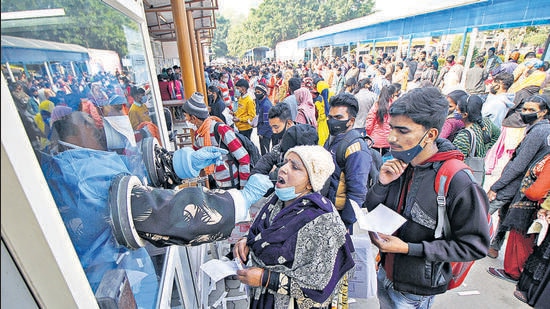
“They (testing products) are huge in number; and citizens have been empowered (as part of the strategy) to get tests done easily whether it is home based test, rapid antigen test or RT-PCR. The purpose of the revised testing strategy that was released two days back is early detection of symptomatic cases for quick care, and early detection of the infection for the elderly with co-morbidities for quick care,” said Balram Bhargava, director general, ICMR, during the weekly Covid briefing.
India has tested about 700 million samples to detect Covid-19 in the past two years, across 3,128 laboratories.
In all, 205 RT-PCR kits, 53 rapid antigen test kits, and seven home antigen test kits have been approved and are currently in use in the country. India’s daily capacity of RT-PCR tests at present is roughly two million .
The tests that are available in the country are standard molecular tests, which cost between ₹400 and ₹500 with a turnaround time of four to six hours; rapid molecular tests, priced between ₹1,200 and ₹2,500 with a turnaround time of about two hours; rapid antigen tests, which costs between ₹50 and ₹100; and home antigen tests, priced between ₹250 and ₹300. The last two tests take about 15 to 30 minutes to show results.
“Symptomatic individuals who show up negative in either rapid or home antigen tests need to get a confirmatory RT-PCR test done,” Bhargava said, adding, “Viral load starts rising from day 2, peaks on day 5 and then gradually falls by day seven or eight before it pitters away.”
ICMR has evaluated at least 15,00 test kits over the past two years, of which 740 have been approved and 580 of those are indigenously developed. As for production capacity, India has the manufacturing capacity of 7.1 million RT-PCR test kits per day; 7.9 million kits of rapid antigen test; and 1.8 million home care test kits.
ICMR, which has been spearheading India’s Covid testing initiative, also recently approved a test kit capable of detecting the heavily mutated Omicron variant. The old standard to detect the variant remains whole genome sequencing.
“Among the non-genome sequencing method of detecting Omicron is the S gene target failure, which is being used in the United Kingdom (TaqPath RT-PCR kits). However, Omicron has three lineages— BA. 1, BA.2, and BA.3, and sub-lineage BA.2 does not cause S gene drop-out (witnessed in 30% of the cases in the US) and it is a problem with the TaqPath kit. Now, an innovative solution has been developed in India which is detecting the S gene drop out as well as all three sub-lineages with very high sensitivity and specificity that has been developed by TataMD, and is validated by ICMR,” said Bhargava.
He added that other non-genome sequencing technologies are also being evaluated by ICMR to detect Omicron.
The research body also released the testing strategy, according to which asymptomatic contacts of a laboratory confirmed Covid-19 case do not require to undergo tests unless they are at risk due to age (if older than 60) or if suffer from certain underlying medical conditions such as diabetes, hypertension, liver, kidney or heart disease etc.
Experts maintained that ramping up testing is crucial in catching the infection early.
“The idea is to identify those who are infected early; isolate them; and put them on treatment, if required, especially the vulnerable ones. Increasing testing is crucial in serving this purpose,” said T Jacob John, former head, virology department, CMC Vellore.
Apart from ramping up testing, the focus should also be on covering all eligible persons for vaccination.
While overall pace of vaccination has been satisfactory, VK Paul, member (health), Niti Aayog, pointed out that there is still a percentage of persons aged 60 and above who are yet to receive their first vaccine dose.
“As estimated 137.5 million people in India are aged 60 and above, and first dose has been so far administered to 122.5 million of them. Our elders who are left still...we should make an effort to help them get their vaccine dose. This is an unfinished work but is essential as their vulnerability is a cause for concern for us,” Paul added.
On the oral anti-viral drug, molnupiravir, still not introduced in the national Covid treatment protocol, Bhargava said it has been deliberated upon extensively by the experts concerned by looking at all the data available.
“Three trials— move in trial on 1,433 patients; move out trial that was prematurely terminated due to business reasons; and move ahead trial, which is ongoing -- besides 12 clinical trials are registered on the clinical trials registry of India site. The final conclusion was that molnupiravir has certain risk that warrants caution in its use. Experts present at the meeting also opined that there is a rampant and irrational use of molnupiravir and that efforts should be made to restrict its use as known and unknown harms far outweigh its claimed benefit. The currently available synthesized evidence was reviewed and the members unanimously agreed that it doesn’t merit the inclusion in the national treatment guidelines. The emerging evidence will constantly be reviewed,” said Bhargava.


