
 E-Paper



CPCB recommends penalties for groundwater exploitation
The CPCB has recommended a minimum penalty of Rs. 50,000 for institutions, commercial complexes and townships.

 Prefer HTon Google


In a first, the Central Pollution Control Board (CPCB) has recommended penalty ranging from Rs. 10,000 to Rs. 100,000 for illegal extraction of groundwater. In addition, the pollution watchdog has suggested that no new water intensive industries should be allowed in areas where groundwater has been overexploited.
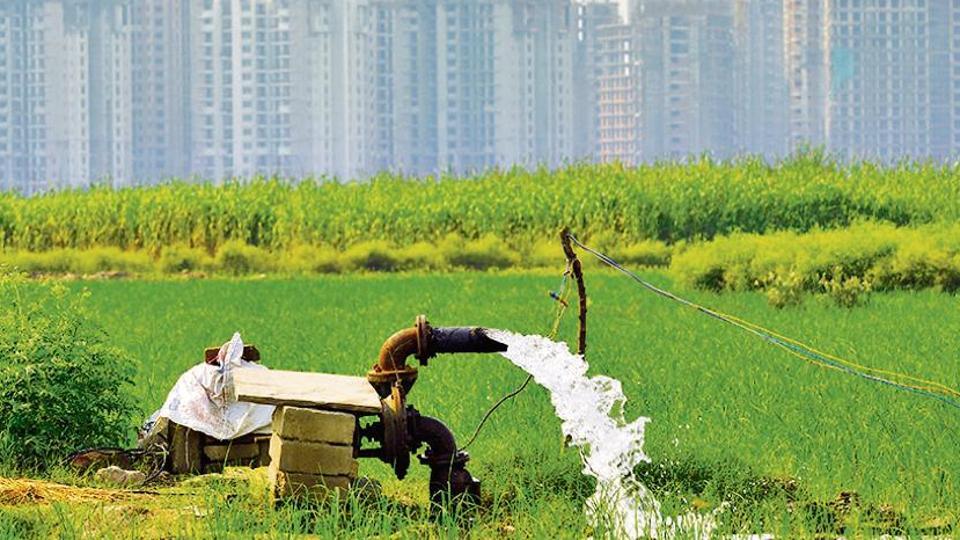
These recommendations are part of a CPCB report that was submitted to the National Green Tribunal on July 1. A petition was filed at the NGT seeking conservation of groundwater.
“The Environment Compensation Rate [as the fine is called] for illegal extraction of groundwater should increase with increase in water consumption as well as for water scarcity in an area. Further, the rate has been relaxed for drinking and domestic use as compared to other [commercial] use considering the basic need of human beings,” the CPCB report said.
The penalty provisions are for three categories — individuals, commercial use and water intensive industries.
For individuals and domestic use, the CPCB has fixed a minimum fine Rs. 10,000. Besides, one has to pay Rs. 100 per day for extracting groundwater from “overexploited, critical and semi-critical” and Rs. 50 per day for those living in areas categorised as safe for groundwater use.
One-third of the 6,584 blocks in the country fall under overexploited, critical and semi-critical categorises for groundwater, according to data shared by the Jal Shakti ministry in the Lok Sabha on Monday.
The CPCB has recommended a minimum penalty of Rs. 50,000 for institutions, commercial complexes and townships. There will differential rates based on two parameters — the highest for exploited blocks and lowest for safe zones. The amount will increase depending on extraction of groundwater.
For instance, the penalty would be in the range of Rs. 4-40 per cubic metre depending on the zone from where the water is being extracted.
The third category — packaged drinking water units, mining and infrastructure companies and industrial units — comes under the highest penalty bracket, Rs. 100,000.
“The activities such as packaged drinking water, mining and industries draw ground water to add commercial value to their products and hence, that activities attack stricter provisions of deterrence and inter-generational equity,” the CPCB report said.
The pollution watchdog said all repeat offenders should be fined 1.25 times of the last amount paid. The penalty on individuals will be imposed by district magistrate or the Central Ground Water Authority (CGWA) while the industries will be penalised by CPCB or the state pollution control authorities, the report said.
It also recommended that no new water intensive industries be allowed in overexploited blocks; the industries running without the prior consent of the Central Ground Water Authority (CGWA) — the nodal agency to allow extraction of water in overexploited blocks —be closed and no expansion of existing industries be allowed in the over-exploited blocks.
Vikrant Tongad, on whose petition the environment compensation framework was drawn, welcomed the CPCB recommendation but said that agriculture sector, which uses 85% of the groundwater, has not been covered. “There should be a separate mechanism to regulate use of groundwater by the agriculture sector. Repeat offenders should face harsher punishment as 1.25 times of the original fine will not be a deterrent,” he said.
Himanshu Thakkar of South Asia Network of Dams Rivers and People (SANDRP) welcomed the CPCB recommendations but said its implementation will not be easy as there would be resistance from individuals and industrial units. “I don’t think that district magistrates will be able to enforce the regulation considering millions of people use groundwater. There should be incentive to recharge the groundwater in the regulation,” he said.
According to the Central Ground Water Board report of 2013, the exploitation of the groundwater was the highest in Punjab (76 %), followed by Rajasthan (66%), Delhi (56%) and Haryana (54%).
India is considered one of the world’s most water stressed countries with annual per capita availability of water falling from 5,177 cubic metre in 1951 to 1,545 cubic metres in 2011, a decline of about 70%. The United Nations has defined water availability of less than 1,700 cubic metres a year as a water-stressed condition and less than 1,000 cubic metre as water scarcity.


