
 E-Paper



Decongestion at airports: Govt to introduce 3D baggage scanners soon
The new baggage scanners will be first installed in all major airports such as Delhi, Mumbai, Bengaluru and Hyderabad. Once the notification is issued, airport operators are expected to install them within a year.


NEW DELHI: India will soon mandate the use of new baggage scanners that produce three-dimensional images of the contents at the country’s airports, enabling security personnel to better analyse what is inside the baggage without requiring passengers to remove electronic devices, people familiar with the matter said.
“Our aim is to clear the passengers faster and with better security equipment,“ said a Union civil aviation ministry official, adding that the notification for the new baggage scanners will be issued within a month.
The new machines will be first installed in all major airports such as Delhi, Mumbai, Bengaluru and Hyderabad. Once the notification is issued, airport operators are expected to install them within a year.
These machines, which are widely used at many airports in the United States and Europe, do not require passengers to remove their laptops, chargers, or jackets from the cabin baggage. These will make the airport experience smoother for flyers and increase the airport’s capacity to handle more passengers and flights, the official said.
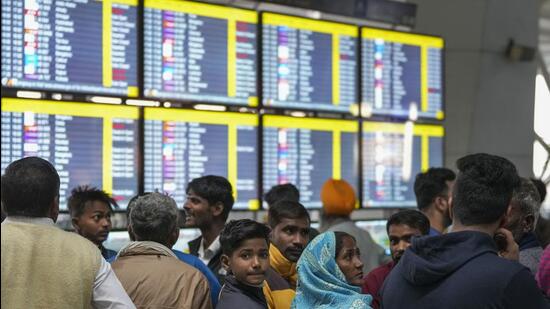
The move comes against the backdrop of passengers reporting delays at various airports. The Delhi airport has been in the spotlight for a week now and the delays led Union civil aviation minister Jyotiraditya Scindia to step in.
Scindia told TV channels on Wednesday that a primary reason for congestion in Delhi was that flights were bundled depending on the number of flights that could land and take off. This, he said, was flawed and told officials to fix the number of flights on the basis of the airport’s throughput capacity.
The security check after passengers pick up their boarding passes has been one bottleneck. Scindia said the number of x-ray machines have been increased from 13 to 17 and this figure will go up to 20 by the end of this month.
Aviation ministry officials said the machines, which produce high-resolution 3D images that enable security officers to make a more accurate assessment of a bag’s contents, will increase the number of cabin baggage that can be scanned and lead to shorter queues.
A CISF official said about 200 additional personnel will be deployed at IGI airport by December 28.
An airport official also said that in order to expand the security area, the airport operator was to demolish the reserved lounge near the security handling area along with couple of offices of CISF officers by September. “However, the work has been pending due to which the minister has asked the operator to make space and install two stand-alone roller machines (that require lesser space) and an ATRS (automated tray retrieval system that allows faster passenger clearance) by December 28.”
Delhi’s T3 was handling 21 departures in an hour, a second official said.
“A scanner can handle a maximum of 15 flights in an hour but handling 21 flights in an hour is not doable. According to our study, the automated tray retrieval system (ATRS) can handle a maximum of 270 bags in an hour but the increase in the number of flights during the morning and evening peak hours has been leading to excessive burden on the scanning personnel leading to long queues,” he said.


