
 E-Paper



Despite Trump's Exec Order, why Piyush Goyal says Russian oil and India-US deal are 'different issues' | Explained
Energy purchases will be diversified on basis of market conditions and international dynamics, MEA has said; Goyal seeks to delink Russian oil from US deal

 Prefer HTon Google


A narrative rift appears to have opened up on multiple fronts in New Delhi and Washington in the one week since President Donald Trump announced a trade deal and rollback of tariffs, which was later confirmed by Prime Minister Narendra Modi. India's commerce minister Piyush Goyal has since skirted questions centred on Russian oil: Will India stop buying it, as Trump claimed, or continue nonetheless?
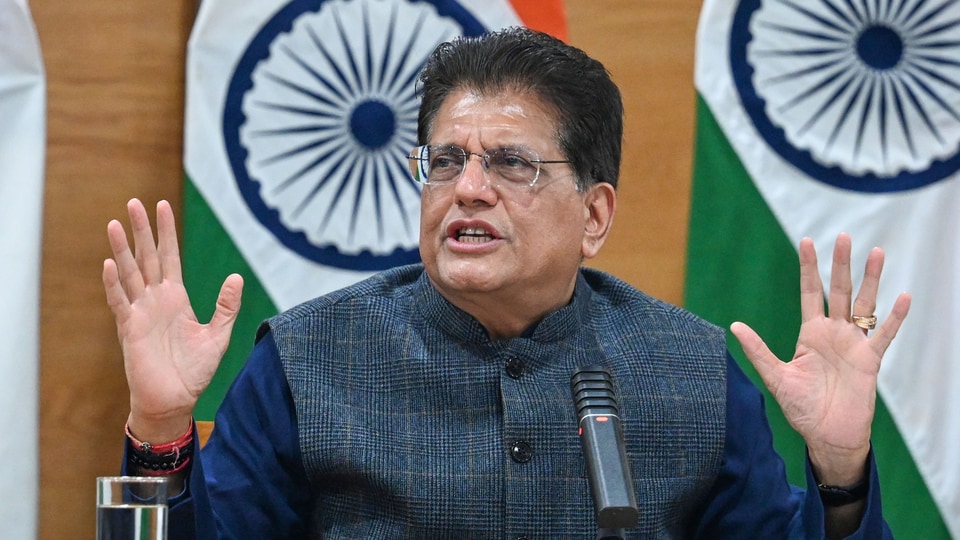
While the Trump administration asserts a total cessation of Russian oil imports was a prerequisite for the deal, New Delhi’s lead negotiator, Piyush Goyal, has so far remained diplomatic about it, only saying India can “diversify” its energy-sourcing destinations. Goyal also claims there is a misunderstanding about the Russian oil issue and the trade deal.
At the nub of the issue also are Trump's Truth Social post and a subsequent Executive Order he signed.
First, what Goyal has said
Piyush Goyal has been steadfast in his refusal to link India’s energy procurement with the US trade deal, a framework for which is in the works for an eventual signing some time later.
In multiple interviews, he has characterised the two issues — oil purchases and the trade agreement — as unrelated matters, stating that “people have mixed up two different issues”. According to Goyal, the trade deal is a technical framework designed to ensure "preferential access” for Indian businesses at an 18% reciprocal tariff. He argues that this gives Indian exporters a distinct advantage over competitors from other developing nations, naming neighbours such as Bangladesh and Asian manufacturing hubs like Vietnam.
Which ministry for which issue?
Goyal said specifics of oil procurement were never on the negotiating table for the deal as such. “The trade deal anyway won't discuss who will buy what and from where,” he told news agency ANI, insisting that such decisions are governed by market conditions and national energy security.
He also cited ministerial purviews — he handles trade, while the Ministry of External Affairs (MEA) manages foreign relations and thus the question of dealing or not with Russia. He did, say, however, that it's in “India’s own strategic interests” to buy energy from the US and diversify its supply lines.
In the ANI interview, the question was straight. If there is a lack of bilateral consensus on Russian oil or on defence matters, doesn't that impact the trade deal too? “No, not at all,” Goyal answered.
The MEA, led by S Jaishankar, has stuck to a diplomatic line it has held for months since the August imposition of 50% tariffs by Trump — half of that rate for Delhi's oil purchases from Moscow despite the war in Ukraine.
India's energy purchases will be diversified on the basis of market conditions and international dynamics to ensure the country’s energy security, says the MEA.
Statements considered, that brings us to the documents.
Tale of two documents
Goyal has said the joint statement on the deal framework does not mention Russian oil. There's another official document that does, though.
That is, Donald Trump's Executive Order titled ‘Modifying Duties to Address Threats to the United States by the Government of the Russian Federation’.
This order explicitly says the removal of a 25% tariff on India, imposed over its Russian oil dealing, will help stop funding to Vladimir Putin-led Russia's war in Ukraine.
Further, it sets a condition for India, and says this 25% tariff can be re-imposed too. The text is unambiguous: "India has committed to stop directly or indirectly importing Russian Federation oil.”
To ensure compliance, Trump has authorised a monitoring mandate, whereby the US secretary of commerce, Howard Lutnick, is tasked with tracking Indian oil imports to verify if New Delhi "resumes" trade with Russia. In such case, the US President can reimpose the penalty tariff, it says.
Even in his Truth Social post, Trump was rather clear about the linkage, and said India would now buy from America instead. He wrote that PM Modi "agreed to stop buying Russian oil, and to buy much more from the United States and, potentially, Venezuela". The US currently controls Venezuelan oil after forcing a regime change there using military action.
Trump also said that PM Modi committed to "BUY AMERICAN", at a much higher level, such as $500 billion in US energy, technology, agriculture and coal, among other things. That was last Monday.
On Friday, Trump signed the order that eliminated the 25% penalty tariff imposed on India for its Russian energy purchases. In this executive order, Trump reiterated: “India has committed to stop directly or indirectly importing Russian Federation oil, has represented that it will purchase United States energy products from the United States, and has recently committed to a framework with the United States to expand defense cooperation over the next 10 years.”
The joint statement indeed does not mention Russia, but it does talk about India's $500-billion commitment to buy from the US over five years. Goyal has said that is achievable, even though that means more than doubling US imports.
Analysts say stress test for strategic autonomy
Strategic experts and former diplomats suggest that while Piyush Goyal may attempt to decouple these issues for a domestic audience, the geopolitical reality is rather straightforward.
Brahma Chellaney, professor emeritus at the Centre for Policy Research, New Delhi, described Trump's mandate to monitor India's oil imports as “real sting”. He noted that while the US administration has removed the immediate “tariff noose”, it has left the “rope firmly in place” should India return to Russia for oil. Chellaney also estimated that replacing discounted Russian crude with market-priced US oil could add $4 billion a year to India’s import bill.
India's former foreign secretary Nirupama Menon Rao offered a more measured assessment, noting that Trump's tariff-cut order signals a world where “energy choices are now treated as geopolitical behaviour, not just commercial decisions”. She argued that India’s cherished principle of strategic autonomy is currently being “stress-tested”.
Nevertheless, she observed that the very fact Washington is negotiating shows that “India’s leverage is visible”, and that the country remains too strategically important to be sidelined.
Breach of Privilege notice against Goyal
The domestic political theatre has turned volatile over the issue. On Monday, the Rajya Sabha and Lok Sabha were rocked by protests, leading to multiple adjournments.
There was also a notice of breach of privilege submitted by Tiruchi Siva, a lawmaker from a major national opposition contituent and Tamil Nadu's ruling DMK, against Piyush Goyal.
Siva alleged that the commerce minister showed a “lack of respect” for the House by briefing the media on the US trade deal's details while Parliament was in session. Citing parliamentary convention, the DMK leader sought a formal discussion on the deal’s implications, particularly concerning its potential to harm domestic industries and farmers.
The Lok Sabha was equally chaotic, primarily due to a biter stand-off between Leader of Opposition Rahul Gandhi and parliamentary affairs minister Kiren Rijiju.
Rahul Gandhi claimed he had been given a “personal commitment” by Speaker Om Birla to raise specific points regarding the deal and other sensitive issues before the budget discussion.
Rijiju, however, disputed this, calling Rahul Gandhi’s assertion “100 per cent false”. Presiding officer Sandhya Ray eventually adjourned the House for the day.
The House has already been seeing disruption after Rahul Gandhi sought to cite an unpublished autobiography of former army chief Gen MM Naravane to question the Modi government's handling of the border dispute with China. The Parliament standoff originally began over that issue on February 2, hours after which the trade deal agreement was announced by Trump and confirmed by PM Modi.


