
 E-Paper



‘Don’t test our patience’: Gen Naravane’s blunt message to China on LAC row
The army chief said India had given a fitting response to the (Chinese) conspiracy to unilaterally change the status quo in the Ladakh theatre where the Indian Army and the Chinese People’s Liberation Army (PLA) have deployed more than 100,000 combat-ready soldiers and advanced weaponry.


In a blunt message to China in the midst of a lingering border standoff in eastern Ladakh, army chief General Manoj Mukund Naravane on Friday said India was committed to resolving the situation along the contested Line of Actual Control (LAC) through talks but no one should test India’s patience.
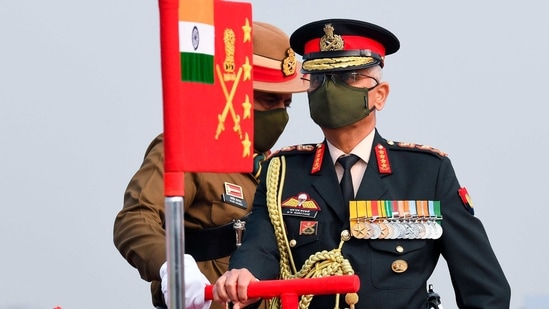
“We are committed to resolving disputes through talks and political efforts. However, no one should make the mistake of testing India’s patience,” Naravane said during his customary Army Day address at a parade in Delhi Cantt where the force put up a display of its military might including the maiden demonstration of an under-development drone swarming capability.
The border standoff in the Ladakh theatre is in its ninth month, with multiple rounds on military and diplomatic talks failing to break the deadlock.
The army chief has conveyed to China in unequivocal terms that India is prepared for any eventuality, said former Northern Army commander Lieutenant General BS Jaswal (retd). “The message is clear --- if push comes to shove, India will take the necessary actions in the Ladakh sector,” Jaswal added.
The army chief said India had given a fitting response to the (Chinese) conspiracy to unilaterally change the status quo in the Ladakh theatre where the Indian Army and the Chinese People’s Liberation Army (PLA) have deployed more than 100,000 combat-ready soldiers and advanced weaponry.
Naravane assured the country that the sacrifice of the Indian soldiers killed in the Galwan Valley on June 15, 2020 would not go in vain --- the Chinese PLA also suffered heavy casualties in the brawl but Beijing has kept the figures under wraps.
The army chief said the morale of soldiers deployed in forward areas in the Ladakh sector was higher than the mountains they were defending despite the extreme weather conditions. He said India will continue with its efforts to resolve the prevailing situation on the basis of principles of “mutual and equal security.”
In a separate message published on Army Day, Naravane said the Indian Army has been “swift and decisive” in its response to counter the PLA’s attempts to unilaterally alter the status quo on the LAC.
On January 12, Naravane said the army was prepared to hold ground in eastern Ladakh “for as long as it takes” to achieve national objectives in case the ongoing military and diplomatic talks with China to reduce tensions are “prolonged,” even as he described a joint threat from China and Pakistan as “very potent.”
On the situation along the Line of Control (LoC) with Pakistan, the army chief said in his address that 300 to 400 terrorists were present in terror training camps in Pakistan-occupied Kashmir and waiting to sneak into India.
He said ceasefire violations by the Pakistan army along the LoC increased by 44% in 2020 compared to the previous year, exposing the neighbour’s attempts to help terrorists infiltrate into the country. Ceasefire violations by the Pakistan army are usually a cover to help infiltrators sneak into Jammu and Kashmir.
He said the army’s operations along the LoC not only caused heavy losses to the enemy but also thwarted a large number of infiltration attempts. He said the army killed a total of 200 terrorists at the LoC and in counter-terror operations in the hinterland.
Speaking about capability building at a time when India faces challenges from China and Pakistan, Naravane said the army invoked emergency and fast-track procedures in 38 cases to buy weapons and systems last year to sharpen its combat edge. Apart from this, the army also concluded capital procurements worth ₹13,000 crore last year, he said.
In his January 12 media briefing, the army chief said that there was no doubt that India faced a collusive threat from China and Pakistan.
“This is not just something that was part of some strategic paper or loud thought process. It is very much manifesting itself on the ground. There is indeed increased cooperation between China and Pakistan in both military and non-military fields. And a two-front threat is very much something that we have to be prepared for,” he had then said.
Army displays Drone Swarming capability
The Indian Army on Friday demonstrated its new drone swarming capability at the Army Day-2021 parade at Delhi Cantt, with 75 locally-designed and developed drones buzzing in the skies and simulating a raft of missions including offensive operations.
“The drones executed an array of artificial intelligence (AI)-enabled simulated offensive missions and close support tasks during the parade,” the army said in a statement on the technology demonstration.
Drones within a swarm can carry out a wide range of missions including strikes against tanks, infantry combat vehicles, ammunition holding areas, fuel dumps and terror launch pads, officials said.
The army’s drone swarming capability is under development, though it has been tested for HADR (humanitarian assistance and disaster relief) roles --- dropping medicines and essential items. The technology is being developed by the army in partnership with a Bengaluru-based start-up NewSpace Research and Technologies.
“This demonstration is a recognition of the Indian Army’s steady embrace of emerging and disruptive technologies to transform itself from a manpower- intensive to a technology-enabled force to meet future security challenges,” army spokesperson Colonel Aman Anand said.
These autonomous drones can enter 50 km inside enemy territory and strike targets with high-impact warheads, officials said. “In a kamikaze mission, the drones can strike at a range of 100 km,” the officials added.
The Indian Army is investing heavily into AI, autonomous weapon systems, quantum technologies and robotics to achieve a convergence between its war-fighting philosophies and military attributes of these technologies, the statement said.
“One such project is the AI offensive drone operations, which has been incubated with an Indian start-up. This project symbolises the beginning of the Indian Army's tryst with autonomy in weapon platforms and showcases the army's commitment towards merging the cutting-edge of digital technologies with its human resource,” the statement added.


