
 E-Paper



‘Ease of justice’ should keep poor in mind: PM Modi
Modi also expressed concerns over delays in justice delivery system, calling it one of the major challenges being faced by people, and underlined: “Sensitive justice system is an essential condition for a capable nation.”


The government in the last eight years scrapped more than 1,500 obsolete and irrelevant laws, many of which continued from the time of the British rule, Prime Minister Narendra Modi said on Saturday, as he emphasised on reforms in judicial systems.
Modi also expressed concerns over delays in justice delivery system, calling it one of the major challenges being faced by people, and underlined: “Sensitive justice system is an essential condition for a capable nation.”
Since obscurity of law creates complexity, new laws should be written in a lucid manner and in regional languages to bring in “ease of justice” so that even the poor can easily understand them, said the PM, adding legal language should not become a hurdle for citizens.
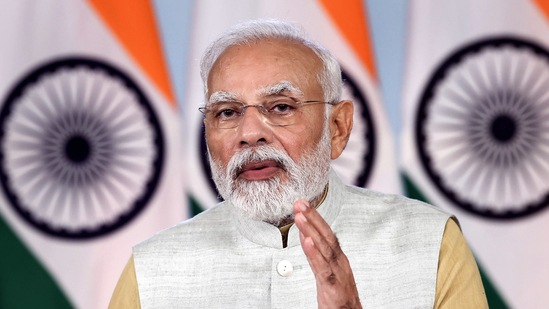
Addressing virtually the inaugural session of the two-day ‘All India Conference of Law Ministers and Law Secretaries’ at Ekta Nagar in Kevadia near the ‘Statue of Unity’ in Gujarat, Modi said: “It is important for us to break the shackles of colonialism by removing regressive colonial laws, then only India can progress in true sense. In the last eight years, we removed 32,000 compliances to improve ease of living.”
Commending the judiciary for its efforts in this regard, the PM said: “We will have to work together to tackle this” in this “Amrit Kaal”.
“Our society voluntarily got rid of obsolete laws, bad customs and traditions as we know that if they become stereotypes, they pose a hindrance to progress,” said Modi, adding that a review of existing laws in states with special focus on ease of living and ease of justice will also be helpful.
“Delay in getting justice is one of the major challenges being faced by the people of our country,” highlighted the PM, pointing out that Lok Adalats have been established in the country as a means of speedy justice.
“The people of the country should not feel the absence of government. The people of the country should not feel the pressure of the government. Over 1,500 archaic laws have been terminated. Numerous cases have been resolved in the country through Lok Adalats,” PM Modi said.
He also talked about the issue of speedy trials for undertrials and said the state governments should do their best for this. “Sensitive justice system is an essential condition for a capable nation and a harmonious society... which is why I raised the issue of undertrials in the meeting of chief justices of high courts,” he said.
Three pillars of the Constitution — judiciary, legislative and executive — need to work in tandem, the PM said.
“The Constitution is supreme for the justice delivery system of our country... So, even though the functions (of the judiciary, the legislature, and the executive) are different, if we look at the spirit of the Constitution, there is no scope for argument or competition among them,” the Prime Minister said.
During his address, the PM said that legal language should not act as a barrier for citizens.
“Obscurity of law creates complexity. If law is comprehensible to the common man, it will have a different impact,” Modi said.
In some countries, when a law is framed, it is decided in two ways. One is by giving a detailed explanation of its legal terms using technical terminology, and another is by writing it in the regional language so that the common man can understand it, he said.
“Therefore, while framing a law, our focus should be such that even the poor could understand the new law,” said Modi while adding that he has been raising the issue of the use of local languages in the legal system before the judiciary.
“The country is making many big efforts in this direction. We will need the support of logistics and infrastructure for the legal language not to become a hurdle for citizens, and for every state to work in this direction,” he said.
There is also a need to create a legal academic system in mother tongue for the youth, he said. Work needs to be done to make law courses in mother tongue, for laws to be written in simple language, and for digital libraries of important cases of high courts and the Supreme Court to be made available in local language, he said.
This will help increase the knowledge of law among common people and reduce the fear of heavy legal terminologies, Modi said.
Stressing the need for modern technology in the legal system, he said that during the pandemic, technology played an indispensable role.
“E-Courts Mission is moving fast in the country. Systems like virtual hearing and production have become a part of our legal system. E-filing of cases is also being encouraged. With the advent of 5G in the country, such systems will gain pace, and many changes are inherent,” he said.
The two-day conference has been organised by the ministry of law and justice in Gujarat.
According to the Prime Minister’s Office (PMO), the objective of the conference is to provide a common forum for policymakers to discuss issues relating to the Indian legal and judicial system. Law ministers and secretaries from states and Union territories will attend the event.
With inputs from agencies


