
 E-Paper



Encephalitis kills 74 kids in Odisha’s worst outbreak
Odisha’s worst-ever encephalitis outbreak has killed 74 children in the Maoist-hit Malkangiri district.


Odisha’s worst-ever encephalitis outbreak has killed 74 children in the Maoist-hit Malkangiri district, home to nearly 6.2 lakh people, mostly from the Scheduled Castes and tribes like Bondas, Koyas, Porajas and Didayis.

“Till Monday, 74 children have died, all from the Koya community. Forty-seven of the deaths have been due to Acute Encephalitis Syndrome (AES) and 27 from Japanese Encephalitis (JE),” Dr Madan Mohan Pradhan, joint director of the National Vector-Borne Disease Control Programme in Odisha, said. “It’s the biggest outbreak in the district. We are studying why it is happening.”
“All children in the district will be vaccinated against JE on December 1,” Odisha director of health services Dr Chittaranjan Nayak said.
“The process of procuring the vaccines from the Centre, training the staff and the logistical assessment has begun.”
A single shot protects children for up to a year against the JE strain prevalent in India.
While JE is a viral infection spread by mosquitoes, AES can be caused by a range of viruses, bacteria, fungi, parasites, chemicals and toxins. Encephalitis is marked by inflammation of the brain’s membrane that causes rapidly rising fever, headache, stiffness of the neck, disorientation, coma, seizures, spastic paralysis and even death.
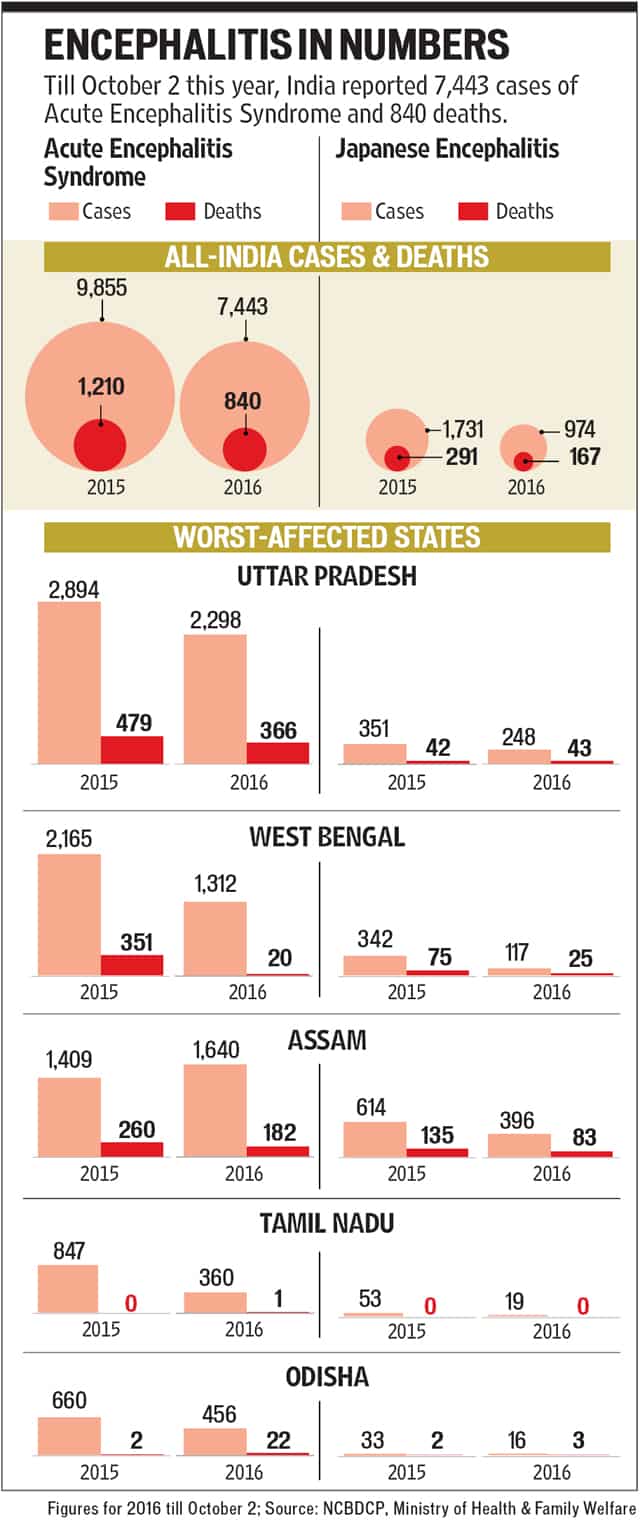
Odisha first reported encephalitis cases in 2015, when 660 AES cases and 33 JE cases were detected. There were four deaths, two from each. “Children in Malkangiri have never been vaccinated against JE because there were no cases till now,” says Dr Nayak.
Till October 2, 2016, India reported 7,443 AES cases and 840 deaths, while JE has infected another 974 people and killed 167. Of these, 456 AES and 16 JE cases were from Odisha.


