E-Paper



Fire at Assam’s Baghjan gas well finally doused after more than five months
The fire was extinguished by a team of experts from Canada, who had reached the site in Tinsukia district on November 4, using a technique called snubbing.

 Prefer HTon Google


The fire at the Baghjan natural gas well of Oil India Limited (OIL) that had raged from June 9 was finally doused on Sunday after a five-and-half-month effort.
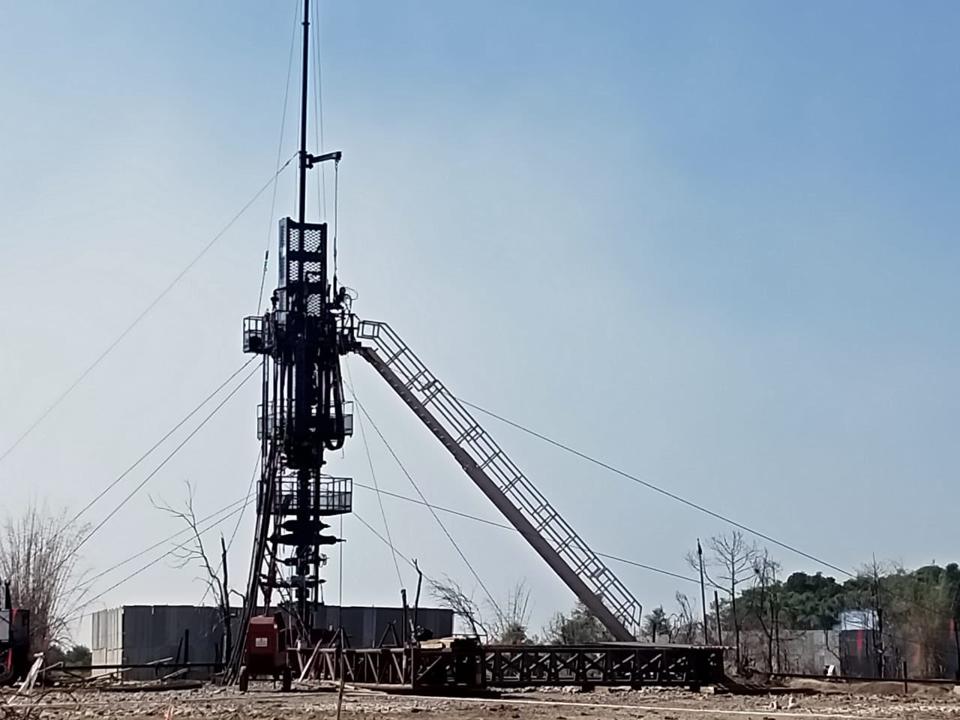
The fire was extinguished by a team of experts from Canada, who had reached the site in Tinsukia district on November 4, using a technique called snubbing.
“The well has been killed with brine solution and is under control now. The fire has been doused completely,” OIL spokesperson Tridiv Hazarika said in a statement on Sunday.
“There is no pressure in the well now and the same will be observed for 24 hours to check if there is any amount of gas migration and pressure build up. Further operation to abandon the well is in progress,” he added.
The gas well in Tinsukia district had a blowout (uncontrolled release of oil or gas) during a workover operation on May 27. It caught fire on June 9 killing two firefighters. Another engineer died at the site in September due to electrocution.
Though the fire at the wellhead was doused in August and a portion of the released gas diverted for production, the unused gas directed to a flare pit near the well was still blazing.
Finally it was decided to ‘kill’ the well by snubbing-a process to install or remove tubular from a well while it remains pressurized (alive). This technique is used when it is not possible or desired to kill a well using a mud-sludge called ‘kill fluid’, a technique which was tried unsuccessfully earlier.
Earlier this month, a National Green Tribunal (NGT) panel has stated that OIL was operating well at Baghjan without the required official permissions at the time of the incident.
In its progress report filed on November 3, the committee headed by retired Gauhati High Court judge Brojendra Prasad Katakey also recommended directions to be issued to Pollution Control Board, Assam (PCBA) to take legal action against OIL and its officials for violation of mandatory requirements.
The committee’s report also mentioned that despite Supreme Court orders, OIL did not carry out biodiversity impact assessment study for the Baghjan well, which is close to the Dibru Saikhowa National Park (DSNP).
It stated that OIL had also not taken environmental clearance from the Union environment, forest and climate change ministry before starting drilling operations at Baghjan from November, 2006.
Besides the loss of three lives, over a dozen houses located close to the well had been gutted in the fire and nearly 40 others damaged partially. Thousands of people were forced to leave their homes and stay in temporary camps for months while efforts were on to control the blaze.
As the well is located close to the Dibru Saikhowa National Park and the Maguri Motapung Wetland there were also apprehensions of damage to ecology due to the blowout and fire.
According to OIL, several studies were conducted to access the damage caused and none of them had detected any major harm. Impact on the areas close to the well will be studied after the well is completely brought under control.