
 E-Paper



Four sub-killer P-8I craft coming to India next year, then talks for six more
The Indian Navy variant of the P-8A Poseidon - P-8I where I stands for India - is essentially designed for maritime patrol. Integrated with the Harpoon Block II air launched missiles and lightweight torpedoes, the reconnaissance craft - it can carry 129 sonobuoys to locate subs - turns into a deadly submarine killer that can also launch anti-ship missiles.

 Prefer HTon Google


India’s long-range anti-submarine, reconnaissance, surveillance and electronic jamming capabilities in the Indian Ocean Region are going to get a further boost with the induction of four more P-8I multi-mission aircraft from the US next year. India has the option of buying another six from Boeing to be negotiated later in 2021, people familiar with the developments in New Delhi and Seattle said.
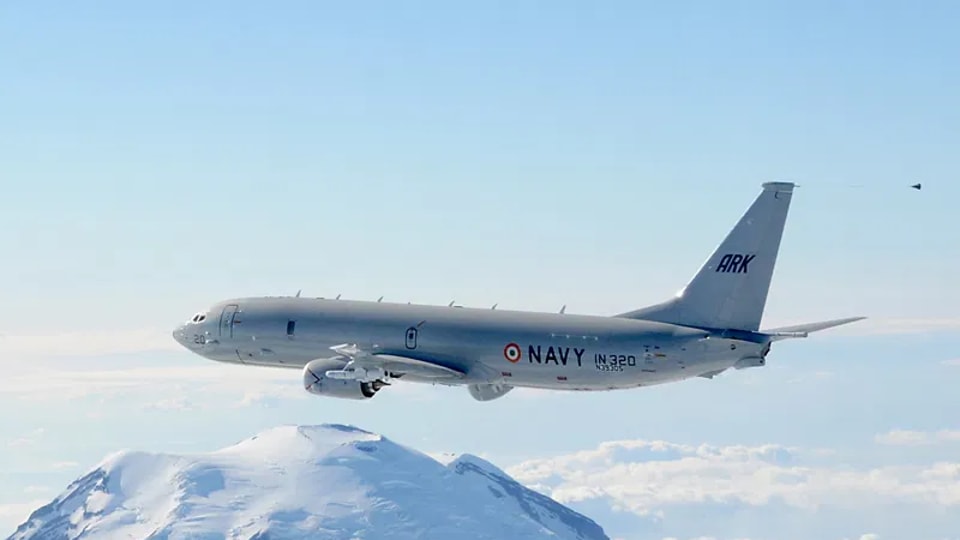
The Indian Navy variant of the P-8A Poseidon - P-8I where I stands for India - is essentially designed for maritime patrol. Integrated with the Harpoon Block II air launched missiles and lightweight torpedoes, the reconnaissance craft - it can carry 129 sonobuoys to locate subs - turns into a deadly submarine killer that can also launch anti-ship missiles.
The proposed acquisitions come against the backdrop of China’s efforts to militarise the South China Sea and expand its sea footprint.
Beijing had already acquired a string of ports in Myanmar, Sri Lanka, Pakistan, Iran and east Africa to not only contain the Indian Navy but also challenge the presence of US Central Command forces as well as French and British Navy.
Beijing has 70 percent stake in Kyaukpyu port in Myanmar, which sits in the Bay of Bengal, Hambantota port in South Sri Lanka dominates the Indian Ocean, Gwadar port in Pakistan sits on the mouth of Gulf of Oman and the port of Jask in Iran is located on the edge of Persian Gulf.
National security planners believed that the possibility of China attempting to replicate its aggressive posture along the Line of Actual Control at a time of its choosing in the Indian Ocean Region was very real, a government official said.
India also inched closer to formalising the anti-China QUAD - Quadrilateral Security Dialogue - strategic grouping. The United States, Japan and Australia are the other members.
In some measure, the QUAD is already a reality on the high seas due to India signing the Communications, Compatibility and Security Agreement (COMCASA) agreement in September 2019. The P-8I helped.
The pact provided the legal framework for exchange of encrypted communication. P-8I makes this possible with ease, particularly since the aircrafts are interoperable, can communicate securely and is designed for .
“This is a de-facto QUAD because these have interoperability with the P-8A Poseidon delivered to other countries,” said the official.
The secure communications enables one aircraft to share real-time operational intelligence, including a Common Tactical Picture with other P-8 aircraft.
The P-8I aircraft is designed for long-range anti-submarine warfare, anti-surface warfare, and intelligence, surveillance and reconnaissance missions. It operates with joint and combined
But it can be used elsewhere too. The military had relied on the reconnaissance aircraft for surveillance during the ongoing Ladakh standoff with China as well as the 2017 Doklam standoff.
It has a range of about 2,200 km and flies at a maximum speed of 490 knots, or 789 km per hour.
The negotiations for the purchase of six more P-8I aircraft are yet to begin, a government official in New Delhi said. The purchase of six P-8I was cleared by the Defence Acquisition Council in November 2019, long before the stand-off with an aggressive China along the Line of Actual Control in Ladakh.


