
 E-Paper



Fourth Delhi Police official dies as Covid-19 takes toll on front-line warriors
Since April, at least 689 Delhi Police personnel have tested positive for the coronavirus disease and the swift spread of the pathogen has forced authorities to seal at least four police stations.

 Prefer HTon Google


A 59-year-old Delhi Police sub-inspector (SI) died of coronavirus disease (Covid-19) on Tuesday morning, becoming the fourth city police personnel to succumb to the infection and spotlighting the turmoil within the force struggling with rising cases coupled with falling morale, long working hours and panic among the families of the front-line workers.
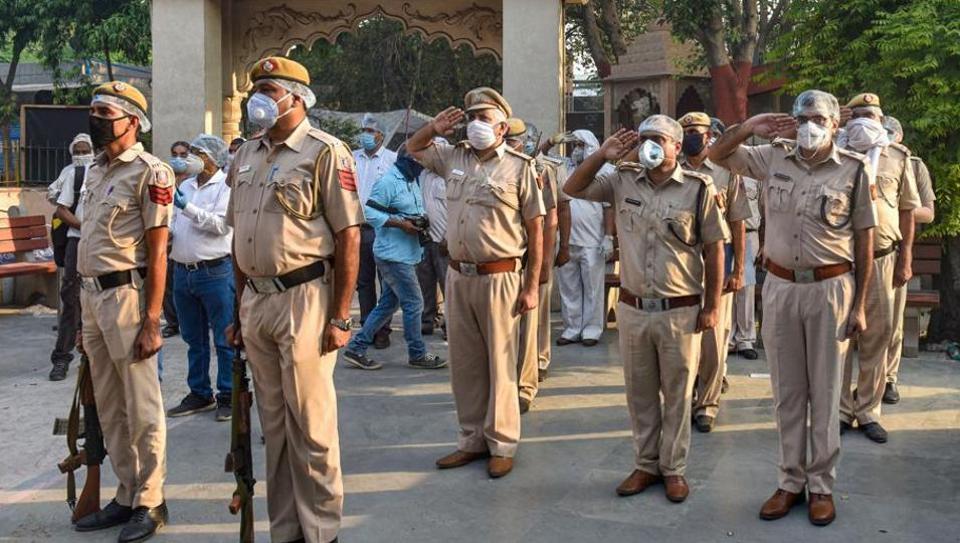
Karambir Singh was posted as the driver of assistant commissioner of police (ACP) Seelampur, Saurabh Chandra, in the city’s northeast district. He developed mild symptoms in the last week of May, after which he remained in quarantine for three to four days, said deputy commissioner of police (northeast) Ved Prakash Surya.
“Karambir’s testing report came positive on June 1. He was admitted to Army Base hospital the next day as he was symptomatic. He died during treatment. The ACP’s test was also done but his report is negative,” added Surya.
Before Singh, two assistant sub-inspectors (ASIs), Shesh Mani Pandey and Vikram died on May 30 and May 31, respectively. Head constable Amit Kumar died on May 5. The two ASIs died during treatment at the Army Base hospital and they were symptomatic. The constable was confirmed to have contracted the virus after his death.
Since April, at least 689 Delhi Police personnel have tested positive for the disease and the swift spread of the pathogen has forced authorities to seal at least four police stations. In many of these spots, mini outbreaks of the disease were reported – such as 25 personnel infected in Moti Nagar police station, 10 cases each at Jahangirpuri police station and at Chandni Mahal police station.
A number of senior officers -- including deputy commissioner of police (north) Monika Bhardwaj and additional DCP (Shahdara) Rohit Rajbir Singh -- were also infected, but have recovered and returned to work.
Bhardwaj said she visited city railway stations, where Shramik Special trains for migrant workers were operating, before developing a fever. “For the first five days, I had mild fever but when the temperature started increasing, I got the Covid-19 testing done. I remained in home quarantine and away from my family members and children after being tested positive,” she added.
At the beginning of May, the number of cases in the force was 110. The near six-fold rise in one month has spooked junior ranks in the force even as senior officers insist that a foolproof standard operating procedure (SOP) on precautions and reporting virus symptoms has helped in managing the disease. Most of the cases have been reported from the northwest, central, northeast and west districts.
“There are few areas which have reported more cases than others. We are taking all due precautions and are regularly advising our staff about the safety protocols against the pandemic. A detailed SOP was drawn way back all unit in-charges are advised to follow the same strictly,” said joint commissioner of police (northern range) Manish Kumar Aggarwal.
Still, there are signs that the force is struggling to deal with the disease. On April 23, the department announced it will give ₹1 lakh to patients for treatment. But the amount was decreased to ₹10,000 in the third week of May after the number of cases spiked.
The rising number of cases has triggered anxiety among the junior ranks and their families, said a top police official on condition of anonymity.
“Many of our police station personnel were worried as they had to visit the containment areas. Some were concerned about their families. but we assured them that our department will take all necessary steps for our well-being,” the officer said.
To deal with rising stress and anxiety in the force, Delhi Police commissioner SN Shrivastava ordered in April that 33% of staff in police stations and other units would be sent off duty for 10 days on rotation, with preference given to those above 50 or with co-morbidities. But this may not be enough.
The Delhi Police comprises 80,000 personnel, roughly 70% of which are engaged in Covid duties that kicked in soon after the government imposed a nationwide lockdown on March 25 to arrest the disease’s spread. These duties included enforcing the lockdown, stopping people from stepping out in containment zones, keeping a check on people in home quarantine and in quarantine centres and feeding migrant workers who were on the roads.
A second top police officer said the manifold duties meant that work hours soared and many personnel were working for 10-12 hours straight, often without adequate medical protection in the early weeks.
“Our duty hours increased because of the multiple works. Though we feel proud being among the front-liners in the fight against Covid-19, our personal safety and safety of our family members always remain a major concern. Our fears increased and the morale came down when police officers we know personally are found positive but we have no choice but to deal with it,” said the officer. To be sure, the police also faces several allegations of excess force being used, especially on the poor and migrants.
A third police officer who is the station house officer of a police station said the problems increased once the lockdown was relaxed as crime soared and personnel frequented crime scenes that were sometimes inside containment zones or hot spots. “To solve cases and arrest suspects, we require multiple visits to various areas. This increases the infection risk,” the SHO said.
Former Delhi Police commissioner Ajai Raj Sharma said police officers were more vulnerable to the infection as they are front-line workers. “Senior officers should regularly meet the constabularies to increase their morale,” he said.
Dr Jugal Kishore, head of the department of community medicine at Safdarjung hospital, said police personnel were more vulnerable to infection because they come in contact with a large number of people and no kind of social distancing is possible in policing. “Long working hours, little rest and improper diet increase their stress level and affects their immunity,” he added.
To be sure, such problems have plagued police forces in other cities too. In Mumbai, which has 51,000 infections until now, the local police have seen 1,871 of their colleagues contract to the virus while many others have fainted on the streets, collapsed at home or protested after 12-14 hours of gruelling duty under the scorching sun.
Despite the rising numbers, Delhi Police say they have a plan to contain the virus spread.
This includes reserving beds for police personnel in 10 hospitals and setting up isolation centres for asymptomatic personnel, who are advised to be in home quarantine, but many of whom do not have enough space at home to self-quarantine themselves.
A testing centre dedicate for police personnel is operational at Shalimar Bagh with a capacity of testing 50 samples per day. Around 1,500 personnel have already been tested here, said a third police officer privy to the information on condition of anonymity. Six police vehicles have been designated for ferrying personnel to quarantine centres or hospitals from their homes, following all protocols such as wearing PPE kits.
“As soon as any symptoms are reported by any personnel, the person is quarantined in a suitable facility - may it be hospital, quarantine centre or home quarantine. The person’s testing is done and based on the outcome contact tracing is done without a delay. The contacts are also isolated and subject to all preventive measures,” said Aggarwal.
Joint commissioner of police (southern range) Devesh Chandra Srivastava said that a circular was issued last month that detailed how to work amid the pandemic and avoid coming in physical contact of colleagues and the public. “Focus has been given on the use of technologies to avoid physical contacts. Most of the meetings are now being done through video conferencing,” added Srivastava.


