
 E-Paper



From Nowshera LoC, PM Modi red-flags PLA hybrid warfare
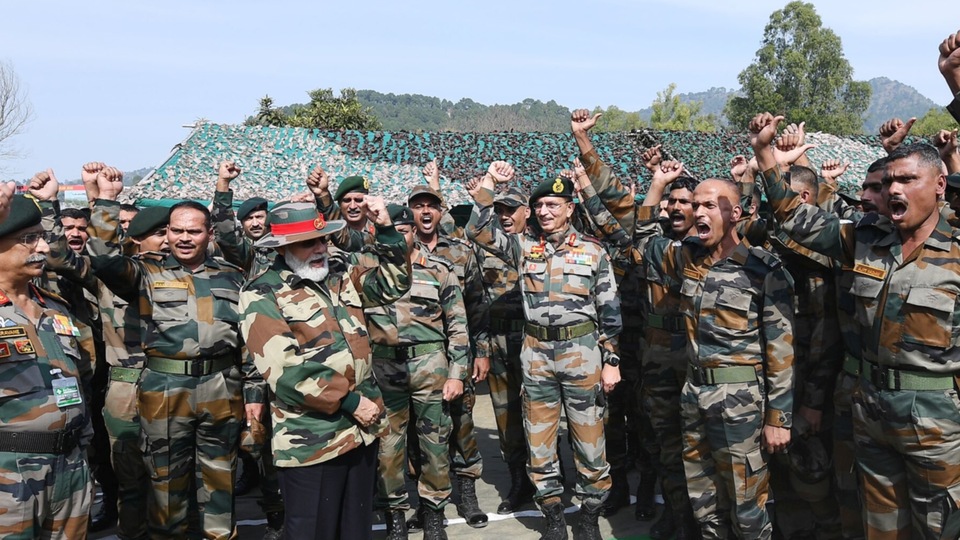
From Nowshera, PM Modi was making the troops and their division and brigade commander aware that future wars will not be slugged out artillery battles of the bygone World War II era.

 Prefer HTon Google


From 80 brigade headquarters in Nowshera, south of Pir Panjal, Prime Minister Narendra Modi sensitised the troops on the revolution in warfare with a focus on what in American parlance is called non-kinetic battles in the future. He talked about hybrid warfare, which goes beyond the spectrum of land, air, sea battles, into cyber and information warfare.
PM Modi’s speech came at a time when a Pentagon report on China confirmed Indian intelligence reports that PLA had laid optical fibre cables all along the contested 1597 km Ladakh Line of Actual Control (LAC) for faster war deployment and decision making. A 2009 Chinese report on “Lectures on Joint Campaign Information Operations”, which was translated and published by the US air force’s China Aerospace Studies recently, laid bare PLA plans and capability to conduct extensive non-kinetic warfare operations in any future conflict against the United States.
According to this 438-page Chinese report, the US military’s “strike chain” of the time it takes from the discovery of enemy target, to aim, then attack and lastly evaluation was 100 minutes in the 1993 Persian Gulf war. This was reduced to 10 minutes in the 2003 Iraq war.
By linking the forward defence localities to command headquarters in hinterland Tibet with optical fibre, the Chinese have speeded up the decision-making process on the Ladakh front and with it its capacity to respond to Indian airpower in case of an attack. One must remember that the PLA has stationed one regiment of Russian S-400 air defence system in Gar Gunsa airbase close to Ladakh LAC and another system at Nyingchi, close to Arunachal Pradesh LAC. In simple terms, faster decision making will lead to a rapid response from the PLA in a worst-case scenario.
From Nowshera, PM Modi was making the troops and their division and brigade commander aware that future wars will not be slugged out artillery battles of the bygone World War II era. Future wars will be stand-off battles with a strategy seeking information dominance over enemies as a major weapon that will be a key factor in determining victory or defeat in battle.
The Chinese report states: “The manifested forms of joint campaign information warfare operations mainly are electronic warfare, network warfare, intelligence warfare, psychological warfare, physical destruct warfare. Among these, electronic warfare and network warfare are the main forms of information operations.”
With the objective of information warfare to seize and control information power by damaging the enemy’s information systems, the PLA plans to launch electronic attacks, wage computer network warfare, conduct psychological operations and employ military deception. The attacks, the report states, will seek to influence, damage, interrupt and deprive the enemy of its human and automated military decision making. Information warfare will require protecting PLA systems from foreign electronic and networks attacks. Targets in conflict will be radar and communication nodes on land, sea, air, cyberspace and space.
“Electronic attacks mainly include electronic jamming, counter-radiation weapon attack, and special information warfare weapon attack. Network attack includes information stoppage, network infiltration and virus attack to either damage or destroy enemy’s information management through loopholes or backdoor of the existing network,” the report states.
Psychological attacks, which the PLA is quite proficient in, mainly includes psychological propaganda, deception, and threat.
Simply put, the front-line troops will be used only for preventing the enemy from making unilateral changes in borders while the main hybrid battle will be fought from remote cyber command centres. In this context, India needs a dedicated cyber warfare centre under the Indian military with experts from not only the services but also from the private sector. It needs synergised theatre commands for rapid decision making. The existing silos within the army, navy and air force must be broken down or else Indian forces will be up for a surprise from PLA like in May 2020. Indian intelligence needs off the air interceptors to pick up information from across the LoC and LAC as well as use firewalls in sensitive areas so that enemy propaganda does not enter the public narrative through social or propaganda media. This is what is done presently by the Communist Party of China or even Pakistan on the LoC albeit it will be very difficult in democratic India. But then the enemy is not obliged to fight on Indian terms and conditions.


