
 E-Paper



How Modi govt's equation with Sonam Wangchuk collapsed: From ‘wonderful conversation’ to Jantar Mantar
Back in 2023, Dharmendra Pradhan, whose resignation is Wangchuk's chief demand, had held a cordial meet with him; a lot has changed since.

 Prefer HTon Google


Social activist Sonam Wangchuk's hunger strike entered its 18th day on Wednesday, with his parameters stable but dipping. Relaying his message to those pleading with him to stop, Abhijeet Dipke of the Cockroach Janta Party (CJP), the satirical outfit that started the protest, said Wangchuk had told him: “Ask the government why they won't even have a dialogue.”
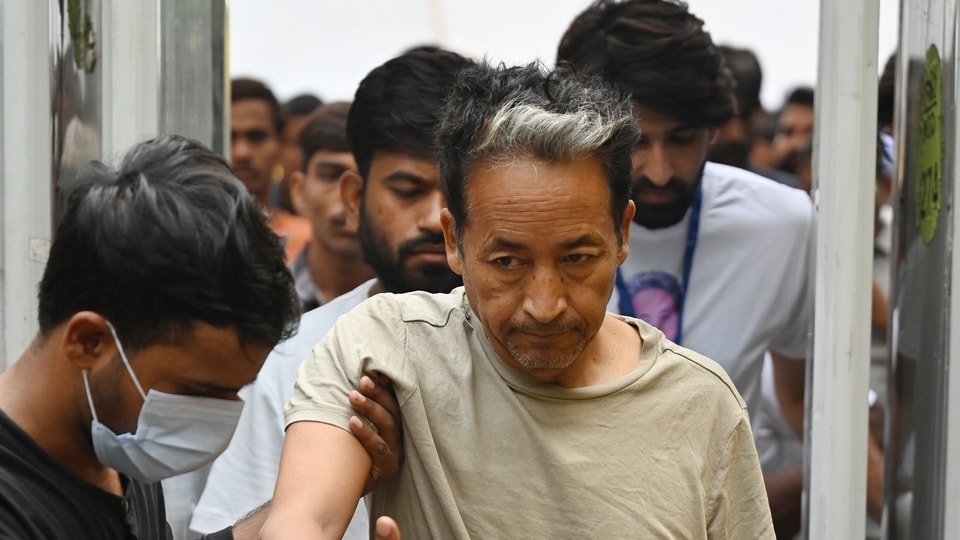
That refusal to engage — over a demand for Union education minister Dharmendra Pradhan's resignation — is the latest chapter in a relationship that had once been warm enough for the minister to call it “wonderful”.
A cordial meeting, then a warning
On March 15, 2023, Wangchuk and his wife, Gitanjali Angmo — co-founder with him of the Himalayan Institute of Alternatives, Ladakh (HIAL) — met Pradhan in Delhi. Pradhan posted on X afterwards, calling it a "wonderful conversation with Shri @Wangchuk66 and his wife Gitanjali J Angmo ji”. Wangchuk shared his post at the time and thanked him for “being so open to innovative ideas in education”.
The warmth with the Modi regime did not last, clear also from Wangchuk’s six months in jail later over an agitation for more rights to Ladakh in 2025-26.
Angmo recalled the 2023 meeting in a recent interview, noting that Pradhan had “proudly tweeted about our meeting with him”. But she alleged that when she had met him again in November 2024, he told her the HIAL’s file with the University Grants Commission (UGC) for recognition would remain frozen for as long as Wangchuk kept pushing for his Ladakh-related demands.
By August 2025, Ladakh’s administration cancelled the HIAL’s 40-year land lease. Wangchuk called the cancellation a “witch-hunt” aimed at silencing his push for statehood and constitutional safeguards for Ladakh.
By the time Wangchuk joined the CJP's protest in June, the demand for Pradhan’s resignation carried this personal history along with the fresh controversies over NEET-UG paper leak and CBSE paper-checking system irregularities.
Wangchuk, a millennial-era hero whose life as a scientific innovator inspired was rumoured the main character in Aamir Khan's ‘3 Idiots’ (2009), has insisted that his support to the Gen-Z-focused outfit CJP is based on them “keeping a distance from politics”.
He did, however, add that if top Opposition leaders, such as Rahul Gandhi of the Congress, did not show up to back him, that would be “great pettiness”.
But the government’s response has sharpened in the meantime, with Pradhan himself branding the CJP “B-team of terrorists”. BJP president Nitin Nabin has attacked “virus and cockroach-like parties… [that] want to divide the country”.
From Ladakh to Delhi, via jail
The Pradhan relationship did not sour in isolation.
When the Centre hollowed out Article 370 in August 2019 to take away Jammu and Kashmir’s special status, Wangchuk was among those who welcomed Ladakh's carve-out as a Union Territory. Wangchuk had thanked the prime minister directly, “for fulfilling Ladakh's longstanding dream”.
That sentiment shifted as Ladakhis lost land and job protections previously held under J&K, and by 2022 the region's leadership — the Leh Apex Body (LAB) and Kargil Democratic Alliance (KDA) — had consolidated four demands. These were granting of statehood, Sixth Schedule status for protection of tribal areas, Lok Sabha seats, and a dedicated Public Service Commission.
On September 24, 2025, statehood protests in Leh turned violent and four protesters were killed in police firing. The BJP's local office was burnt down.
Wangchuk condemned the violent turn. But the Centre was not convinced.
The Union home ministry led by Amit Shah blamed Wangchuk's rhetoric — police said he was instigating a Nepal- and Bangladesh-like Gen-Z protest — and he was detained under the National Security Act two days later.
This, when as recently as February 2025, barely eight months before his NSA detention, Wangchuk praised Modi from a stage in Islamabad, Pakistan. Angmo later cited that moment while rejecting allegations against him, asking why he would have praised Modi if “anti-national”.
Their institute HIAL had even won a Union renewable energy ministry award for its solar building designs. That honour, alongside Wangchuk's 2018 Magsaysay Award, have been cited repeatedly by Angmo: “If Sonam is anti-national, is the government awarding anti-nationals?”
After the Ladakh agitation-linked arrest in 2025, Wangchuk spent nearly six months in the Jodhpur jail, released only in March 2026. He struck a conciliatory note at a press conference after it, saying talks would yield results.
Some thaw on statehood demand
After Amit Shah visited Ladakh on April 30-May 1, Wangchuk claimed he had told him: “Ladakh is concerned about democratic rights and safeguards.” He said he had expected an open conversation, "but it was restricted to discussing the holy (Buddha) relics and development”, with core political demands pushed to a subcommittee meeting on May 22.
That meeting produced real movement, though. The LAB and KDA said they had reached an in-principle understanding with the Centre on constitutional safeguards via Article 371 — the provision already applied to Nagaland, Sikkim and Mizoram for some safeguards and rights. Ladakh’s chief secretary, Ashish Kundra, called it "positive forward movement” and said the negotiations had unfolded in a constructive environment, HT reported.
By Monday this week, the Centre said Ladakh would get one hill council each for all seven districts, plus an overarching “UT-level body” under a "customised Article 371 framework” that would have “no parallel elsewhere in the country”.
Wangchuk, who had earlier “expressed hope” of an Article 371 proposal, has not yet commented on Monday's announcement.
He remains at Jantar Mantar.
What next for Wangchuk
The current protest has drawn some MPs, including Priya Saroj of the Congress in the latest, to the site. Actors have voiced support too. TMC MP Mahua Moitra wrote that his goal is reached: "Govt doesn't care about your life or that of crores of youth. But your life matters to us.”
Rahul Gandhi has not visited, though he met CBSE whistleblower-students at his residence on June 2 and launched a separate campaign, ‘Chhatron Ki Goonj’, on June 17.
Congress MP and spokesman Pawan Khera has expressed concern over Wangchuk’s health. He also contrasted the BJP-led NDA government's posture with how Anna Hazare's 2011-12 fast was handled under the Congress-led UPA regime.
Wangchuk has resisted being cast as a successor to Mahatma Gandhi or Anna Hazare, saying such comparisons make him uncomfortable. He said the Cockroach Janta Party — founded and named thus after the Chief Justice of India made some sharp comments in May — is a platform with “no colour”.
The CJP's march from Jantar Mantar to Parliament is set for July 20, the first day of the Monsoon Session.


