
 E-Paper



‘Data protection to Delhi ordinance’: Crucial bills on anvil in monsoon session
At an all-party meeting on Wednesday, chaired by Union minister Rajnath Singh and attended by 34 parties, the Opposition sought a debate on Manipur violence.

 Prefer HTon Google


New Delhi The Union government hopes to pass 31 pieces of legislation — including those on the control of the bureaucracy in Delhi, data protection, mediation, forest conservation, and reservation laws in Jammu & Kashmir — even as a discussion on the violence in Manipur has emerged at the top of the Opposition agenda, setting the stage for a confrontation during Parliament’s Monsoon session.
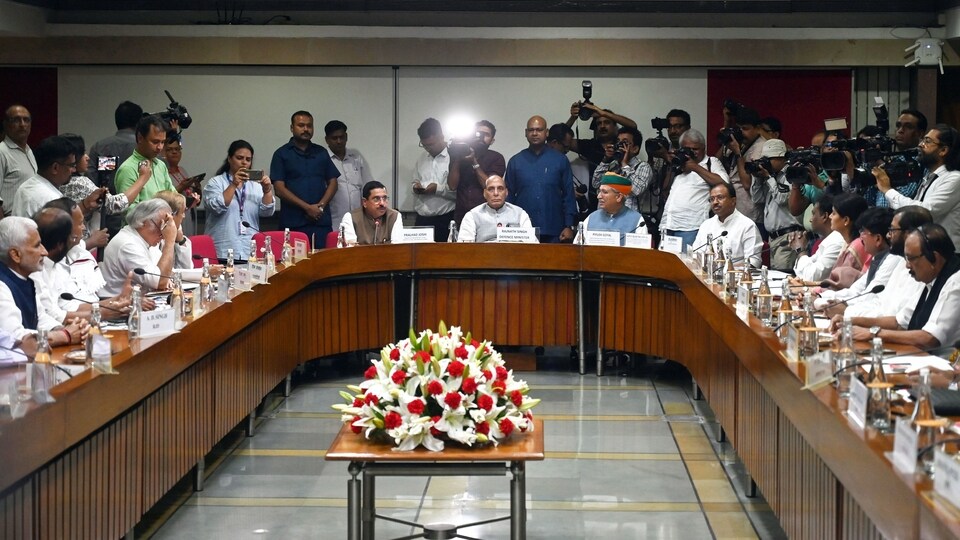
At an all-party meeting on Wednesday, chaired by Union defence minister Rajnath Singh and attended by 34 parties, the Opposition sought a debate on the ethnic violence in the northeastern state that has claimed at least 150 lives, and demanded that Prime Minister Narendra Modi speak on the issue. The government responded that it was ready for a discussion on any topic, including Manipur, but would not agree to any specific conditions.
Also Read | Parliament panel holds final meet on draft forest bill ahead of monsoon session
“Many parties want to debate Manipur. The government is ready for a debate. As and when the presiding officers give us time, we will debate. But (Union) home ministry is the nodal ministry for Manipur. We feel that they are trying to put a caveat for disrupting the House,” said Union parliamentary affairs minister Pralhad Joshi.

Joshi underlined that the monsoon session, from July 19 to August 11, was very important, and reiterated that the government listed 31 bills for the session with 17 sittings.
“Currently, the government have 31 legislative items which have been identified. What we have to bring and what not we will decide later but at least 31 legislative items are fully ready now,” Joshi said.
Also Read | ‘We are political untouchables for them’: AIMIM leader on not receiving invitation to Opposition meet
In the all-party meeting, the Congress, the Aam Aadmi Party (AAP), Left parties, the Dravida Munnetra Kazhagam and other constituents of the newly formed INDIA (Indian National Developmental Inclusive Alliance) — stuck to their demand for a debate on Manipur. A number of Opposition leaders are set to bring adjournment motion in both Houses on the Manipur situation to discuss the issue on priority and set aside scheduled agenda.
“The first order of business in both houses has to be a discussion on Manipur with the Prime Minister giving either a statement or a reply. They have to withdraw the (Delhi) ordinance. Why bring the ordinance in the first place when a five-judge Constitution bench of the Supreme Court gave an order?” asked Congress’s Rajya Sabha chief whip Jairam Ramesh after the meeting.
The Monsoon session will be the first opportunity for the new alliance to show its importance and clout. With several issues such as price rise, unemployment, federalism, Manipur and the Odisha railway accident, INDIA is keen to corner the government.
Top Opposition leaders indicated their protest might continue if the PM doesn’t speak on the Manipur violence. At the Opposition meeting in Bengaluru over the past two days, the leaders questioned why the PM remained silent on the ethnic violence roiling Manipur.
The last session of Parliament was washed out due to a deadlock between the government and the Opposition, with only 34.9% work transacted in the Lok Sabha and 24.4% in the Rajya Sabha. All parties should ensure that the crucial work of Parliament — deliberation on the laws that govern India — is not disrupted, and find ways to bridge the trust deficit between the treasury and opposition benches.
AAP leader Raghav Chadha attacked the ordinance. “This is an anti-national legislation. Every patriot will oppose this when it is introduced in Parliament and all those who oppose will be deemed as anti-nationals. This bill is going to be the semi-final for 2024,” said Chadha.
Prominent among the other bills that are slated for introduction is the Digital Personal Data Protection Bill 2023, that aims to provide for “the processing of digital personal data in a manner that recognises both the right of individuals to protect their personal data and the need to process personal data for lawful purposes”. Its introduction is being keenly watched as a previous version of the bill was shelved by the government last year.
Also controversial is the Forest (Conservation Amendment) Bill 2023, which has prompted many activists and experts to write to environment minister Bhupender Yadav, urging him to not table it. The bill, which proposes to modify the Forest (Conservation) Act, 1980, has a number of controversial clauses, which experts say could jeopardise vast tracts of ecologically important forests and leave out several so-called unclassed forests that cover around 15% of India’s total forest cover.
The government will also try to clear the Biological Diversity (Amendment) Bill, the Jan Vishwas (Amendment of Provisions) Bill and The Multi-State Cooperative Societies (Amendment) Bill. The other new bills include the Postal Services Bill, 2023 to stipulate fundamental matters on postal services, facilitate the development of the postal sector, protect the rights and interests of users, and promote the socio-economic development of the country through post offices. The National Cooperative University Bill, 2023 will be brought to establish the institution, and The Ancient Monuments and Archaeological Sites and Remains (Amendment) Bill will rationalise the prohibited area and other amendments. A bill to repeal the International Monetary Fund and Bank Act, 1945, another one to repeal the provisional collection of taxes, a bill to set up the national dental commission and the national nursing and midwifery commission will also be brought.
The Registration of Births and Deaths (Amendment) Bill, 2023 to accommodate “progressive changes in the society during the last five decades, making registration process people friendly, and to update other databases at national and state level using database of registered births and deaths,” was listed for introduction.
The government also plans to bring a number of bills to amend existing reservation laws in Jammu and Kashmir to change the nomenclature of weak and under-privileged classes to Other Backward Classes, and include the Valmiki community in the list of scheduled castes of the Union Territory. The Cinematograph (Amendment) Bill to make the process of sanctioning of films for exhibition more effective, the Mines and Mineral (Development and Regulation) Amendment Bill, 2023 for “introducing exploration licence and to delist some minerals from list of atomic minerals” are also likely to be tabled in the session.


