
 E-Paper



‘Govt has taken a host of measures to tackle low GDP’: PK Mishra
Mishra said that the economic fundamentals of the country were strong and between 2014 and 2019, India’s annual average GDP growth of 7.5 percent was the highest since Independence.

 Prefer HTon Google


On a day when India’s GDP growth fell to 4.5% for the July-September quarter, its worst in the last 6 years, principal secretary to the Prime Minister, PK Mishra, admitted that India has witnessed a slowdown in GDP growth in the last few months, but added that the government was alert and active and a number of measures have been taken to rejuvenate the financial sector and the economy.
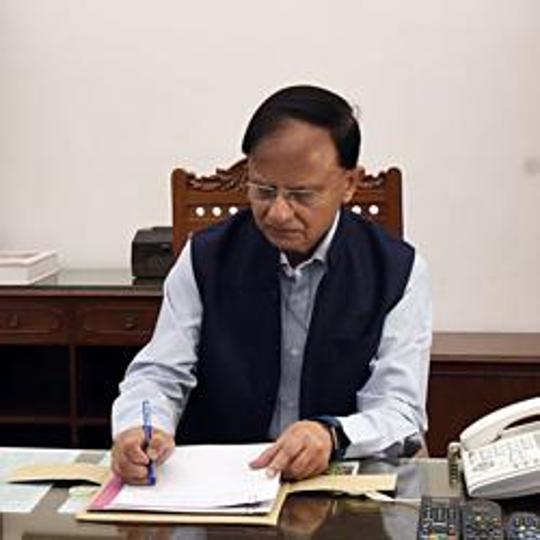
Mishra said it was important to understand the various factors feeding into the same, especially cyclical ones. “There is a slowdown in global growth of output. Intensive efforts to bring about transparency, prevent leakages and improve governance would have also caused some transitory disruptions. The strong corrective action of the past 5 years, of emphasizing on rule of law and formalization of the economy, are bound to have a short-term drag effect,” he said, while addressing the 30th convocation ceremony of Sambalpur University of Odisha, his alma mater on Friday.
He said landmark steps to increase productivity of the factors of production such as land, labour and capital are also being worked out. “On the whole, given the strong fundamentals, a landmark clean-up drive and ambitious reform agenda initiated, India is set to grow at a much faster pace in the coming months and years,” he said.
Reiterating that the economic fundamentals of the country were strong, Mishra said between 2014 and 2019, India’s annual average GDP growth of 7.5 percent was the highest since Independence. “It was also the highest among the G20 countries. Macro-economic stability during the last five years has been the bedrock on which various reforms have been rolled out. We have kept inflation low, fiscal spending disciplined, and current account deficit under control. If we compare the two periods 2009-14 and 2014-19, inflation has decreased from 10.3 percent to 4.5 percent, fiscal deficit from 5.3 percent to 3.4 percent of GDP, and current account deficit from 3.3 percent to 1.4 percent of GDP,” he said.
Mishra said the government was confident of achieving the target of becoming a USD 5-trillion economy by 2024. “Innumerable initiatives are being taken in line with our Prime Minister’s vision of a New India. While this is an ambitious aspiration, we are on track and fully committed to the same. Several fundamental, path-breaking reforms have been undertaken. Introduction of the Insolvency and Bankruptcy Code in 2016 was a landmark step towards cleaning up and strengthening the financial system of the country. No one would have imagined 4 or 5 years ago, that even large corporates would be held accountable if they tried to play with the system, that they would lose their assets if they did not pay back their loans.”
“Implementation of the Goods and Services Tax in 2017 also stands out as a critical measure for unifying India economically as one common market. This supports high economic growth, while bringing in transparency and improving the ease of doing business. Continuous opening up and liberalization of foreign direct investment has resulted in unprecedented inflows of FDI into the country,” he said.
In his address to university students, Mishra said game-changers such as the smart phone revolution, artificial intelligence, big data analytics, augmented reality, 3D printing, robotics and block chain technology, are fundamentally transforming our world and the way we engage in it.
“The changes are taking place at an unprecedented pace every day. From the way we communicate and connect with one another, to the way we move from one place to another, the way we send and receive money or the way we even get our food. There is disruption everywhere. It is a different world, if one compares it with what it was even a decade ago; forget when we were in university. These opportunities pose many challenges as well. Unless we are able to keep abreast of the changes, learn new things and compete with others, we will fall behind. This is the challenge that all of you need to keep up with. Our age-old scriptures had envisioned the value of knowledge and continuous learning. These are even more relevant in today’s fast-changing technology-driven world,” he said.


